AIXX Pedia › Rack Entry › GB200 NVL72
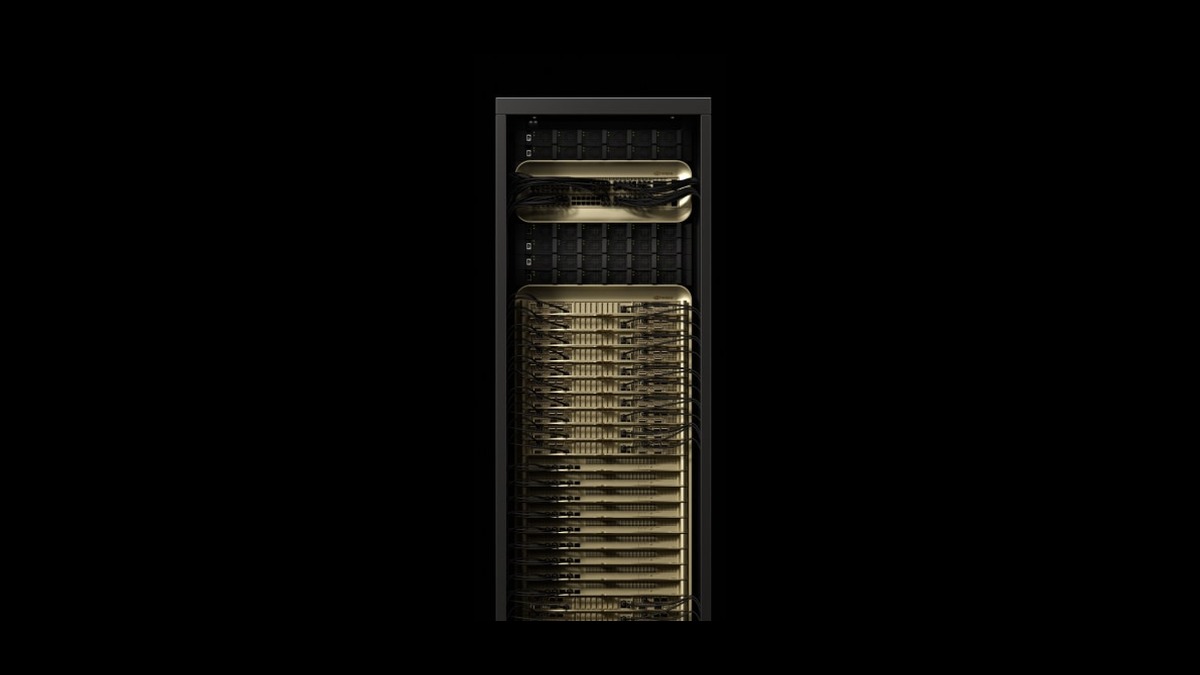
GB200 NVL72
Overview OVERVIEW
GB200 NVL72 is NVIDIA's Rack-scale Superchip System : a single rack packs 72 Blackwell GPUs + 36 Grace CPUs with full liquid cooling; the 72 GPUs form a single fully-connected NVLink domain via fifth-generation NVLink (1.8TB/s per GPU, 30.4TB/s aggregate), delivering up to 1.44 EF FP4 of inference/training compute (per the official product page and Supermicro system documentation[1][2]).
It pushed the definition of "a server" to rack scale: compute trays (4×B200 + 2×Grace per tray) and NVLink switch trays (9 per rack) are fully connected over copper interconnects within the rack with no blocking, so training and inference run as if on one giant GPU (as announced at GTC, March 2024[3]). It was the workhorse rack of global AI infrastructure buildout in 2025 — leading the NVL72 family in deployment volume, discussion, and expected secondhand value.
On the 2026 spot market, GB200 NVL72 circulates in two forms: full racks and tray-level disassembly . Full-rack project delivery dominates, though compute trays and switch trays also trade at tray level. Procurement is heavy engineering work: liquid-cooling primary/secondary loops, power, rigging, and the software stack (NVLink domain health) must each be verified. This entry carries no market band — rack prices are actual price subject to the seller's quote.
Use Cases FIT
AIXX Index (0–100): weighted from public specs — compute 40% + interconnect 30% + deployment barrier 30%. 90+ flagship tier · 75+ Excellent · 60+ usable · below 60 not applicable.
History HISTORY
March 2024 , NVIDIA unveiled the Blackwell platform and the GB200 NVL72 : Built on the Grace Blackwell superchip (2×B200 + 1×Grace), with rack-scale NVLink full interconnect — the "72 GPUs as one GPU" narrative rewrote AI infrastructure from that point on (per NVIDIA's official page and GTC announcements[1][3]).
2024–2025 , the at-scale deployment phase: first racks went live at major North American cloud providers, with global shipments ramping through 2025 — liquid-cooling adoption climbed rapidly alongside NVL72 family volume (industry view: AI data center liquid-cooling penetration estimated above 30% in 2025, per TrendForce public reports[4]). Across the supply chain, cold plates, CDUs, manifolds, and quick connectors all scaled in step (see the AIXX Pedia entry on Liquid-cooled CDUs for details).
2025 , generational handoff: the GB300 NVL72 (Blackwell Ultra, 72×B300) launched and began shipping, moving GB200 NVL72 from new product to a phase where installed-base deployments and secondhand expectations run in parallel — both rack generations circulate in the 2026 market (see the GB300 entry).
2026 , spot positioning: GB200 NVL72 enters the circulation market as full racks or tray-level units. Cross-border policy for rack-scale equipment is still evolving; verify with regulators and professional counsel at procurement time (public reporting; not legal advice).
Technical Specifications SPECIFICATIONS
| Item | Specifications (GB200 NVL72 · official figures) |
|---|---|
| GPU | 72× NVIDIA Blackwell (B200 superchip dies) |
| CPU | 36× NVIDIA Grace (72-core Armv9) |
| GPU Memory | Up to 13.4TB HBM3E (per rack total) |
| CPU Memory | Up to 17TB LPDDR5X (ECC) |
| Compute | Up to 1.44 EF FP4 (per rack, official figures) |
| Interconnect | NVLink 5.0 · 1.8TB/s per GPU · 72-GPU single domain · 130TB/s aggregate (official page) |
| Compute Trays | 4×B200 + 2×Grace per tray, 18 trays per rack (per Supermicro system documentation[2]) |
| Switch Trays | NVLink switch trays × 9 per rack (copper, fully connected, non-blocking) |
| Cooling | Rack-level liquid cooling (cold plates + CDU loop, see the Liquid-cooled CDU entry) |
| Launch | March 2024 (GTC, Blackwell platform) |
Specifications per NVIDIA's official product page (as of October 2026)[1]; total system power and power-delivery details follow the system vendor's (ODM/OEM) configuration. Anything not listed here = not verified — no guessing.
NVL72 family, two generations side by side TWO GENERATIONS
| Item | GB200 NVL72 | GB300 NVL72 |
|---|---|---|
| GPU | 72× B200(Blackwell) | 72× B300(Blackwell Ultra) |
| Board Memory | 192GB HBM3E class | 288GB HBM3E |
| Networking | ConnectX-7 generation | ConnectX-8 generation (800G) |
| Positioning | Installed-base workhorse | Current new-rack mainstay |
| One-line buying advice | Hunting value in the installed base | Flagship for new purchases |
See the GB300 NVL72 entry for the GB300 line[1]; the two rack generations share the same liquid-cooling architecture lineage (for CDU return-loop details, see the Liquid-cooled CDU entry).
Family Members FAMILY
GB-series racks are tiered by generation and form factor; GB200 NVL72 is the Blackwell-generation rack. Family members:
Cooling & Deployment COOLING
GB200 NVL72 is a fully liquid-cooled rack : cold plates cover every GPU/CPU/NVLink switch die, and the in-rack secondary loop exchanges heat with the facility's primary cooling water via a CDU (Coolant Distribution Unit) — the liquid-cooling loop is the first deployment barrier: primary-side supply temperature/flow/water quality, secondary-side quick disconnects and manifolds, and CDU N+1 redundancy must be verified item by item against the design (see the Liquid-cooled CDU entry). Retrofit cost and facility conditions are the real barriers to NVL72 adoption — air-cooled server rooms cannot take these racks directly.
Power and rigging are the other two barriers: rack power density far exceeds traditional air-cooled racks (have the OEM/ODM configuration re-check power and busbar capacity), and rack weight and transport rigging require advance planning for floor loading and routing. On the software side, NVLink domain health (NVLink switch trays + copper cable backplane) is the key acceptance item — a single bad copper cable can degrade the 72-GPU interconnect domain (Pedia editorial notes).
Use-Case Fit WORKLOAD FIT
| Workload | GB200 NVL72 performance profile | AIXX Index |
|---|---|---|
| Trillion-Parameter MoE Training | 72-GPU single domain + 13.4TB HBM3E per rack, expert parallelism without cross-rack hops | 95 |
| Large-model online inference | FP4 1.44 EF + in-domain memory sharing over NVLink, flagship batch concurrency throughput | 93 |
| Video/multimodal generation | FP4/FP8 inference pipelines saturate the NVLink domain bandwidth | 88 |
| Traditional FP64 HPC | Not Blackwell's home turf — double-precision-centric workloads should look at the Hopper generation or CPU clusters | 70 |
Workload tiers are Pedia editorial notes based on public specs (estimates; not a performance commitment).
Gallery GALLERY
Actual photos are added continuously as inspection batches are stocked; AI-generated images are never passed off as real photos.
Software & Ecosystem ECOSYSTEM
| Item | Requirements / Status |
|---|---|
| Base Software | NVIDIA AI Enterprise / Base Command family (cluster-level scheduling and monitoring) |
| Collective Communication | NCCL auto-detects the NVLink domain; full in-rack interconnect works with zero configuration |
| Cross-Rack Networking | Quantum-2/X800 (InfiniBand) or Spectrum-X (Ethernet) per fabric route, with ConnectX-7/8 NICs |
| Storage | GPUDirect Storage pass-through (see the NVMe All-Flash Storage entry) |
| Operations | Liquid-cooling loop inspections + NVLink domain health checks are the two daily routines |
| System Vendor | Full-rack NVL72 solutions from Supermicro, Dell, Lenovo, Inspur, and others (per Supermicro documentation[2]) |
Rack-scale systems upgrade "server ops" to "data-hall-level ops" — liquid cooling and the NVLink domain are two new specializations; software evolves over time, defer to NVIDIA's official releases.
Purchasing & Inspection PROCUREMENT
GB200 NVL72 procurement inspection checklist (three items):
For the full six-test verdict framework see this entry "How to Stress-Test" section.
How to Stress Test BENCH TEST
Six-test methodology, all numeric verdicts anchored to GB200 NVL72: unboxing & identification → liquid-cooling loop → NVLink domain → compute baseline → storage pass-through → extended burn-in.
Shipping & Delivery LOGISTICS
OEM & Variants VENDORS
GB200 NVL72 is delivered primarily as full racks by NVIDIA-authorized OEMs:
| System Vendor | Reference Solutions | Differentiators | Status as of 2026 |
|---|---|---|---|
| Supermicro | SuperCluster GB200 NVL72 (per official documentation[2]) | Tray configuration and delivery cadence | One of the mainstream full-rack delivery options |
| Dell | PowerEdge rack-level solution | Tier-one global service network | Full-rack delivery |
| Lenovo/Inspur and others | NVL72 full-rack solution | Regional delivery and service coverage | Project-based circulation |
| Rack/tray-split circulation | Compute tray / switch tray level | Mixed-tray assembly risk; inspect each tray individually | Spot secondary market |
System configurations follow each vendor's official documentation[2].
Glossary Cards GLOSSARY
Rack-scale superchip
Rack-scale systems named NVL (NVLink): compress the traditional cluster of multiple servers plus switches into a single rack, with 72 GPUs forming a single NVLink domain — from a programming perspective, it is one giant GPU card, and cross-GPU communication no longer goes through the network stack.
Grace Blackwell superchip
The compute unit of the GB200: 2 B200 GPUs and 1 Grace CPU (72-core Armv9) packaged via NVLink-C2C interconnect — a unified CPU-GPU memory coherence view, and the building block of the compute tray.
NVLink switch tray
9 NVLink switch trays inside the rack: weave 72 GPUs into a single fully interconnected domain — copper backplane interconnect (no optical modules in-rack), the biggest architectural difference between NVL72 and traditional 8-GPU servers.
Secondary loop / primary loop
Two-stage Liquid-cooled architecture: the secondary loop (in-rack coolant, running through cold plates) exchanges heat with the primary loop (facility cooling/chilled water) via the CDU — the CDU is the interface device between the two loops and core supporting infrastructure for NVL72 deployment.
Rack splitting and mixed trays
The secondary market form of rack-scale equipment: full racks are broken down and traded at tray level. For mixed-tray assembly (trays from different sources combined into one rack), focus on verifying NVLink domain integrity and tray condition consistency — spelling out configuration provenance in the contract is the baseline for self-protection.
Limitations & Controversies LIMITS
- Liquid cooling is a hard requirement Air-cooled facilities cannot host it directly — primary-side water conditions, CDU redundancy, and quick-disconnect workmanship; any failing link means a Full Load incident (per this Pedia's compilation; see the Liquid-cooled CDU entry for details).
- Capital and facility barriers of full-rack-only sales The procurement granularity of NVL72 is the rack — budget, floor loading, power upgrades, and crane installation all come first. Smaller-scale needs should look at HGX baseboard systems (see the B300 NVL16 entry).
- FP64 is not its home turf The Blackwell architecture focuses on FP4/FP8/BF16; traditional double-precision HPC users should weigh FP64 figures carefully when selecting (public architecture figures).
- Second-hand Market Circulation is still in its early stages There is no mature yardstick for residual value assessment of rack-scale equipment — liquid-cooling component lifespan, NVLink copper cable condition, and tray mixing history are all variables. Inspection costs for a used NVL72 should be factored into the total price (per this Pedia's inspection experience).
- Export-control-sensitive model The GB200 NVL72 is a key focus of export controls (per public reporting) — for cross-border circulation, always verify compliance status against professional advice first. This Pedia only notes policy developments and does not constitute legal advice.
Market Notes MARKET NOTE
The GB200 NVL72 circulates at two levels — full racks and split trays — and tray composition, liquid-cooling support, and facility conditions make single-rack prices highly dispersed. There is no verifiable unified market snapshot yet. AIXX Pedia honesty principle: no market band; prices are subject to the seller's quote 。
Spot search: AIXX Exchange Hall › (Zero-commission Matching; no involvement in transactions; no knowledge of or speculation on transaction prices — hence data neutrality). This section will switch to a standard market band once enough snapshots accumulate.
Price milestone timeline MILESTONES
FAQ FAQ
For new purchases, consider budget and lead time: the GB300 (B300 288GB/card + CX-8 800G) is the flagship of new racks; the GB200 is the previous-generation rack with the largest installed base, with second-hand value depending on tray condition and liquid-cooling support. Both generations share the same liquid-cooling architecture, offering high facility condition reuse.
Three things: liquid cooling (primary-side water conditions + CDU deployment; air-cooled facilities cannot host it directly), power (full-rack power density far exceeds traditional racks; review busbars and transformers against the complete system configuration), and floor loading plus crane installation paths. On the software side, accept the NVLink domain and direct-attached storage per this entry's benchmarking criteria.
Tray-level circulation exists in the secondary market (18 compute + 9 switch trays can be split), but NVLink domain integrity depends on the rack-level backplane and switch trays — a single tray outside a rack has no NVLink domain value. Mixed-tray assemblies must pass full-domain stress testing before acceptance.
The dividing line is scale and budget: dozens of GPUs, air-cooled/hybrid facilities — HGX baseboard systems are more flexible; hundreds of GPUs, prioritizing single-domain interconnect efficiency, with liquid-cooling-ready facilities — NVL72. See each entry for a detailed comparison.
Two special inspections + one asset: full liquid cooling loop chain (CDU/manifold/quick connectors/cold plate pressure testing), full NVLink domain inspection (all ports Active + cross-tray bandwidth), tray-level asset verification (serial numbers and mixed-tray history). Complete the six stress tests in this entry before signing off.
Related Entries SEE ALSO
Model comparison and selection COMPARE
References REFERENCES
- NVIDIA official site — GB200 NVL72 product page (primary spec reference, as of 2026-10) https://www.nvidia.com/en-us/data-center/gb200-nvl72/
- Supermicro — SuperCluster GB200 NVL72 Datasheet (OEM configuration document: tray composition and interconnect figures) https://www.supermicro.com/datasheet/datasheet_SuperCluster_…
- HPE — GB200 NVL72 QuickSpecs (second OEM source) https://www.hpe.com/us/en/collaterals/collateral.a50009224en…
- TrendForce — public report on AI data center liquid-cooling penetration (2025-08, industry figures) https://www.trendforce.com/
- Listings search — AIXX Exchange (Zero-commission Matching; no market snapshot for GB200 NVL72 yet, actual price subject to the seller's quote) https://www.aixx.vip/hall.html?model=GB200