AIXX Pedia › Model Entry › ConnectX-7
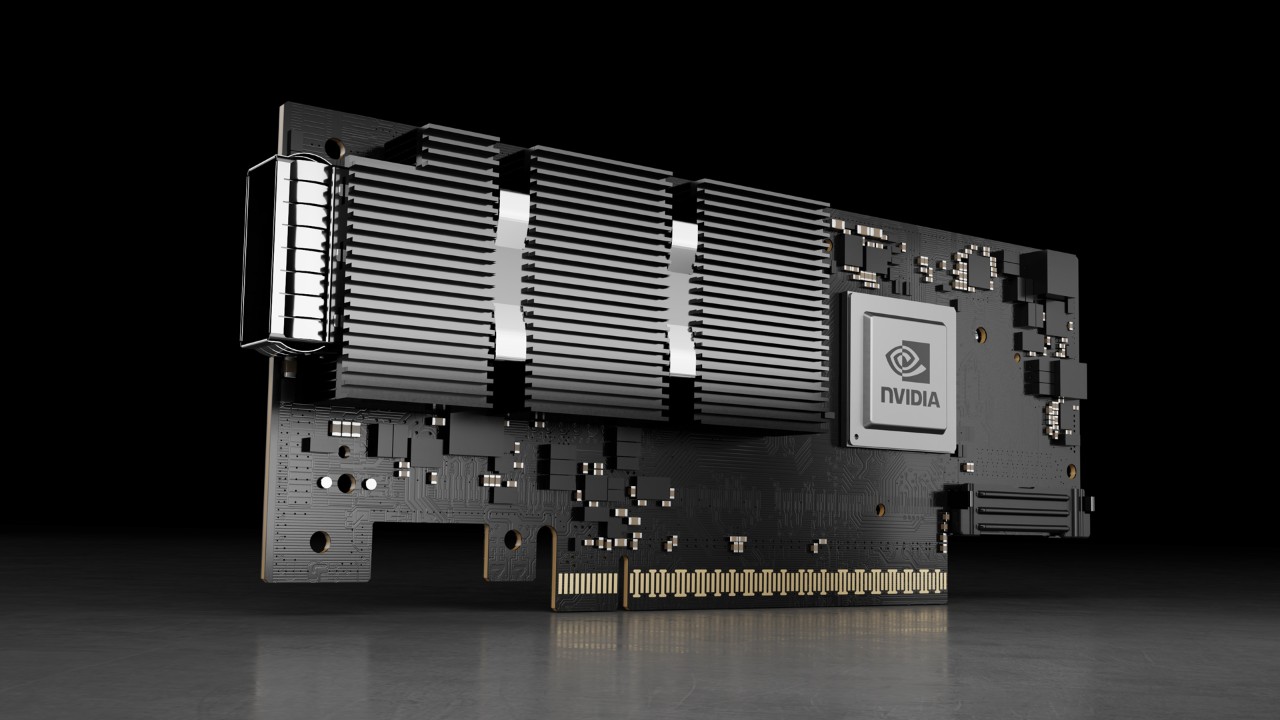
ConnectX-7
Overview OVERVIEW
ConnectX-7 (The NVIDIA ConnectX-7 smart adapter, seventh generation of the Mellanox lineage) is NVIDIA's flagship 400G network card : Single-port 400Gb/s (dual-mode NDR InfiniBand and 400GbE, per VPI spec), PCIe Gen5.0 host interface (up to 32 lanes, per the official datasheet), available in 1/2/4-port variants, with typical power draw of just around 16.7W (passive cable configuration, per the official user manual [3]).
It is the networking standard : In the factory server configurations of the H100/H200/B300 generations, ConnectX-7 handles the compute nodes' connectivity to the NDR InfiniBand fabric—paired with Quantum-2 QM9700 switches (64×400G) to form a 400G non-blocking fabric (same-launch announcement [1][2]); on the Ethernet side, it is fully rate-compatible across 10/25/40/50/100/200/400GbE (per the official spec page [4]). Its RDMA and In-Network Computing acceleration engines offload work from the CPU during collective communication, forming the underlying prerequisite for NCCL/rccl to saturate bandwidth.
In the 2026 spot market, ConnectX-7 is the most widely circulated 400G NIC : whole-system pulls, channel inventory, and project surpluses coexist as three supply streams; the core procurement variables are port form factor and firmware mode —OSFP/QSFP112 cages, InfiniBand mode vs. Ethernet mode (VPI firmware can switch between the two protocols)—all of which must be cross-checked against your cluster fabric. This entry carries no market pricing—actual price subject to the seller's quote.
Use Cases FIT
AIXX Index (0–100): this index is a weighted estimate from public specifications—bandwidth 40% + ecosystem 30% + use-case fit 30%. 90+ flagship · 75+ Excellent · 60+ usable · below 60 not applicable. The methodology is transparent and verifiable, and constitutes no performance guarantee.
History HISTORY
April 2021 , NVIDIA unveiled the seventh generation of Mellanox InfiniBand (NDR 400G) and the Quantum-2 platform at GTC: ConnectX-7 was first disclosed as the platform's adapter card, doubling single-port bandwidth to 400Gb/s over the previous generation and introducing the In-Network Computing engine (NVIDIA press release [1]).
Autumn 2021 , at GTC Fall, ConnectX-7 appeared alongside Quantum-2 QM9700 switches and the BlueField-3 DPU, completing the 400G access-switch-DPU trio. It subsequently shipped with H100-generation servers, becoming the mainstream factory NIC for AI clusters.
2022–2024 , the ecosystem matured: PCIe Gen5 server platforms (H100/H200 generation) made CX-7 a factory standard, with dual-mode InfiniBand and Ethernet coverage; OEMs including Lenovo/Dell/Supermicro all offer integrated solutions.
2026 , spot positioning: ConnectX-7 circulates heavily on the second-hand and spot channels—whole-system pull cards, channel-new units, and project surpluses run in parallel. The next generation, ConnectX-8 (800G), is already on NVIDIA's public roadmap, but 400G NDR remains the mainstream fabric for current H100/H200/B300 clusters. Cross-border trade policies for high-end networking equipment are still evolving; at procurement, defer to regulator policies and professional advice (per public reporting).
Technical Specifications SPECIFICATIONS
| Item | Specifications (NVIDIA ConnectX-7 · official figures) |
|---|---|
| Max bandwidth | 400Gb/s (NDR InfiniBand or 400GbE, dual-mode VPI) |
| Host Interface | PCIe Gen5.0 (up to 32 lanes, per the official datasheet) |
| Port Configurations | 1 / 2 / 4 network port variants (OSFP / QSFP112 cages depending on model) |
| Ethernet rates | 10 / 25 / 40 / 50 / 100 / 200 / 400GbE |
| Signal modulation | NRZ (10G/25G) and PAM4 (50G/100G and above) |
| Typical power | about 16.7W (passive copper cable configuration · per the official user manual) |
| Power | 12V + 3.3VAUX |
| Form Factor | PCIe HHHL half-height half-length / OCP 3.0 (SFF/TSFF) |
| Network acceleration | RDMA, In-Network Computing acceleration engine |
| Protocol switching | VPI—the same card switches between InfiniBand and Ethernet via firmware |
Specifications are per NVIDIA's official datasheet and user manual (as of 2026-10) [3][4]; for specific variants (single-port OSFP / dual-port QSFP112 / OCP version), slots and power draw are per the corresponding model's datasheet.
NVIDIA networking trio · role comparison FABRIC ROLES
| Role | ConnectX-7 | Quantum-2 QM9700 | BlueField-3 |
|---|---|---|---|
| Identity | 400G access NIC | 64×400G IB switch | DPU (Data Processing Unit) |
| Bandwidth | 400G per card | 51.2Tb/s aggregated (bidirectional) | 400GbE / NDR 400G |
| What It Does | The gateway from servers into the fabric | Non-blocking switching between nodes | Network/storage/security offload |
| One-line buying advice | Cluster access standard | NDR fabric core | Purpose-built for infrastructure offload |
See individual entries for the QM9700/BlueField-3; the trio was announced together in 2021 (per NVIDIA's launch release [1]).
Family Members FAMILY
The ConnectX family is tiered by bandwidth generation and form factor; the main members circulating in the 2026 spot market are:
Cooling & Deployment COOLING
ConnectX-7 is a half-height half-length (HHHL) dual-slot add-in card , passive cooling relies on server chassis airflow—typical power draw is around 16.7W (passive copper cable configuration [3]), placing minimal direct burden on the data center. The three things to verify before deployment are: PCIe topology (Gen5 slots connect directly to the CPU; going through a PCIe switch costs latency and bandwidth), Cages and cabling (OSFP and QSFP112 are not intermateable, and 400G cabling splits into DAC/AOC/optical transceiver paths with big differences in distance and budget), and Firmware mode (the VPI card's factory firmware determines IB or Ethernet mode; switching requires NVIDIA tools and must match the fabric protocol).
OCP 3.0 form factors (SFF/TSFF) are used in OEM rack-scale solutions and are not interchangeable with standard PCIe add-in cards—when buying whole-system pull cards, verify form-factor compatibility with your own chassis.
Network Fit FABRIC FIT
| Cluster scale | Fabric solution | CX-7's role | AIXX Index |
|---|---|---|---|
| 8–64 cards, single rack | 1–2 QM9700 switches | One port per card, direct-connect, 400G non-blocking; compute/storage traffic can be split across ports | 95 |
| Hundreds of cards, multi-rack | QM9700 spine-leaf fabric | Standard at the leaf access layer, with SHARP in-network aggregation reducing collective-communication overhead | 93 |
| Thousand-card scale and above | Multi-plane NDR fabric + optical interconnect | Same access cards, optical transceivers across racks—optics become the bulk of the budget | 90 |
| Ethernet RoCE clusters | Spectrum-X / lossless Ethernet | VPI firmware switches to 400GbE mode; PFC/ECN tuning is the engineering focus | 86 |
Scale tiers are this index's compilation from public fabric topology sources (estimated, no specific cabling plans included); at thousand-card scale, optical module counts are estimated as nodes × ports × planes.
Gallery GALLERY
Official ConnectX-7 images and real photos are added continuously as inspection batches arrive; AI-generated images are never passed off as real photos.
Software & Ecosystem ECOSYSTEM
| Item | Requirements / Status |
|---|---|
| Driver | NVIDIA MLNX_OFED (Linux) / WinOFED (Windows), with InfiniBand and Ethernet in the same stack |
| Firmware Tools | MFT (Mellanox Firmware Tools)—firmware flashing, VPI mode switching, port configuration |
| Stress-Test Tools | perftest suite (ib_write_bw / ib_read_latency, etc.)—standard tools for real-world bandwidth and latency measurement |
| Collective Communication | Natively recognized by NCCL / rccl; SHARP in-network aggregation requires switch-side enablement |
| Virtualization | SR-IOV multiple virtual functions, with mature multi-tenant cloud solutions |
| Operating system | Mainstream Linux distributions + Windows Server; for the MLNX_OFED support matrix, defer to NVIDIA's official documentation |
The ConnectX ecosystem has been refined over two decades (dating to the Mellanox era), with complete toolchains for both IB and Ethernet stacks; software versions evolve over time—defer to NVIDIA's official releases.
Purchasing & Inspection PROCUREMENT
Three inspection checkpoints when buying a ConnectX-7:
For the full six-test verdict framework see this entry "How to Stress-Test" section.
How to Stress Test BENCH TEST
The six-point stress-test protocol, with all numeric thresholds anchored to ConnectX-7: unboxing identification → single-card bandwidth (400G tier ≥85% = Pass) → latency (RDMA write latency without spikes) → bidirectional head-to-head → firmware and mode verification → extended Burn-in Test.
Shipping & Delivery LOGISTICS
OEM & Variants VENDORS
ConnectX-7 is dominated by NVIDIA original cards; OEM integrated solutions and variant form factors are as follows:
| Channel/Form factor | Reference Solutions | Differentiators | Status as of 2026 |
|---|---|---|---|
| NVIDIA original | Full ConnectX-7 HHHL lineup | 1/2/4-port variants, OSFP/QSFP112 cages | Spot-market mainstream |
| Lenovo | ThinkSystem integrated CX-7 NDR solutions | Factory-integrated system, unified firmware warranty | Both project surplus and pulled units circulating |
| OCP 3.0 form factor | SFF/TSFF rack-scale solutions | Not interchangeable with standard PCIe add-in cards | Circulates as full-system bundle |
| Cloud hyperscaler custom | Cloud hyperscaler custom firmware versions | May have firmware locks; unlocking costs extra | Pulled units entering the spot market; key inspection point |
OEM part numbers and configurations are per the manufacturers' official documentation [5].
Glossary Cards GLOSSARY
NDR and 400G
NDR (Next Data Rate) is the fifth-generation InfiniBand speed spec, 400Gb/s per port; the corresponding Ethernet generation is 400GbE. ConnectX-7 is a VPI card—the same hardware switches between the two protocols via firmware, but can only run one at a time.
RDMA
Remote Direct Memory Access: data moves directly between the memory of two machines, bypassing both kernels and CPU copies—the underlying dependency for low-latency, high-bandwidth LLM collective communication (NCCL AllReduce, etc.), and the standard approach for storage networks (NVMe-oF).
VPI dual-mode
The Mellanox-inherited "one card, two protocols" design: the same ConnectX-7 can run InfiniBand or Ethernet via firmware configuration. Before buying, confirm the firmware mode matches your target fabric; switching modes requires NVIDIA tools and an authorization process.
In-Network Computing
NVIDIA in-network computing engine: switches/NICs perform collective aggregation in-flight (e.g., SHARP's in-network AllReduce reduction), reducing data round trips—introduced with the NDR generation alongside the ConnectX-7/Quantum-2 platform.
OSFP and QSFP112
The two major optical cage standards of the 400G era: OSFP is larger with better cooling (mainstream on the QM9700 switch side), while QSFP112 offers better backward compatibility (common on NICs and server side)—the two are not interchangeable; cables and modules must be procured in pairs matched to the cages on each end.
SHARP
Scalable Hierarchical Aggregation and Reduction Protocol: collective reduction operations are completed in-network at the switches, so traffic doesn't have to traverse fully to endpoints—one of the efficiency engines for running LLM training on NDR fabric, requiring coordinated enablement on switches and NICs.
Limitations & Controversies LIMITS
- Firmware mode is the hidden hurdle : Switching a VPI card between IB/Ethernet modes involves NVIDIA tools and an authorization process. Getting a card "in the wrong mode" means extra firmware conversion costs and downtime—the first thing to check in spot procurement is the firmware mode (based on this Pedia's inspection experience).
- Cloud-vendor custom cards entering the market : CX-7 cards customized by major clouds (firmware-locked, special Part Numbers) circulate in the pulled-unit market; unlocking and restoring factory firmware is expensive—verifying serial numbers and Part Numbers is a necessary step.
- 400G cables and optics are the real expense : The card itself is just the tip of the fabric-cost iceberg; OSFP/QSFP112 DAC/AOC/optical modules are tiered by distance and speed, and at thousand-GPU scale the optics budget often exceeds the switches themselves (compiled by this Pedia; see "Network Integration" for the basis of this estimate).
- RDMA over Converged Ethernet (RoCE) tuning threshold : IB mode works out of the box; running lossless RoCE in Ethernet mode requires fine-grained PFC/ECN configuration—when a team lacks lossless Ethernet experience, IB is actually the lower total-cost option (consensus from public reviews).
- Cross-border trade policy variables : Export control policies for high-end networking equipment continue to evolve, and cross-border compliance status changes with policy (based on public reporting)—this Pedia only flags policy evolution; specific determinations depend on authorities' policies and professional advice, and do not constitute legal advice.
Market Notes MARKET NOTE
ConnectX-7 spot supply flows through three channels in parallel: factory-new units, full-system pulls, and project surplus. Port form factor, firmware mode, and origin (cloud-custom or not) create significant price spreads—no verifiable unified market snapshot is available yet, AIXX Pedia honesty principle: no market band; prices are subject to the seller's quote 。
Spot search: AIXX Exchange Hall › (Zero-commission Matching; no involvement in transactions; no knowledge of or speculation on transaction prices — hence data neutrality). This section will switch to a standard market band once enough snapshots accumulate.
Price milestone timeline MILESTONES
FAQ FAQ
It depends on the role: CX-7 is a pure NIC (the gateway into the fabric), while BlueField-3 is a DPU (a data processor with 16 Arm cores handling network/storage/security offload). For networking alone, CX-7 is sufficient and cheaper; only when you need to offload virtualization, security, or storage stacks from the CPU do you need BlueField-3.
Cables and modules are the big spend: DAC copper cables (short in-rack runs, cheap), AOC active optical cables (medium distances), optical modules (long distances, expensive)—procured in pairs matched to the cages on each end (OSFP/QSFP112) and distance; at thousand-GPU scale, optics budgets often exceed the switches.
Not simultaneously: VPI cards run in one mode via firmware configuration. Switching modes requires NVIDIA tools (MFT) and a process; choose the firmware mode based on your target fabric at purchase. "Wrong mode" is the most common reason for returns in spot transactions.
Three steps: read the model and Part Number via ibstat/ethtool -i and check against the seller's description → test actual bandwidth and latency with ib_write_bw/ib_read_latency (Pass at ≥85% of rated, per the case-law framework) → check for firmware locks and cloud-custom traces (mst flint query). Gold-finger oxidation and dust in the cage are common hidden flaws on pulled cards.
Not mandatory: IB (CX-7+QM9700) delivers the lowest latency out of the box; Ethernet (CX-7 Ethernet mode + Spectrum-X) offers better ecosystem interoperability but requires lossless network tuning. Both are mainstream in 2026—choose based on your team's ops experience and existing fabric.
Related Entries SEE ALSO
Model comparison and selection COMPARE
References REFERENCES
- NVIDIA Newsroom — NVIDIA Announces Mellanox InfiniBand for Exascale AI Supercomputing (2021-04, NDR 400G/Quantum-2/CX-7 announcement) https://nvidianews.nvidia.com/news/nvidia-announces-mellanox…
- NVIDIA Quantum-2 400G Switches and ConnectX-7 at GTC Fall 2021 (on-site coverage) https://www.servethehome.com/nvidia-quantum-2-400g-switches-…
- NVIDIA Official — ConnectX-7 InfiniBand Adapter Datasheet (PDF, primary spec document, as of 2026-10) https://www.nvidia.com/content/dam/en-zz/Solutions/networkin…
- NVIDIA Official Docs — ConnectX-7 Adapter Cards Specifications (user manual spec pages) https://networking-docs.nvidia.com/connectx7hw/specification…
- ThinkSystem NVIDIA ConnectX-7 NDR 400GbE OSFP Adapters (OEM integration solutions) https://lenovopress.lenovo.com/lp1692-thinksystem-nvidia-con…
- Listing Search — AIXX Exchange (Zero-commission Matching; no market snapshot for CX-7 yet, actual price subject to the seller's quote) https://www.aixx.vip/hall.html?model=ConnectX-7