AIXX Pedia › Rack Entry › HGX B300 NVL16
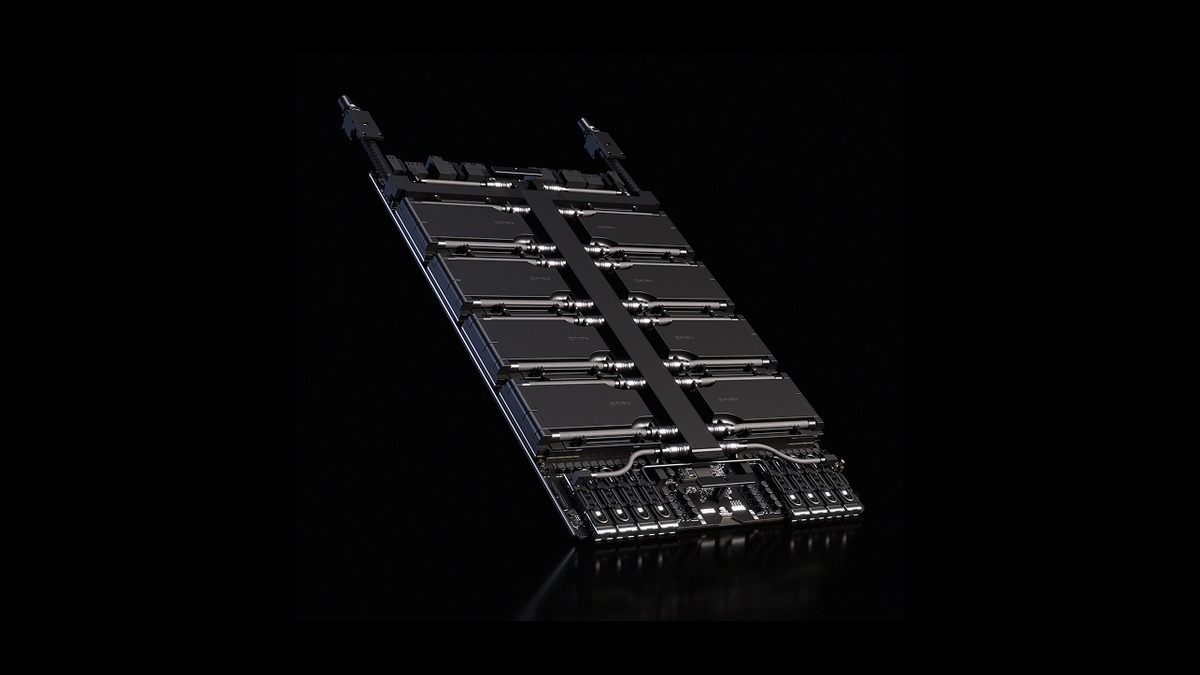
HGX B300 NVL16
Overview OVERVIEW
HGX B300 NVL16 of the Blackwell Ultra generation, in 16-GPU NVLink fully connected form : Sixteen B300 (Blackwell Ultra) GPUs form an NVLink domain within the baseboard/compute tray assembly—each card carries 288GB HBM3E, FP4 throughput is substantially higher than the previous generation, and aggregate NVLink 5 switching bandwidth sits around 14.4TB/s (16-GPU domain basis, NVIDIA HGX platform figures[1]). It occupies the middle tier of the form-factor spectrum: below the 8-GPU HGX baseboard system, above the GB300 NVL72 rack.
To be precise about positioning: NVIDIA's officially promoted HGX B300 baseboard is the 8-GPU configuration, while NVL16 refers to the 16-GPU NVLink fully connected configuration —The compute half of the GB300 NVL72 rack (2×8-GPU compute trays + NVLink switching) is exactly this form factor, and system vendors also offer project-based delivery of a 16-GPU NVLink domain (public sources[2]). For buyers it's a compromise of "rack-scale compute, baseboard-level granularity": one step up from an 8-GPU system in NVLink domain size, one step down from a full rack in datacenter retrofit requirements.
In the 2026 spot market, the B300 NVL16 form factor entered circulation in step with GB300 NVL72 volume: project leftovers, OEM solutions, and tray-level trading coexist. This entry carries no market band — actual price subject to the seller's quote.
Use Cases FIT
AIXX Index (0–100): estimated by weighted public specifications — compute 40% + interconnect 30% + deployment friendliness 30%. 90+ flagship · 75+ Excellent · 60+ usable · below 60 not applicable.
History HISTORY
2025 , as the Blackwell Ultra generation rolls out: B300 (Blackwell Ultra) ships with GB300 NVL72 racks and the HGX B300 platform—each B300 carries 288GB HBM3E with NVFP4 throughput improved over B200, and the HGX platform positioning defines a 16-GPU NVL form factor (NVIDIA HGX platform page[1]).
2025-2026 , the form-factor split took shape: 8-GPU HGX B300 baseboards serve small-to-mid deployments, GB300 NVL72 serves hyperscale clusters, and the 16-GPU NVLink domain form factor (NVL16) lands as the middle tier via both system vendor project builds and the rack's compute half (public sources[2]).
2026 , spot circulation: the B300 NVL16 form factor entered spot-market view alongside GB300-generation volume — OEM project leftovers and tray-level trading in parallel. Cross-border trade policies for high-end models continue to evolve; at procurement, defer to regulatory policy and professional advice (per public reporting, not legal advice).
Technical Specifications SPECIFICATIONS
| Item | Specifications (HGX B300 NVL16 · official basis) |
|---|---|
| GPU | 16× NVIDIA B300(Blackwell Ultra,SXM) |
| Board Memory | 288GB HBM3E |
| In-domain memory | 16×288GB = 4.6TB HBM3E (estimated: per-GPU ×16) |
| Board bandwidth | 8TB/s HBM3E |
| Per-GPU compute | Around 15 PFLOPS FP4 dense (NVIDIA HGX platform figures[1]) |
| NVLink | Fifth-generation NVLink · aggregate NVLink Switch bandwidth around 24TB/s (platform figures[1]) |
| Form Factor | Baseboard/compute tray group (16-GPU NVLink domain), predominantly liquid-cooled |
| Generation Positioning | Same-origin form as the compute half of the GB300 NVL72 rack; 8-GPU HGX B300 is the smaller tier |
Specifications per NVIDIA HGX platform figures (as of October 2026)[1]; system power draw, power delivery, and tray physical specs follow the system vendor's configuration. Not listed here = unverified—no guessing.
B300 Three-Tier Form-Factor Comparison THREE SCALES
| Item | 8-GPU HGX Baseboard | NVL16 (this entry) | GB300 NVL72 |
|---|---|---|---|
| NVLink Domain | 8 GPUs | 16 GPUs | 72 GPUs |
| In-domain memory | 2.3TB (estimated) | 4.6TB (estimated) | ~20TB (estimated) |
| Deployment Barrier | Air-cooling viable | Mostly liquid-cooled | Full-rack liquid-cooling retrofit |
| One-line buying advice | Small-cluster starting point | Hundred-GPU building block | Very large clusters, full rack |
In-domain memory = per-GPU memory × GPU count (estimated); see respective entries for B300/GB300 NVL72.
Family Members FAMILY
The B300 form-factor spectrum splits into three tiers by NVLink domain size; NVL16 is the middle tier. Family members:
Cooling & Deployment COOLING
Cooling for the NVL16 form factor centers on Mostly liquid-cooled : 16-GPU NVL16 systems come in both air-cooled and liquid-cooled versions (8U rack form, per industry sources); confirm the OEM solution's cooling type before purchase. The liquid-cooled option also involves a CDU loop (smaller scale than rack-level — see rackmount CDU), with facility-side water conditions and quick-disconnect workmanship to be checked item by item (see the Liquid-cooled CDU entry).
Compared with a full NVL72 rack, the NVL16 is one tier friendlier to deploy: no rack-level power retrofit or lift planning needed — it lands at the rack level. But the NVLink switching (16-GPU in-domain full interconnect) remains a baseboard-level component — NVLink domain health is the first inspection item at acceptance (per this library's compilation).
Use-Case Fit WORKLOAD FIT
| Workload | B300 NVL16 Performance Basis | AIXX Index |
|---|---|---|
| Hundred-billion-parameter training/fine-tuning | 16 GPUs in one domain, no cross-node communication within the NVLink domain | 88 |
| Extra-large model single-domain inference | 4.6TB in-domain memory (estimated) fits extra-large models + long contexts | 89 |
| Hundred-GPU cluster building block | 6×NVL16 + fabric makes a hundred GPUs, in-domain efficiency on par with rack solutions | 90 |
| Traditional FP64 HPC | Not Blackwell's home turf — weigh double-precision workloads separately | 70 |
Workload tiers are Pedia editorial notes based on public specs (estimates; not a performance commitment).
Gallery GALLERY
Image is the official HGX platform image; field photos of NVL16 systems will be added per inspection batch.
Software & Ecosystem ECOSYSTEM
| Item | Requirements / Status |
|---|---|
| Base Software | NVIDIA AI Enterprise family (shared with the HGX platform) |
| Collective Communication | NCCL auto-detects NVLink domain topology |
| Cross-domain networking | ConnectX-8/7 + IB (Quantum family) or Spectrum-X Ethernet |
| Storage | GPUDirect Storage pass-through (see the NVMe All-Flash Storage entry) |
| System Vendor | Dell/Supermicro/Lenovo/Inspur and other HGX B300 system solutions (per public product lines) |
The HGX platform software ecosystem is common to the 8-GPU form; versions evolve over time — defer to official NVIDIA releases.
Purchasing & Inspection PROCUREMENT
Three inspection points when buying a B300 NVL16:
For the full six-test verdict framework see this entry "How to Stress-Test" section.
How to Stress Test BENCH TEST
Six-test burn-in framework, with all benchmarks anchored to the B300 NVL16: unboxing identification → NVLink domain → cooling loop → compute baseline → storage passthrough → extended Burn-in Test.
Shipping & Delivery LOGISTICS
OEM & Variants VENDORS
Deployment paths for the NVL16 form factor, with same-generation comparisons:
| Path | Form Factor | Differentiators | Status as of 2026 |
|---|---|---|---|
| Rack compute half | 16-GPU NVLink domain inside GB300 NVL72 (2 compute trays + switching) | Ships with the rack, not sold separately | Rack basis |
| OEM 16-GPU solution | Project systems built on the HGX B300 platform | Configuration and cooling vary by OEM | Project-based circulation |
| 8-GPU HGX baseboard | Standard HGX B300 | One tier smaller domain, air-cooling viable | Spot-market mainstream |
Form-factor information compiled from NVIDIA HGX platform figures[1] and public sources[2]; specifics are subject to the system vendor's official documentation.
Glossary Cards GLOSSARY
NVL naming
In NVIDIA product names, NVL + a number = the GPU count in a fully connected NVLink domain: NVL16 means 16 GPUs in one NVLink domain. The bigger the number, the bigger the domain, and collective communication within the domain bypasses the network stack — the essential difference between NVL16 and NVL72 is simply domain size.
Blackwell Ultra(B300)
The enhanced Blackwell generation: 288GB HBM3E per GPU (up from B200), NVFP4 throughput a further step up — the core GPU of GB300 NVL72 and the HGX B300 platform. SXM package, baseboard-level integration.
NVLink Switch
The NVLink domain's switching component: baseboard/tray-level switch chips weave 16 GPUs into full interconnect — equal bandwidth between any two GPUs in the domain. NVL16's aggregate switching bandwidth is at the 24TB/s class (platform basis), the physical foundation of the "giant GPU" experience.
Compute Trays
The compute unit inside racks/systems: the GB300 NVL72 packs 18 compute trays per rack (4 GPUs + 2 CPUs per tray) — the NVL16 form corresponds to 2 compute trays + NVLink switching, and tray-level trading is the main granularity in the secondary market.
Limitations & Controversies LIMITS
- Form-factor positioning, stated clearly first : NVIDIA officially leads with the 8-GPU HGX baseboard and the GB300 NVL72 rack—"NVL16" is largely an industry term for the 16-GPU NVLink domain form factor (the rack's compute half / system vendor project builds). When procuring, verify the specific vendor's configuration and tray composition; don't treat it as a "standard SKU" (public sources[2]).
- Two Cooling Versions Confirmed : NVL16 systems come in both air-cooled and liquid-cooled versions (8U rack form factor)—the liquid-cooled variant offers higher performance ceilings but requires CDU support, while the air-cooled variant is friendlier to existing data centers. Spell out the cooling attribute in the contract.
- The Domain-Size Dilemma : The selling point is interconnect efficiency one tier above an 8-GPU domain, but scaling a 16-GPU domain to hundreds of GPUs still requires fabric—budget for both layers of cost: 'in-domain efficiency + out-of-domain networking' (compiled by this Pedia).
- Second-hand Market Circulation is still in its early stages : The Blackwell Ultra generation only rolled out in 2025, so residual-value benchmarks for used NVL16 systems aren't mature yet—verify tray provenance, liquid-cooling component lifespan, and NVLink component condition item by item (this Pedia's inspection experience).
- Export-control-sensitive model : The Blackwell Ultra generation falls under close export-control scrutiny (per public reporting)—consult professional counsel on cross-border transfer compliance first; this Pedia does not constitute legal advice.
Market Notes MARKET NOTE
B300 NVL16 systems trade at two levels—OEM project designs and rack teardown trays—and wide configuration and cooling variations create large price dispersion—no verifiable unified market snapshot yet, AIXX Pedia honesty principle: no market band; prices are subject to the seller's quote 。
Spot search: AIXX Exchange Hall › (Zero-commission Matching; no involvement in transactions; no knowledge of or speculation on transaction prices — hence data neutrality). This section will switch to a standard market band once enough snapshots accumulate.
Price milestone timeline MILESTONES
FAQ FAQ
Not a single standard product in the strict sense: NVIDIA officially centers on the 8-GPU HGX baseboard and GB300 NVL72 rack; NVL16 is a general term for the '16-GPU fully NVLink-interconnected configuration'—implemented as a rack compute half or OEM project design. When purchasing, verify the specific design and tray contents.
It comes down to the NVLink domain: NVL16 is a single 16-GPU domain (fully interconnected within, no cross-machine communication), while two 8-GPU systems are two independent domains connected via the network. Collective communication efficiency differs by a tier in both training and inference—that's the source of the NVL form factor's premium.
NVL16 systems come in air-cooled and liquid-cooled versions (per industry sources): the liquid-cooled version offers a higher thermal ceiling but needs CDU loop support; the air-cooled version (8U rack) is friendlier to existing facilities. Decide based on your data center and OEM design.
It's a line of scale and barriers: NVL16 is a building block toward hundred-GPU clusters, deployable at rack level; NVL72 is a full-rack solution requiring data center liquid-cooling retrofits up front. Both architecture generation (Blackwell Ultra vs first-gen Blackwell) and domain size (16 vs 72) differ—decide by cluster scale and facility conditions.
Three things: full NVLink domain acceptance testing (all ports Active + in-domain bandwidth), cooling solution attributes and loop condition, and tray/baseboard asset verification. The Blackwell Ultra generation is still early in circulation—tray provenance and mixed-configuration history should be written into the contract.
Related Entries SEE ALSO
Model comparison and selection COMPARE
References REFERENCES
- NVIDIA official site — HGX platform page (B300 platform compute and NVLink bandwidth figures, Oct 2026) https://www.nvidia.com/en-us/data-center/hgx/
- ESaiTech — HGX B300 NVL16 Architecture Guide (public industry material, form-factor positioning reference) https://esaitech.com/blogs/insights/hgx-b300-nvl16-architect…
- NVIDIA official site — GB300 NVL72 product page (rack compute half figures) https://www.nvidia.com/en-us/data-center/gb300-nvl72/
- Marketplace Search — AIXX Exchange (Zero-commission Matching; no market snapshot for B300 NVL16 yet, actual price subject to the seller's quote) https://www.aixx.vip/hall.html?model=B300
Video Overview VIDEO
Community real hardware · Source: YouTube COMMUNITY HANDS-ON


Playback may not be available in some regions