AIXX Pedia › Networking Device Entry › Spectrum-4 SN5600
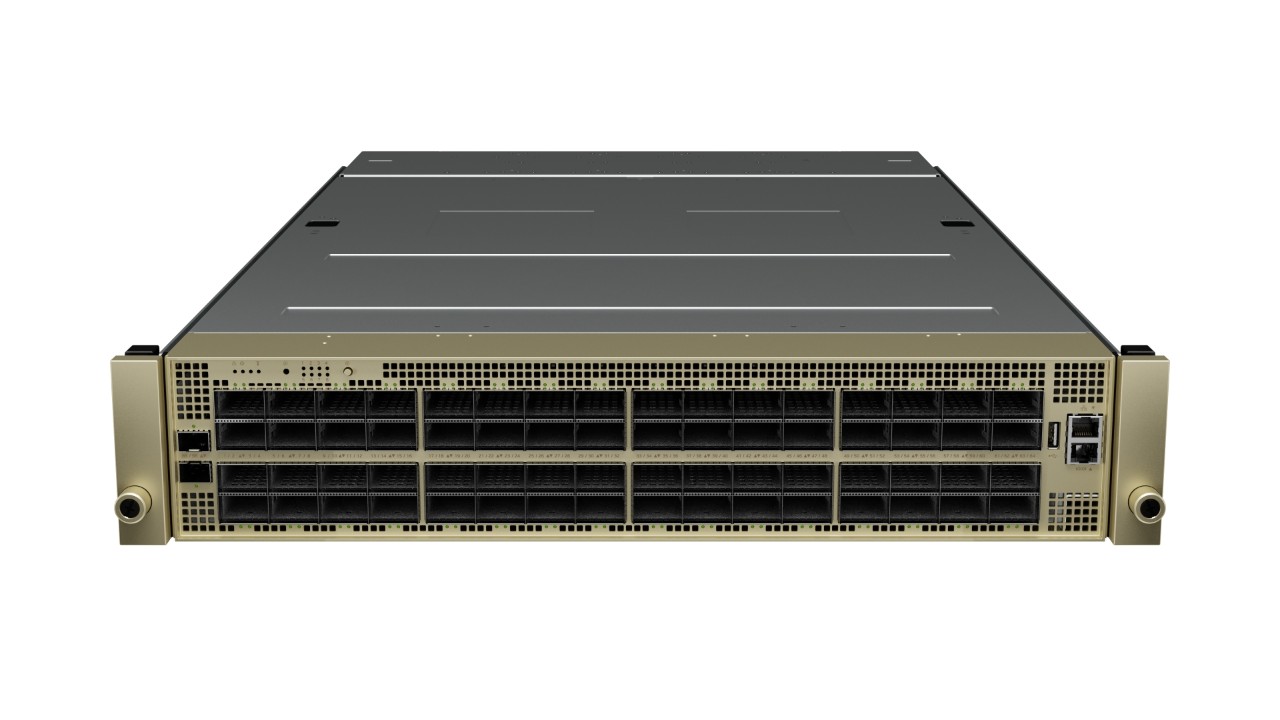
Spectrum-4 SN5600
OverviewOVERVIEW
Spectrum-4 SN5600(The NVIDIA SN5600 switch, flagship of the Spectrum-4 SN5000 series) is NVIDIA's 800G Ethernet switch: 64 800GbE OSFP ports plus one 25GbE management port, with a switching capacity of 51.2Tb/s non-blocking; at its core is the Spectrum-4 ASIC, in a 2U rack form factor, with per-port speeds covering the full range of 10/25/50/100/200/400/800G (per the official spec sheet[2])。
It is in the Spectrum-X AI Ethernet family, serving as the super-spine/leaf core: when NVIDIA announced the Spectrum-X product roadmap for "accelerating Ethernet for generative AI" in June 2024, the SN5600 was the 800G-tier flagship (NVIDIA announcement[1]) — running AI clusters over Ethernet relies on Spectrum-X's adaptive scheduling and lossless features to lower the RoCE tuning barrier.
On the 2026 spot market, the SN5600 is the flagship circulating model of 800G Ethernet: mirroring the IB route (QM9700), it is the preferred choice of the cloud and multi-tenant camp. The key procurement variables are the same as for all high-end switches:accessory completeness and data-center load history. This entry carries no market pricing — actual price subject to the seller's quote.
Use CasesFIT
AIXX Index(0–100): this database estimates via weighted public specs — capacity 40% + networking role 30% + ecosystem 30%. 90+ flagship-tier · 75+ Excellent · 60+ usable · below 60 not applicable.
HistoryHISTORY
On June 2, 2024, NVIDIA announced "NVIDIA Supercharges Ethernet Networking for Generative AI": the Spectrum-X Ethernet AI platform roadmap was unveiled, and the Spectrum-4 ASIC and SN5000 series switches (including the SN5600 800G flagship) entered the product lineup (NVIDIA announcement[1])。
2024–2025, the Spectrum-X ecosystem rolled out: combined with BlueField-3 DPU SuperNICs, the Ethernet route scaled up in cloud and multi-tenant AI clusters (platform documentation[1]); the SN5600's 64×800G ports began appearing at the spine/super-spine layer of hyperscale data centers (per public reporting).
2026, spot-market positioning: the SN5600 entered spot circulation as the 800G Ethernet flagship, forming an "Ethernet vs InfiniBand" mirror choice with the IB route's QM9700. The next-generation Spectrum roadmap evolves with NVIDIA's public disclosures (platform page documentation). Cross-border circulation policies for high-end network equipment are still evolving; for procurement, defer to regulator policies and professional advice (per public reporting).
SpecificationsSPECIFICATIONS
| Item | Specifications (Spectrum-4 SN5600 · official documentation) |
|---|---|
| Port configuration | 64× 800GbE OSFP + 1× 25GbE SFP28 management port |
| Switching capacity | 51.2Tb/s (non-blocking) |
| Switch chip | NVIDIA Spectrum-4 ASIC |
| Per-port speeds | 10/25/50/100/200/400/800G (ports 1-64); 1G/10G/25G (management port 65) |
| Typical role | smart-leaf / spine / super-spine (Spectrum-X deployment documentation) |
| Form Factor | 2U rack-mount |
| Same series | SN5000 series (Spectrum-4 family) |
Specifications per the NVIDIA official spec sheet (as of 2026-10)[2]; detailed figures for total power draw, power supplies and ports per the corresponding model's documentation. Anything not listed in this table = unverified; we don't make things up.
Two fabric routes · same-capacity comparisonTWO PATHS
| Item | SN5600 (Ethernet) | QM9700(InfiniBand) |
|---|---|---|
| Ports | 64×800GbE OSFP | 64×400G NDR(32 OSFP×2) |
| Aggregate throughput | 51.2Tb/s | 51.2Tb/s (bidirectional) |
| Companion NICs | ConnectX-7/8 (Ethernet mode) + BlueField-3 SuperNIC | ConnectX-7 (IB mode) |
| AI features | Spectrum-X adaptive scheduling + lossless Ethernet | SHARP in-network aggregation + adaptive routing |
| Selection in one line | Cloud and multi-tenant preference | Standard component of pure IB clusters |
The two routes mirror each other, competing head-to-head at the same capacity tier (per respective official documentation[1][3]); for companion NICs see the ConnectX-7/BlueField-3 entries.
Family MembersFAMILY
The Spectrum family is tiered by speed generation; the SN5600 is the Spectrum-4 800G flagship. Family members:
Cooling & DeploymentCOOLING
The SN5600 is a 2U rack device — twice the space of the QM9700's 1U. Spreading the thermal load of 64 fully populated 800G OSFP ports across 2U is relatively manageable, but with 800G optics fully populated you should still verify rack power delivery against the PSU rating (official documentation). Three deployment checklist items, same as for all high-end switches:airflow direction(front-to-back airflow consistent with hot/cold aisles),the OSFP transceiver list(OSFP module classes in the 800G era differ from the 400G era; verify cabling distances before purchase), and management port planning(connect the 25GbE SFP28 management port to the out-of-band network).
A bonus for Spectrum-X deployments: when paired with BlueField-3 SuperNICs, end-to-end congestion scheduling is handled by platform features (platform documentation[1]), and the traditional manual PFC/ECN tuning workload on the Ethernet side drops significantly — but with legacy non-Spectrum-X NICs attached, the tuning homework remains.
Network FitFABRIC FIT
| Cluster scale | Typical Topology | SN5600 usage and roles | AIXX Index |
|---|---|---|---|
| Hundred-GPU-class clusters | Two-tier smart-leaf | 2–8 leaf switches, with 800G uplinks leaving ample oversubscription ratio to the spine | 90 |
| Thousand-GPU class | Three-tier spine/super-spine | Super-spine layer workhorse, the east-west traffic backbone | 92 |
| Cloud multi-tenant | EVPN/VXLAN fabric | Full Ethernet cloud-network features, mature multi-tenant isolation | 88 |
| InfiniBand clusters | Not applicable | The SN5600 is an Ethernet switch — for IB clusters see the QM9700 entry | — |
Scale tiers are compiled by this encyclopedia from public fabric topology documentation (estimated basis).
GalleryGALLERY
The SN5600 belongs to the SN5000 series; shown is the series' official image. Actual photos will be added continuously as inspection batches come in.
Software & EcosystemECOSYSTEM
| Item | Requirement / Status |
|---|---|
| Network OS | NVIDIA Cumulus Linux / Onyx series (per official delivery documentation) |
| Cloud-network features | Mature Ethernet cloud-network stack such as EVPN/VXLAN, complete multi-tenant solutions |
| AI features | Spectrum-X adaptive scheduling (works with BlueField-3 SuperNIC, platform documentation[1]) |
| Companion NICs | ConnectX-7/8 (Ethernet mode), BlueField-3 (SuperNIC role) |
| Monitoring and operations | Standard Ethernet monitoring stack (SNMP/streaming telemetry) + NVIDIA network management platform |
| Compatibility | Standard Ethernet — directly compatible with existing Ethernet gear and toolchains |
The universality of the Ethernet ecosystem is the core asset of this route; software versions evolve over time — defer to NVIDIA official releases.
Procurement & InspectionPROCUREMENT
Three inspection checkpoints when buying an SN5600:
See this entry for the full six-item stress-test criteria「How to Stress-Test」section.
How to Stress TestBENCH TEST
Six-item stress test protocol, with all numeric benchmarks anchored to the SN5600: unboxing identification → NOS and licenses → port bandwidth spot test → congestion scheduling function → extended Burn-in Test → accessory and firmware inventory.
Shipping & DeliveryLOGISTICS
OEM & VariantsVENDORS
SN5000 series family and same-tier comparison:
| Model | Ports | Positioning | Status in 2026 |
|---|---|---|---|
| SN5600 | 64×800GbE | Spectrum-4 flagship · super-spine/leaf | 800G spot-market flagship (this entry) |
| SN5400 | 64×400GbE | Spectrum-4 same-series 400G tier | Project surplus stock |
| SN4700 | Previous-generation Spectrum-3 400G | Legacy 400G Ethernet clusters | Installed-base Circulation |
Family information from the NVIDIA official spec sheet and product line documentation[2]; for exact configurations, refer to official documentation.
Glossary CardsGLOSSARY
Spectrum-X
NVIDIA's "Ethernet for AI" platform: Spectrum-4 switches + BlueField-3 SuperNICs + platform-level adaptive scheduling, running AI clusters over standard Ethernet — officially launched in June 2024 (per the announcement), the other officially mainlined route besides InfiniBand.
800GbE and OSFP
The per-port speed specification of the 800G Ethernet era; OSFP cages have become mainstream on the 800G switch side thanks to their thermal advantage — the SN5600 with 64 OSFP ports delivers 51.2Tb/s of non-blocking capacity in 2U.
SuperNIC
The role positioning of network acceleration cards for AI clouds: in the Spectrum-X platform, the BlueField-3 serves as the SuperNIC — not just networking, but an intelligent network entry point with compute offload, coordinating with the switch side for end-to-end scheduling.
Lossless Ethernet (RoCE)
Running RDMA over Ethernet (RoCEv2): relies on PFC (priority flow control) and ECN (explicit congestion notification) to build a lossless network — traditionally a high tuning barrier, which Spectrum-X lowers via platform-level adaptive scheduling.
super-spine
The top layer of a three-tier Clos topology: connects multiple spine planes and carries heavy inter-plane traffic — at the 800G tier (SN5600), one unit does the work of four 400G switches, serving as the main gate for east-west traffic in large clusters.
Limitations & ControversiesLIMITS
- Spectrum-X feature-binding ecosystem: AI features such as adaptive scheduling need BlueField-3 SuperNICs to reach full capability (platform position[1]) — when clusters with legacy non-Spectrum-X NICs are onboarded, the low-friction selling point loses value, and standard RoCE tuning work still applies.
- NOS version and licensing are hidden pitfalls on used units: Spectrum-X features may depend on specific NOS versions and license status; upgrade and re-licensing costs for older used units must be factored into the total price (per this database's inspection experience).
- Steep cost curve for 800G optics: the module budget for a fully loaded 64×800G far exceeds the switch itself; supply and price volatility of 800G optical components directly affect total fabric cost (compiled by this database; basis under 'Network Adaptation').
- Choosing between the IB route and this one: at the same capacity tier, the QM9700 and SN5600 mirror each other — there is no standard answer to the route debate; team O&M experience and existing fabric are harder determinants than spec sheets (public platform comparison).
- Cross-border policy variables: Export control policies for high-end networking equipment continue to evolve (public reporting basis) — this entry serves only as a policy-evolution reminder; specific determinations rest with the competent authorities' policies and professional advice, and do not constitute legal advice.
Market NotesMARKET NOTE
SN5600 spot supply comes mainly from project leftovers and channel stock; NOS version, license status, and accessory completeness create significant price gaps — no auditable unified market snapshot is available yet,This database's honesty principle: no market band; prices are subject to the seller's actual quote。
In-stock search:AIXX Exchange Hall ›(Zero-commission Matching, no participation in transactions; we neither hold nor speculate on transaction prices, keeping the data neutral). This section will switch to a standard market band once sufficient price snapshots accumulate.
Price milestonesMILESTONES
FAQFAQ
Pick the fabric route first: Ethernet (SN5600 + Spectrum-X) has a broad ecosystem and mature cloud management, with a low tuning barrier when paired with BlueField-3; InfiniBand (QM9700 + CX-7) offers the lowest out-of-the-box latency. The two mirror each other at the same capacity tier — decide by team O&M experience and existing fabric.
Yes: per-port speeds cover the full 10-800G range (official spec page), with downward-negotiation compatibility for lower-speed access — but mixed-speed cabling raises module inventory management complexity, so uniform speed tiers are recommended for new clusters.
Three steps: accessory completeness + export NOS version and license status → dual-switch cross-test sampled port bandwidth (≥8 ports, per the case-law framework) → three-point load history check (power-on hours / fan noise / dust buildup). Missing Spectrum-X feature licenses mean re-licensing costs must be added.
Yes, but with compromises: platform features like adaptive scheduling require end-to-end BlueField-3 SuperNIC cooperation; legacy Ethernet NICs can still connect, but you fall back to traditional RoCE tuning — PFC/ECN work still applies.
Optics are the big item: OSFP modules for a fully loaded 64×800G far exceed the bare switch; verify rack power against full-load draw; and pair matching NICs (CX-7 Ethernet mode or BlueField-3) per node count. Budget across the full link.
Related EntriesSEE ALSO
Model comparison and selectionCOMPARE
ReferencesREFERENCES
- NVIDIA Investor — NVIDIA Supercharges Ethernet Networking for Generative AI (2024-06-02, Spectrum-X launch release) https://investor.nvidia.com/news/press-release-details/2024/…
- NVIDIA official documentation — SN5000 Series Specifications (primary spec source, as of 2026-10) https://networking-docs.nvidia.com/sn5000hw/specifications
- NVIDIA official site — Spectrum-X platform page (Ethernet for AI product family) https://www.nvidia.com/en-us/networking/spectrumx/
- Listing search — AIXX Exchange (Zero-commission Matching; no market snapshot for SN5600 yet, actual price subject to the seller's quote) https://www.aixx.vip/hall.html?model=SN5600