AIXX Pedia › Networking Equipment Entry › BlueField-3
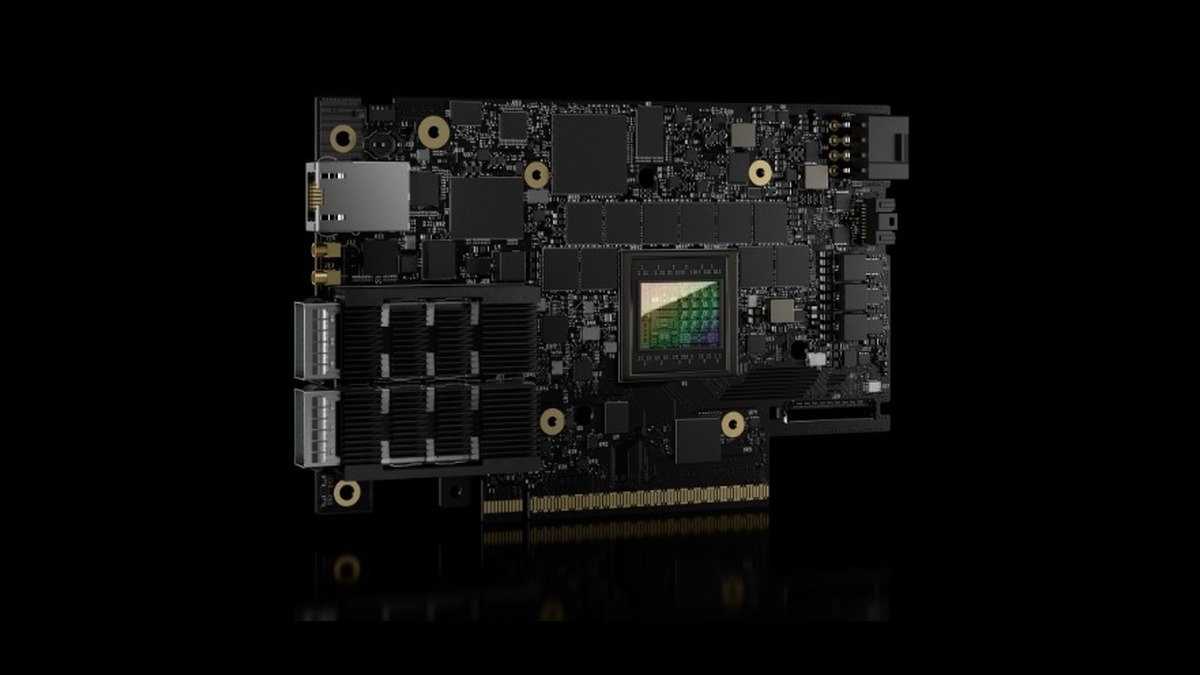
BlueField-3
Overview OVERVIEW
BlueField-3 (NVIDIA BlueField-3 DPU, Data Processing Unit) is NVIDIA's third-generation DPU: the industry's first 400GbE / NDR 400G-class DPU , with onboard 16 Arm Cortex-A78 cores —delivering 10x the acceleration compute of the previous-generation BlueField-2; officially, it can offload infrastructure workloads equivalent to roughly 300 CPU cores from the host to the card (NVIDIA press release [1]).
Its role differs from the ConnectX-7 by a fine line: the CX-7 is a pure network adapter (the gateway into the fabric), while the BlueField-3 is a network entry point with full compute capability —software-defined networking, storage, and security offloads all run on the card, developed with the NVIDIA DOCA software stack (press release [1]). Within the Spectrum-X platform, it also carries a new title: SuperNIC —working end-to-end with Spectrum-4 switches for congestion scheduling in AI clusters [5].
In the 2026 spot market, BlueField-3 is the byword for the DPU category : a standard infrastructure component in the cloud and multi-tenant camp, with project surplus and whole-machine pulls circulating in parallel. The core variable in procurement is software stack ownership — cloud-vendor-customized firmware tied to specific DOCA versions is a common hidden pitfall in the second-hand market. This entry carries no market pricing — actual price subject to the seller's quote.
Use Cases FIT
AIXX Index (0–100): This library estimates via weighted public specs — offload capability 40% + bandwidth 30% + ecosystem 30%. 90+ flagship · 75+ Excellent · 60+ usable · below 60 not applicable.
History HISTORY
April 2021 At GTC, NVIDIA unveiled the BlueField-3: the industry's first 400GbE/NDR-class DPU, with 16 Arm A78 cores and 10x the acceleration compute of the BlueField-2 (NVIDIA press release [1]; SDxCentral coverage [3]).
March 2023 , general availability (GA): Oracle Cloud publicly adopted it as an early user — the DPU took about two years from announcement to large-scale deployment, a testament to cloud vendors' infrastructure upgrade cycles.
2024 , the Spectrum-X platform gave it a new role: SuperNIC —the endpoint scheduler of the AI Ethernet cluster, in tandem with Spectrum-4 switches (press release positioning [5]). BlueField-3's deployment footprint has expanded from cloud infrastructure to AI clusters.
2026 , spot-market position: cloud-customized pulls and original vendor channels circulate in parallel, with the DOCA software stack evolving continuously; the next-generation BlueField-4 has already appeared at NVIDIA public events (per public reporting). Cross-border trade policies for DPUs are still evolving — consult regulator policies and professional advice before procurement (per public reporting).
Technical Specifications SPECIFICATIONS
| Item | Specs (NVIDIA BlueField-3 · per official announcement) |
|---|---|
| Network bandwidth | 400GbE or NDR 400G InfiniBand |
| Onboard processors | 16× Arm Cortex-A78 cores |
| Acceleration compute | 10× BlueField-2 (can offload workloads equivalent to ~300 CPU cores, per official statements) |
| Encryption acceleration | 4× the previous generation's encryption acceleration (line-rate encryption/decryption) |
| Transistor count | ~22 billion (SoC design) |
| Software stack | NVIDIA DOCA SDK (development framework for networking/storage/security offloads) |
| Role | DPU / Spectrum-X SuperNIC |
| Form Factor | PCIe add-in card (HHHL) and integrated module variants |
Specs per NVIDIA's official press release (October 2026) [1]; power, memory, and port details per the relevant model's datasheet—items not listed in this table = unverified, not fabricated.
DPU vs NIC · a fine line DPU VS NIC
| Item | BlueField-3(DPU) | ConnectX-7 (NIC) |
|---|---|---|
| Bandwidth | 400GbE / NDR 400G | 400G (VPI dual-mode) |
| Onboard compute | 16× Arm A78 · runs a full software stack independently | None (acceleration engines only assist) |
| What It Does | Networking/storage/security offload · SuperNIC | Pure network access |
| Software stack | DOCA SDK | Works out of the box with MLNX_OFED drivers |
| One-line buying advice | Purpose-built for infrastructure offload | Networking standard |
See the ConnectX-7 entry for the CX-7; both were announced together in 2021 (press release [1]).
Family Members FAMILY
The BlueField family is tiered by generation; BlueField-3 is the current flagship, and family members are as follows:
Cooling & Deployment COOLING
The BlueField-3 comes primarily as a PCIe HHHL add-in card The primary form factor, passively cooled and reliant on server airflow; as an SoC (22 billion transistors [1]), its power draw is significantly higher than a pure NIC of the same bandwidth—verify slot airflow headroom and PCIe power delivery before deployment (actual power per the model's datasheet; not listed separately in the official press release). Three things to check before deployment: PCIe topology (Gen5 direct to CPU is preferred), DOCA version (bound to upper-layer offload applications), and management plane planning (the OS on the Arm cores needs its own management network and image maintenance process).
Ops tip: a DPU is "a computer on a card" — all three software layers (firmware + DOCA + image) must be included in acceptance and change management, making its ops surface one notch wider than a pure NIC (per this library's inspection experience).
Use-Case Fit WORKLOAD FIT
| Workload type | BlueField-3's role | Typical benefit claims | AIXX Index |
|---|---|---|---|
| Cloud multi-tenant networking | Full offload of VXLAN/security groups/QoS | Host CPUs return to business (~300-core equivalent, per official statements) | 92 |
| AI clusters (Spectrum-X) | SuperNIC endpoint scheduling | End-to-end coordination with SN5600, automated congestion scheduling | 90 |
| Software-defined storage | NVMe-oF offload + encryption gateway | Line-rate encryption, zero host copies | 86 |
| Security isolation | Hardware root of trust for zero-trust architectures | Network plane remains isolated even if the host is compromised (per architecture documentation) | 88 |
Benefit figures come from NVIDIA's official releases and platform documentation [1][5]; actual gains vary with workload architecture—rely on real-world stress testing.
Gallery GALLERY
Actual photos are added continuously as inspection batches are stocked; AI-generated images are never passed off as real photos.
Software & Ecosystem ECOSYSTEM
| Item | Requirements / Status |
|---|---|
| Software stack | NVIDIA DOCA SDK—the development framework for networking/storage/security offload applications (press release positioning [1]) |
| On-card OS | Linux on the Arm side (distributed as BFB images, bundled with DOCA) |
| Driver | MLNX_OFED host-side driver + DOCA runtime |
| Cloud platforms | Early adoption by Oracle Cloud (GA coverage [4]); a common foundation in mainstream cloud providers' infrastructure offerings |
| Virtualization | SR-IOV + VirtIO/netdev offload, multi-tenant data plane acceleration |
| Upgrade chain | Three-layer state management: firmware (MFT) → BFB image → DOCA version — review the version matrix together |
The DPU software stack's three-layer structure (firmware/image/DOCA) is the source of ops complexity and the focus of inspection; versions evolve over time — defer to NVIDIA's official releases.
Purchasing & Inspection PROCUREMENT
Three inspection points for BlueField-3 procurement:
For the full six-test verdict framework see this entry "How to Stress-Test" section.
How to Stress Test BENCH TEST
Six-item benchmark procedure, with all numeric benchmarks anchored to the BlueField-3: unboxing identification → Measured Bandwidth → offload functionality → Arm-side health → extended Burn-in Test → three-layer software export.
Shipping & Delivery LOGISTICS
OEM & Variants VENDORS
Circulation forms of the BlueField-3 and peer comparisons:
| Form/Channel | Reference Solutions | Differentiators | Status as of 2026 |
|---|---|---|---|
| NVIDIA original plug-in card | BlueField-3 HHHL series | Standard PCIe card, officially supported by DOCA | Spot-market mainstream |
| OEM integration | Server factory BF-3 solution | Firmware covered by joint warranty, tied to the server warranty | Both project leftovers and decommissioned units |
| Cloud hyperscaler custom | Custom firmware/images for major cloud providers | Firmware locks and custom software stacks, high unlocking cost | Decommissioned units on the secondary market; key inspection focus |
| BlueField-2 | Previous-gen 25-200G tier | Basic offload, one-tenth the compute | Installed-base Circulation |
Channel information compiled from public reports and official sources [1][4]; specific Part Numbers per official documentation.
Glossary Cards GLOSSARY
DPU (Data Processing Unit)
The "third main chip" alongside the CPU/GPU: onboard Arm cores and network accelerators offload infrastructure workloads — networking, storage, security — from the host CPU — the standard building block of infrastructure modernization in cloud data centers.
DOCA
NVIDIA's DPU software framework: provides networking/storage/security development interfaces on top of the card's Arm system — essentially the CUDA of the DPU world, with the application ecosystem grown around it.
SuperNIC
Spectrum-X platform's new role for the BlueField-3: beyond infrastructure offload, it serves as the endpoint smart NIC for AI Ethernet clusters, working with Spectrum-4 switches on end-to-end congestion scheduling.
BFB image
BlueField Boot Image: the complete image of the on-card Arm system (Linux + DOCA runtime) — a layer above firmware and below DOCA; its version must match the DOCA release, and the three-layer version matrix is essential homework for operations and inspection.
Zero-trust root of trust
A network plane decoupled from the host: even if the host is compromised, network policies and encryption on the card keep working independently — security isolation is DPU's structural advantage over a plain NIC.
Limitations & Controversies LIMITS
- Doubled operational complexity : A DPU is "a computer on a card" — a three-layer software stack (firmware/BFB/DOCA), a separate management plane, and its own upgrade chain. Teams without dedicated ops capability can't handle it (this Pedia's inspection experience).
- Hidden pitfalls of cloud-custom cards : Cloud-hyperscaler custom BF-3s (firmware locks, custom images) circulate on the secondary market; reflashing back to factory state is costly and risky. Verifying Part Number and firmware state is a required procedure (this Pedia's inspection experience).
- Not worth it for pure networking : Using it only as a 400G NIC without offload — a same-bandwidth ConnectX-7 is far cheaper. A DPU's value only makes sense when offloaded workloads are actually running (comparison criteria; see the CX-7 entry).
- DOCA version matrix dependencies : Offload applications are tightly bound to DOCA/BFB/firmware versions; evaluate the upgrade path for older used versions — version gaps may mean unusable features (this Pedia's compilation).
- Cross-border trade policy variables : Export control policies for high-end DPUs keep evolving (public reporting) — this Pedia only serves as a reminder of policy evolution; defer to regulators' policies and professional advice for any specific determination, and this is not legal advice.
Market Notes MARKET NOTE
BlueField-3 spot supply runs on three parallel tracks — cloud-custom decommissioned units, OEM integration leftovers, and original channel — with source and three-layer software state creating wide price spreads. No verifiable unified market snapshot yet, AIXX Pedia honesty principle: no market band; prices are subject to the seller's quote 。
Spot search: AIXX Exchange Hall › (Zero-commission Matching; no involvement in transactions; no knowledge of or speculation on transaction prices — hence data neutrality). This section will switch to a standard market band once enough snapshots accumulate.
Price milestone timeline MILESTONES
FAQ FAQ
Look at the role: BF-3 is a DPU (16 Arm cores running an offload software stack), CX-7 is a pure NIC. For network/storage/security offload or Spectrum-X SuperNIC — BF-3; for networking only — CX-7 is far cheaper. A DPU's value must land on offloaded workloads.
Cloud-hyperscaler custom versions: firmware locks + custom images make reflashing to factory state costly and risky. First step of inspection is mst flint query to export firmware/Part Number/PSID — flag cloud-custom Part Numbers on the spot, then renegotiate or walk away.
Three layers: on-card firmware (managed by MFT) → BFB image (Arm-side Linux + runtime) → DOCA SDK (offload application framework). The three versions must be matched — the version matrix is core homework for ops and inspection.
Technically yes (bare-metal mode), but it's a waste: a same-bandwidth CX-7 is far cheaper. BF-3 only makes sense when you need offload (multi-tenant networking/encrypted storage/security isolation) or the Spectrum-X SuperNIC scenario.
Not mandatory but strongly correlated: platform features like adaptive scheduling need BF-3 end-to-end to be fully realized. Legacy Ethernet NICs can connect to Spectrum-X, but fall back to traditional RoCE tuning mode (platform criteria).
Related Entries SEE ALSO
Model comparison and selection COMPARE
References REFERENCES
- NVIDIA Newsroom — NVIDIA Extends Data Center Infrastructure Processing Roadmap with BlueField-3 (April 2021 launch release, primary spec source) https://nvidianews.nvidia.com/news/nvidia-extends-data-cente…
- NVIDIA Announces BlueField-3 GA, Oracle Cloud Is Early User (GA coverage, 2023-03-21) https://www.hpcwire.com/2023/03/21/nvidia-announces-bluefiel…
- SDxCentral — NVIDIA unveils next-gen BlueField DPU (April 2021 launch coverage) https://www.sdxcentral.com/news/nvidia-unveils-next-gen-blue…
- Blocks & Files — NVIDIA unveils BlueField-3 DPU(2021-04) https://www.blocksandfiles.com/ai-ml/2021/04/12/nvidia-unvei…
- NVIDIA Investor — NVIDIA Supercharges Ethernet Networking for Generative AI (June 2024, Spectrum-X/SuperNIC criteria) https://investor.nvidia.com/news/press-release-details/2024/…
- Listing search — AIXX Exchange (Zero-commission Matching; no market snapshot for BlueField-3 yet, actual price subject to the seller's quote) https://www.aixx.vip/hall.html?model=BlueField-3