AIXX Pedia › Networking Equipment Entry › Quantum-2 QM9700
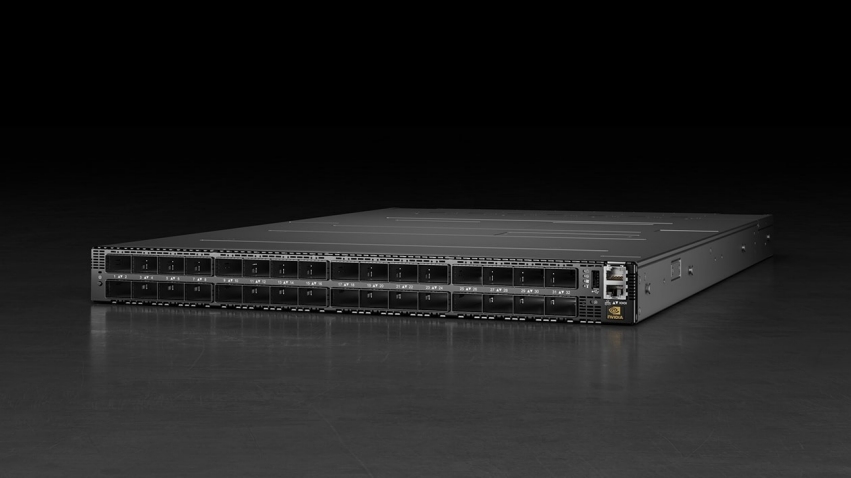
Quantum-2 QM9700
Overview OVERVIEW
Quantum-2 QM9700 (NVIDIA Quantum-2 QM9700 series 1U NDR switch) is NVIDIA's flagship 400G InfiniBand switch : squeezed into a 1U chassis are 64 400Gb/s NDR ports (32 OSFP cages, dual ports per cage), with aggregate bidirectional throughput 51.2Tb/s with packet forwarding exceeding 6.65 billion packets per second, built around the Quantum-2 switch chip (switching capacity of 25.6 Tbps, per the official spec page[2]).
It is the core device for weaving the fabric of this generation of AI clusters : Launched alongside the ConnectX-7 NIC (2021, NVIDIA press release[1]); most 100- and 1000-GPU clusters of the H100/H200/B300 generation run on NDR fabric woven by QM9700. SHARP in-network aggregation and adaptive routing let collective communication traffic be absorbed within the switch fabric itself — the network-side prerequisite for NCCL to saturate bandwidth.
On the 2026 spot market, the QM9700 is the most liquid NDR switch : surplus from cluster expansions, project bulk lots, and channel inventory coexist across three supply channels. The core variables in procurement are accessory completeness and power-on hours — whether the OSFP cage modules, management module, and power/fan units are original and complete, and the machine-room load history directly determine residual value. This entry carries no market-price band — actual price subject to the seller's quote.
Use Cases FIT
AIXX Index (0–100): this Pedia estimates by weighting public specs — capacity 40% + networking role 30% + ecosystem 30%. 90+ flagship · 75+ Excellent · 60+ usable · below 60 not applicable.
History HISTORY
April 2021 , NVIDIA released the seventh generation of Mellanox InfiniBand (NDR 400G) and the Quantum-2 platform : QM9700 was unveiled as the flagship switch of that platform, doubling per-port throughput to 400G from the previous HDR 200G generation, with In-Network Computing (including SHARP in-network aggregation) made a platform staple (NVIDIA press release[1]).
Autumn 2021 ), and at GTC Fall the QM9700 shared the stage with ConnectX-7 and BlueField-3, completing the 400G access-switch-DPU trio. As H100-generation clusters rolled out worldwide, the QM9700 became synonymous with AI training fabric.
2023–2025 , scaled-deployment period: large IB clusters on public Supercomputer rankings adopted Quantum-2 fabric in volume; the domestic AI computing center build-out boom made NDR solutions standard, and the paired liquidity of QM9700s and CX-7 NICs grew in step (per public reporting).
2026 , and its spot-market position has taken shape: the next-generation Quantum-X800 (144×800G) has already appeared on NVIDIA's public roadmap and product pages (per the Quantum-2 platform page[4]), with QM9700 now circulating in parallel as both installed base and spot stock — 400G NDR remains the mainstream fabric for currently operational clusters. Cross-border trade policies for high-end networking equipment are still evolving; procurement should be guided by regulators' policies and professional advice (per public reporting).
Technical Specifications SPECIFICATIONS
| Item | Specifications (Quantum-2 QM9700 · official figures) |
|---|---|
| Port Configurations | 64 400Gb/s NDR ports (32 OSFP cages × 2 ports per cage), non-blocking |
| Aggregate throughput | 51.2Tb/s (bidirectional aggregate) |
| Switch chip | NVIDIA Quantum-2 IC · switching capacity 25.6 Tbps |
| Packet forwarding rate | Over 6.65 billion packets per second |
| In-network computing | SHARP (in-network aggregation for collective communication) · adaptive routing · RDMA |
| Management | The QM9700 includes an Intel Core i3 (Coffee Lake) management host; the QM9790 is the variant without a management host[2] |
| Form Factor | 1U rack-mount |
| Same-generation variants | QM9700 / QM9790 series (differences in management and cooling configuration; see official documentation) |
Specifications follow NVIDIA's official spec page and user manual (as of October 2026)[2][5]; details such as overall power draw and PSU specs are subject to the corresponding model's datasheet. Anything not listed in this table = unverified, and is not fabricated.
400G NDR trio · networking roles FABRIC ROLES
| Role | ConnectX-7 | QM9700 | BlueField-3 |
|---|---|---|---|
| Identity | 400G access NIC | 64×400G IB switch | DPU (Data Processing Unit) |
| Bandwidth | 400G per card | 51.2Tb/s aggregated (bidirectional) | 400GbE / NDR 400G |
| What It Does | The gateway from servers into the fabric | Non-blocking switching between nodes | Network/storage/security offload |
| One-line buying advice | Cluster access standard | NDR fabric core | Purpose-built for infrastructure offload |
The trio launched together in 2021 (per NVIDIA's announcement[1]); see the individual entries for CX-7/BlueField-3.
Family Members FAMILY
The Quantum family is tiered by speed generation; the QM9700 is the flagship of the NDR 400G generation. Family members:
Cooling & Deployment COOLING
The QM9700 is a 1U rack-mount device with front-to-back forced airflow — fitting 64×400G into 1U means OSFP optics account for most of the heat; with modules fully populated, system power draw is significantly higher than when empty (exact power depends on the modules and PSU configuration, per official documentation). Before deployment, check three things against your site: rack power (a 1U switch with fully populated NDR optics requires verifying rack power delivery against the PSU ratings), airflow direction (front-to-back airflow must match the hot/cold aisle layout; reverse-airflow models must be identified in advance), and the OSFP module list (cage modules come in SR/DR/FR/2xFR reach classes; when mixing cabling, list management is routine operational work).
On the management side: the QM9700 includes an i3 management host (the QM9790 does not), and MLNX-OS runs on it — for used purchases, the login and license status of the management module should be part of acceptance inspection (per this Pedia's hands-on verification experience).
Network Fit FABRIC FIT
| Cluster scale | Typical topology | QM9700 count and role | AIXX Index |
|---|---|---|---|
| 8–64 cards, single rack | 1× QM9700, single tier | One unit is full mesh (64 ports to spare), with ports reserved for future rack expansion | 88 |
| Hundred-card class, 2–8 racks | Two-tier leaf-spine | 2–8 units each of leaf and spine, non-blocking oversubscription planned at 1:1 | 94 |
| Thousand-card class | Multi-plane spine-leaf + optical interconnect | Dozens of units; optical module count estimated as planes × ports | 92 |
| Ethernet clusters | Not applicable | The QM9700 is an IB switch — for Ethernet clusters, see the Spectrum-4 SN5600 entry | — |
Scale tiers are this Pedia's compilation based on public fabric topology conventions (estimated); at the thousand-card level, optical module budgets often exceed the cost of the switches themselves (compiled).
Gallery GALLERY
Actual photos are added continuously as inspection batches are stocked; AI-generated images are never passed off as real photos.
Software & Ecosystem ECOSYSTEM
| Item | Requirements / Status |
|---|---|
| Network OS | NVIDIA MLNX-OS (bundled on the management host) |
| In-network computing | SHARP requires coordinated enablement between the switch and NICs (CX-7); NCCL benefits automatically |
| Routing | Adaptive Routing — self-healing under link failure and congestion |
| Monitoring | IB diagnostics toolchain such as perfquery / ibdiagnet (OpenSM ecosystem) |
| Companion NICs | ConnectX-7 (standard NDR access); backward compatible with HDR/NDR200 access |
| Operations practice | Fabric-level health checks (ibdiagnet full-fabric scan) are routine cluster upkeep |
The InfiniBand ecosystem, matured over two decades, has a well-developed toolchain for large-cluster operations; software versions evolve over time — defer to NVIDIA's official releases.
Purchasing & Inspection PROCUREMENT
Key inspection points when buying a QM9700 (three items):
For the full six-test verdict framework see this entry "How to Stress-Test" section.
How to Stress Test BENCH TEST
Six-test protocol, with all pass/fail figures anchored to the QM9700: unboxing identification → management host → port bandwidth sampling → SHARP/adaptive routing function → extended Burn-in Test → accessories and firmware inventory.
Shipping & Delivery LOGISTICS
OEM & Variants VENDORS
The QM9700 circulates mainly as NVIDIA original complete units. Family variants and same-generation comparison:
| Variants | Difference | Use Cases | Status as of 2026 |
|---|---|---|---|
| QM9700 | With an i3 management host (per the official spec page[2]) | Cluster with standalone fabric management | Spot-market mainstream |
| QM9790 | Variant without management host | Massive fabric managed by a central controller | Project circulation |
| Quantum-X800 | 144×800G (next generation) | New X800-generation cluster | New-product roadmap (per the platform page[4]) |
| Previous-gen QM8700 | HDR 200G(Quantum-1) | Capacity expansion of legacy HDR clusters | Installed-base Circulation |
Variant information comes from NVIDIA's official spec and product pages[2][4]; exact configurations are subject to official documentation.
Glossary Cards GLOSSARY
NDR and Quantum-2
NDR (Next Data Rate) is the fifth-generation InfiniBand speed specification: 400Gb/s per port; Quantum-2 is the codename for the switch chip and platform carrying NDR. The previous-gen HDR 200G corresponds to Quantum-1 (QM8700), and the next-gen XDR 800G corresponds to Quantum-X800.
OSFP cages
The QM9700's 64 400G ports are physically housed in 32 OSFP cages — each OSFP cage accepts dual-port modules (2×400G). OSFP's large footprint offers better cooling and is the mainstream cage standard on the NDR switch side; it is not intermateable with the QSFP112 modules common on NICs.
SHARP in-network aggregation
Collective-communication reduction operations (such as AllReduce) are completed in-switch, so data doesn't have to travel fully to endpoints — the efficiency engine for large-model training in the NDR generation, requiring coordinated enablement on both the switch (QM9700) and the NIC (CX-7).
Adaptive routing
A classic InfiniBand capability: when a link is congested or fails, traffic automatically reroutes and the fabric self-heals without interruption — unlike Ethernet's spanning-tree protocol with second-level convergence, IB self-healing happens at the microsecond level.
Leaf-spine mesh
A two-tier Clos topology: the access layer (leaf) connects servers, the core layer (spine) connects leaves, and any two GPUs have equal hop counts and equal bandwidth — the standard structure for a non-blocking AI fabric. How the QM9700's 64 ports are allocated across the two tiers is the core question in fabric design.
Limitations & Controversies LIMITS
- Speaks only InfiniBand : The QM9700 is an IB switch and cannot run Ethernet — for Ethernet AI networking, choose the Spectrum-4 SN5600 (see entry). Fabric-route selection should precede device selection (public platform wording).
- Max-config power and facility requirements : A 1U chassis with 64 400G ports; when fully loaded with optical modules, verify total system power against the PSU rating, and budget rack power and cooling upfront (compiled by this database; actual figures subject to power configuration).
- Optical modules are the hidden big-ticket item : For a thousand-GPU-scale fabric, the optics budget often exceeds the switches themselves — budget for the full chain of "switch + cage modules + cables", not just the bare unit price (compiled by this database; derivation in "Network Fit").
- Used units' workload histories diverge : Prices differ significantly between 7×24 data-center retirements and project surplus units; fan bearings, PSU lifespan, and port degradation all correlate strongly with powered-on hours — the "three checks of workload history" (power-on hours / fan noise / dust buildup) are essential bargaining skills (inspection experience from this database).
- Cross-border trade policy variables : Export control policies for high-end networking equipment continue to evolve (as publicly reported) — AIXX Pedia offers this only as a policy-evolution reminder; actual determinations depend on the competent authority's policies and professional advice, and this is not legal advice.
Market Notes MARKET NOTE
QM9700 units reach the market via three channels: cluster-expansion surplus, full project batches, and channel inventory. Completeness of accessories, workload history, and firmware licensing create significant price gaps — there is no verifiable unified market snapshot yet, AIXX Pedia honesty principle: no market band; prices are subject to the seller's quote 。
Spot search: AIXX Exchange Hall › (Zero-commission Matching; no involvement in transactions; no knowledge of or speculation on transaction prices — hence data neutrality). This section will switch to a standard market band once enough snapshots accumulate.
Price milestone timeline MILESTONES
FAQ FAQ
Choose the fabric route first, then the devices: InfiniBand (QM9700+CX-7) works out of the box with the lowest latency and built-in SHARP/adaptive routing; Ethernet (SN5600+Spectrum-X) has a broader ecosystem and mature cloud management, but lossless networking requires tuning. Both are mainstream options for AI clusters in 2026 — decide based on your team's ops experience and existing fabric.
Yes: NDR switch ports negotiate down for HDR 200G/NDR200 connections, so legacy clusters can expand without a wholesale card swap; however, mixed-speed cabling raises module-list management complexity — for new clusters, standardize on the 400G tier.
Three steps: inventory accessories (cage modules/PSUs/fans) → power on and verify the management host and MLNX-OS → pair CX-7s for spot bandwidth tests on sampled ports (≥8 ports, per the reference framework). For data-center retirements, add the "three checks of workload history": power-on hours, fan noise, and dust buildup.
Sibling models from the same generation and chip: the QM9700 has a built-in i3 management host (MLNX-OS runs locally), while the QM9790 has no management host and relies on a central controller — small and mid-sized clusters will find the QM9700 simpler; massive fabrics with centralized management should pick the QM9790 (official spec-page wording).
Optical modules and cables are the big spend: a fully loaded 32-cage, dual-port configuration costs far more than the bare unit; verify rack power against max-config draw; stock enough CX-7 NICs for all nodes. Budget for the full chain of "switch + modules + NICs", not just the bare unit price.
Related Entries SEE ALSO
Model comparison and selection COMPARE
References REFERENCES
- NVIDIA Newsroom — NVIDIA Announces Mellanox InfiniBand for Exascale AI Supercomputing (Apr 2021, NDR/Quantum-2 launch release) https://nvidianews.nvidia.com/news/nvidia-announces-mellanox…
- NVIDIA official documentation — QM97XX 1U NDR 400Gb/s InfiniBand Switch Specifications (primary spec source, Oct 2026 wording) https://networking-docs.nvidia.com/qm97x0hw/specifications
- NVIDIA official — QM9700/QM9790 User Manual (PDF) https://docs.nvidia.com/networking/display/qm9700-and-qm9790…
- NVIDIA Quantum-2 400G Switches and ConnectX-7 at GTC Fall 2021 (on-site coverage) https://www.servethehome.com/nvidia-quantum-2-400g-switches-…
- NVIDIA website — Quantum-2 platform page (product line and roadmap wording) https://www.nvidia.com/en-us/networking/quantum2/
- Listing search — AIXX Exchange (Zero-commission Matching; no market snapshot for the QM9700 yet, actual price subject to the seller's quote) https://www.aixx.vip/hall.html?model=QM9700