AIXX Pedia › Infrastructure Entries › Optical Modules and Cables
Optical Modules and Cables
Overview OVERVIEW
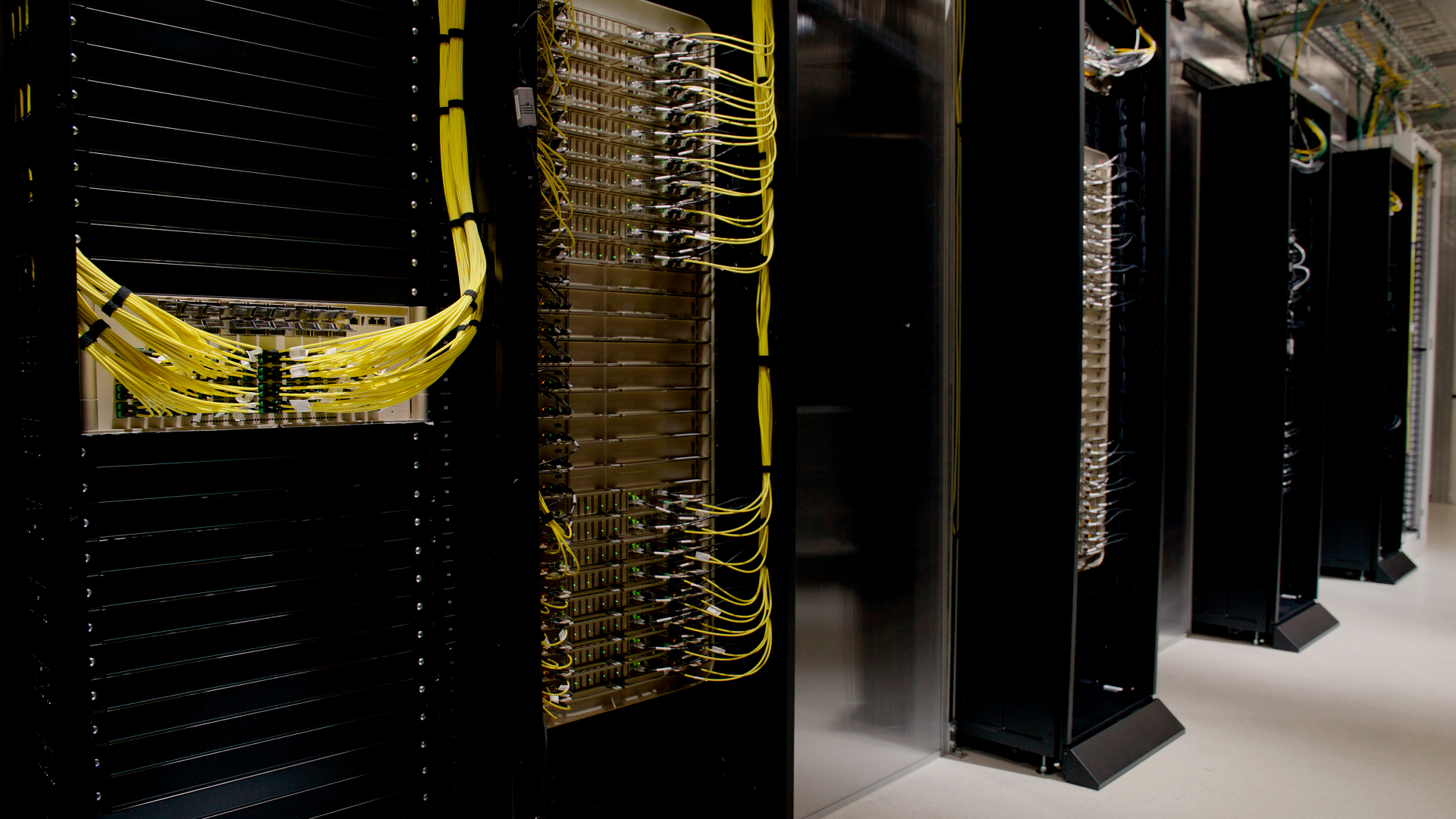
Optical Modules and Cables is the AI data center's second-largest procurement item — beyond GPUs, the interconnect layer that links compute into a cluster (per NVIDIA's official interconnect product line, LinkX) splits into three routes by distance: DAC copper cable (≤3m, in-rack, passive with zero power draw), AOC active optical cable (2.5–5m, between racks), optical modules (DR 500m / FR 2km across data centers — per LinkX's official distance matrix[3])。
AI clusters have pushed this into a hundred-billion-yuan track : a single NVL72 rack contains roughly 5,000 in-rack copper cables (scale-up copper interconnect figures[5]), and per-GPU optical port speeds double with each generation at 200G→400G→800G (official generational figures[5]); domestic vendors hold top positions in global optical module supply, backed by revenue data — the top three players have reached quarterly revenue in the billions of US dollars (public financial reports[6])。
This entry is a product-category selection guide: covering the selection logic, spec tiers, and vendor landscape of the three interconnect routes. Interconnect components have no unified market price; actual price subject to the seller's quote.
Use Cases FIT
AIXX Index (0–100): weighted by fit for interconnect scenarios (category-specific criteria).
History HISTORY
2023–2024 , AI demand ignited the interconnect layer: large-scale H100 cluster deployments drove up 400G optical module demand, with 800G ramping alongside the H200/Blackwell generation — optical modules shifted from the telecom cycle to the AI cycle (industry figures[6])。
March 2024 , NVIDIA GTC unveiled the X800 generation: the Quantum-X800/Spectrum-X800 switching platforms ship with 800G interconnect — LinkX's product-line distance matrix (DAC 3m/LACC/AOC/DR 500m/FR 2km) became the official reference for AI data center cabling (official product-line figures[3])。
2025 , domestic leaders' revenue materializes: Chinese optical module vendors like Innolight and Eoptolink are seeing rapid growth in AI-related revenue (public financial reports: top vendors' quarterly revenue in the billions of US dollars[6]) — the global optical module supply landscape is led by Chinese vendors (supported by financial reports; unverified share percentages omitted).
2025-2026 , Year One of CPO: NVIDIA launched co-packaged optics (CPO) switches — 144×800G / 409.6Tb/s, with official figures citing 5× energy efficiency (official product page figures[5]); Marvell acquired Celestial AI for $3.25 billion to enter CPO (public reports[6]) — the technology race in optical interconnect enters a new phase.
Spec Tiers SPEC TIERS
| Tier | Distance / Spec | Scenario | Basis |
|---|---|---|---|
| DAC copper cable | ≤3m (passive) | In-rack GPU↔switch | LinkX official matrix[3] |
| LACC active copper cable | 2.5–5m · ~4W | Short inter-rack runs | LinkX official matrix[3] |
| 800G DR4 optical module | 500m · 18W max (2W low-power tier) · CMIS 4.0 · MPO-12 APC | Cross-rack / intra-DC fabric | NVIDIA MMS4A20 documentation figures[3] |
| FR optical module | 2km | Cross-data-center | LinkX official matrix[3] |
| 800G ZR+ coherent | 500-1000km@800G · 400G@2500km | DCI data center interconnect | Marvell public product figures[6] |
| CPO switching | NVIDIA Q3450-LD:144×800G · 409.6Tb/s | Next-gen DC energy-efficiency roadmap | NVIDIA CPO official page[5] |
Tiers compiled from NVIDIA's official product line and public vendor materials (2026-10 figures[2][4][5]; for specific compatibility lists, refer to switch vendors' official documentation.
Vendor Landscape VENDORS
Supply landscape of optical modules and interconnect components (public financial reports and hands-on reports[3][5]; this Pedia is not a procurement recommendation):
| Camp | Representatives | Positioning |
|---|---|---|
| NVIDIA in-house | LinkX cable and module product line | Bound to its own switch/GPU ecosystem, distance matrix officially endorsed[3] |
| Domestic leaders | Innolight / Eoptolink | Public financial reports: quarterly revenue in the billions of US dollars, rapid AI-related growth (2026 Q1 figures[6]) — top global supply position backed by revenue |
| International vendors | Coherent / Lumentum / Marvell | Coherent growing fast, Lumentum quarterly revenue on the order of $808M, Marvell's $3.25B acquisition of Celestial AI to enter CPO (public reports[6]) |
| Domestic second tier | Accelink / CIG and others | 800G volume-ramp tier (public reports[6]) |
Vendor information from public financial reports and LightCounting industry figures[5]; unverified share percentages are not cited — a discipline of this library.
Gallery GALLERY
Deployment & Complementary Components DEPLOYMENT
Deployment discipline for interconnect components: Choose among three routes by distance (in-rack DAC / short-run AOC / long-haul optical modules — LinkX matrix figures[3])、 Verify compatibility lists (check module compatibility lists from switch and NIC vendors one by one — third-party module compatibility and warranty are common pitfalls), Power budget (800G optical modules draw up to 18W each per documentation figures[3] — the cumulative draw of hundreds per rack must be factored into rack cooling).
Operational note on CPO: co-packaged optics moves the optical engine into the switch package — the traditional module-level hot-swap maintenance model changes, and failure domains and spares strategies must be adjusted accordingly (compiled by this library).
Procurement & Acceptance PROCUREMENT
Acceptance checkpoints for interconnect procurement (three items):
Glossary Cards GLOSSARY
DAC copper cable
Direct Attach Copper, passive copper cable: ≤3m reach, zero power draw, lowest cost — the default in-rack GPU↔switch interconnect (about 5,000 copper cables per NVL72 rack[5])。
AOC active optical cable
Active Optical Cable: custom-length optical cable with optical transceivers on both ends — the 2.5–5m+ inter-rack tier (LinkX matrix figures[3]); reaches farther than DAC and is simpler than discrete optical module solutions.
DR4 / FR
Distance spec codes for optical modules: DR=500m (single-mode, 4 parallel lanes), FR=2km (single-mode, single wavelength) — 800G DR4 draws 18W max with CMIS 4.0 management (NVIDIA documentation figures[3])。
CPO Co-Packaged Optics
Co-Packaged Optics: optical engines packaged together with the switch chip — NVIDIA official figures: 144×800G / 409.6Tb/s / 5× energy efficiency (product page figures[5]); the energy-efficiency roadmap for next-generation data centers.
GPUDirect RDMA
A path for storage/network data to reach GPU memory directly (bypassing the CPU) — the quality of interconnect components (NIC + module + cable) directly determines the BER and throughput of this path.
Limitations & Controversies LIMITS
- Compatibility is the biggest pitfall : compatibility list mismatches between third-party modules and switches, firmware handshake failures — "plugs in" does not mean "runs reliably"; compatibility list verification and batch BER sampling are the baseline (compiled by this library).
- Fast generational iteration : at the pace of 200G→400G→800G→1.6T, module assets depreciate quickly — align bulk purchases with generational transition timing (compiled by this library).
- Power costs are easy to miss : 800G optical modules draw up to 18W each (documentation figures[3]) — cumulative power draw and cooling for hundreds of modules must go into the rack budget; CPO is the efficiency answer but the ecosystem is still early (official figures[5])。
- Market share data discipline : industry share reports are often distorted in secondhand retelling — this page's vendor landscape is backed by financial-report revenue, and unverified share percentages are not cited (library discipline, consistent with the overall approach).
- This entry takes a category perspective : switches and NICs are covered in their own entries (QM9700/SN5600/CX-7/BlueField-3); this page focuses on the interconnect category.
Market Notes MARKET NOTE
Interconnect components are mostly procured as part of projects (large variation by generation/distance/volume) — AIXX Pedia honesty principle: no market band; prices are subject to the seller's quote 。
Spot search: AIXX Exchange Hall › (Zero-commission Matching, hence neutral data).
Price milestone timeline MILESTONES
FAQ FAQ
By distance: use DAC in-rack up to ≤3m (zero power, cheapest), AOC for 2.5–5m between racks, optical modules (DR/FR tiers) for 500m+ across data centers — the official LinkX matrix is the reference frame; mixing tiers wastes budget or fails to link.
For scale: a single 800G DR4 module tops out at 18W (with a 2W low-power tier, per NVIDIA documentation) — with hundreds of modules per rack, the cumulative power draw has to be factored into the rack's cooling budget; the efficiency edge of the CPO route (officially 5×) targets exactly this.
Check the compatibility list: verify each module against the switch/NIC vendor's official compatibility matrix — plugging in physically doesn't guarantee a stable link; firmware handshake and warranty issues are common pitfalls with third-party modules. Run batch BER sampling tests before bulk purchases.
Per Jensen Huang's public remarks: within 1–2 meters, copper interconnect delivers high reliability, high energy efficiency, and low cost — the in-rack NVLink domain uses copper cable backplanes (roughly 5,000 cables), with optics only for rack-to-rack links — "copper for scale-up, optics for scale-out" is NVIDIA's stated technical roadmap.
Co-packaged optics: the optical engine is packaged together with the switch chip (NVIDIA's official figures: 144×800G / 409.6 Tb/s / 5× energy efficiency) — the technical roadmap is settled but the ecosystem is still early; ordinary buyers can simply keep an eye on it, with hyperscale data centers as the first adopters.
Related Entries SEE ALSO
Selection Guide and Further Reading EXPLORE
References REFERENCES
- NVIDIA Official Site — LinkX Interconnect Product Line (distance matrix and product figures, 2026-10) https://www.nvidia.com/en-us/networking/interconnect/
- NVIDIA Official Documentation — MMS4A20: 800G DR4 Optical Module Specs (500m/18W/CMIS 4.0) https://networking-docs.nvidia.com/
- NVIDIA Official Site — Co-Packaged Optics (CPO) Switch Product Page (144×800G / 409.6 Tb/s figures) https://www.nvidia.com/en-us/networking/interconnect/
- NVL72 Copper Interconnect and Cluster Hands-on Reports (scale-up figures) https://www.servethehome.com/
- LightCounting — Public Optical Module Industry Figures (revenue and growth data, 2026) https://www.lightcounting.com/
- Live Listings — AIXX Exchange (Zero-commission Matching; no market snapshot for interconnect components yet, actual price subject to the seller's quote) https://www.aixx.vip/hall.html