AIXX Pedia › Model Entry › MI350X / MI355X
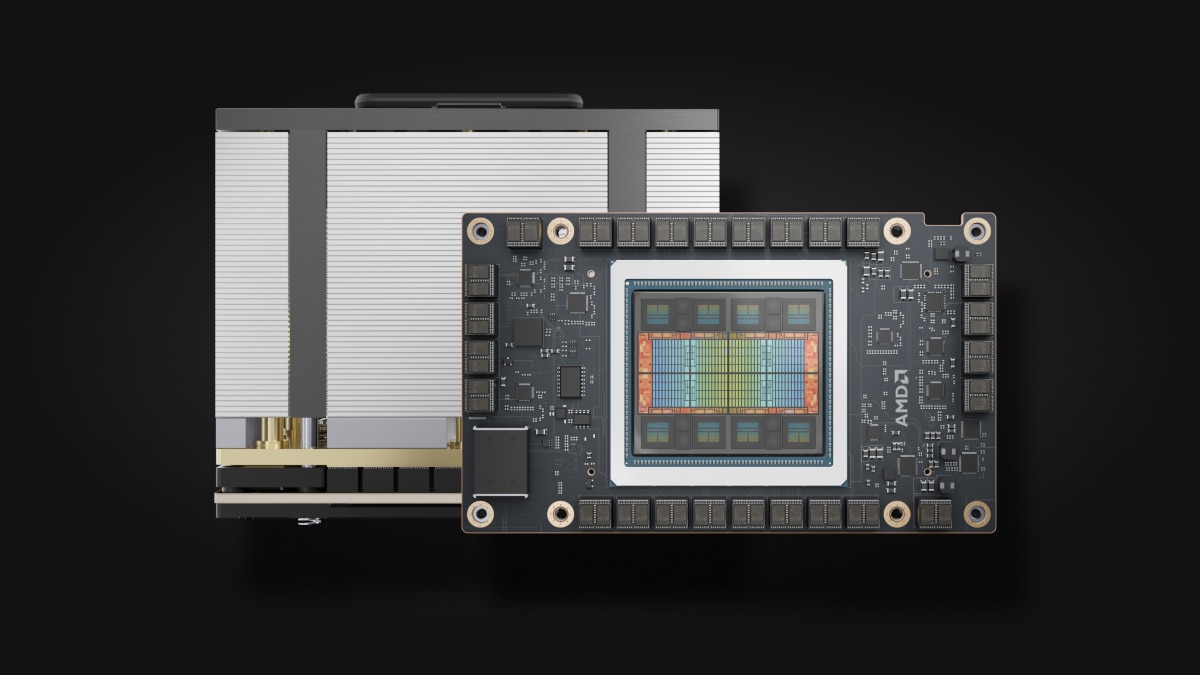
MI350X / MI355X
Overview OVERVIEW
MI350X / MI355X It's the new flagship of the AMD Instinct family with The CDNA4 Architecture Flagship (Released June 12, 2025): 288GB HBM3E per card, 8TB/s bandwidth, 185 billion transistors on 3nm—the two models share the same die and differ in cooling and power: MI350X 1000W Air-cooled (Passive OAM) 、 MI355X 1400W with Liquid-cooled support , with MXFP4 throughput of 9.2/10.1 PFLOPS respectively (per AMD's official two-page spec sheet [1]).
It is the The direct successor to the MI325X : Memory stays in the 288GB class but bandwidth rises to 8TB/s (MI325X was 6TB/s), the architecture moves from CDNA3 to CDNA4, and FP4/FP6 precision gets native support — the delivery on the promise of 'one generation per year' upgrades to both memory and architecture (per AMD's official generational framing [2]). AMD's official B200 comparison cites the current 180GB/7.7TB/s tier — the 288GB capacity gap is the flagship selling point of the AMD camp (official comparison baseline, same as the B200 entry in this library).
In the 2026 spot market, the MI350 series circulates primarily as 8-GPU OAM complete systems, still ramping in volume: the maturity of the ROCm 6.x+ support matrix for CDNA4, and the price spread against MI300X/MI325X inventory, are the core of the three key procurement questions. This entry carries no market band—actual price subject to the seller's quote.
Use Cases FIT
AIXX Index (0–100): Estimated in this Pedia via weighted public specs — memory 40% + interconnect 30% + ecosystem 30%.
History HISTORY
On June 12, 2025 , MI350X/MI355X officially launched (per the official Launch Date framing [1]): CDNA4 architecture, 3nm, 185 billion transistors, 288GB HBM3E/8TB/s — memory and bandwidth take another step up from MI325X (256GB/6TB/s), with MXFP4/FP6 new precision natively added.
2025-2026 , the two models ship in divergent form factors: the Liquid-cooled MI355X (1400W/2400MHz) targets liquid-cooled data centers and leading cloud providers, while the Air-cooled MI350X OAM (1000W/2200MHz) covers air-cooled AI compute centers — a dual-track approach covering different facility conditions (per the official two-page spec framing [1]).
2026 , spot ramp-up: 8-GPU OAM complete systems flowing in growing volume, with the ROCm 6.x+ support matrix for CDNA4 continuing to mature—the MI350 series becomes the AMD camp's current flagship (against the NVIDIA B300 generation). Cross-border circulation policy is still evolving; procurement should follow competent-authority policy and professional advice (per public reporting).
Technical Specifications SPECIFICATIONS
| Item | MI350X | MI355X |
|---|---|---|
| Architecture / Process | CDNA4 · TSMC 3nm · 185 billion transistors | |
| Memory | 288GB HBM3E · 8TB/s (both models) | |
| Peak Clock | 2200 MHz | 2400 MHz |
| MXFP4 Throughput | 9.2 PFLOPS | 10.1 PFLOPS |
| Power (TBP) | 1000W | 1400W |
| Cooling | Passive OAM (air-cooled) | Passive & Active (supports liquid cooling) |
| Shared Specs | Infinity Fabric 8 links · PCIe Gen5 · OAM module · SR-IOV | |
Specifications follow AMD's official two-page spec sheet (official snapshot as of 2026-10 [1], cross-verified by both C5/C6 generation scouts); the Launch Date of 6/12/2025 is per official labeling.
Three AMD Flagship Generations Side by Side THREE GEN
| Item | MI300X | MI325X | MI350X/MI355X |
|---|---|---|---|
| Architecture | CDNA3 | CDNA3 (refinement) | CDNA4 |
| Memory | 192GB HBM3 | 256GB HBM3E | 288GB HBM3E |
| Bandwidth | 5.3TB/s | 6TB/s | 8TB/s |
| New Precision | FP8 | FP8 | MXFP4 / FP6 |
| Power | 750W | 1000W | 1000W / 1400W |
| One-line buying advice | Value on existing stock | Transitional Tier | Current Flagship |
The three-generation comparison uses each model's official snapshot (see individual entries for MI300X/MI325X); CDNA4's MXFP4/FP6 is the new-precision generational capability.
Family Members FAMILY
The Instinct family tiers by generation; the MI350 series is the CDNA4 current flagship:
Cooling & Deployment COOLING
The MI350 series deployment divide is cooling form factor : the MI350X is a Passive OAM air-cooled design (1000W) that can land in air-cooled AI centers; the MI355X supports Liquid cooling (1400W), the density pick for liquid-cooled facilities. The 8-card OAM system (UBB baseboard) is the standard delivery form — rack-level cooling and power (54V power bus) for 1000W/1400W×8 = 8–11kW-class loads must be planned holistically (per the official two-page spec framing [1]).
Deployment differences vs. the MI325X (also OAM): the higher power density of CDNA4 makes liquid cooling go from optional to mandatory for the MI355X —air-cooled facilities choose the MI350X, liquid-cooled facilities choose the MI355X by density—the "fix facility conditions first, then pick the model" selection order holds (per our library's compilation).
Model Compatibility MODEL FIT
| Model / Scenario | Memory Requirement | MI350 Series Deployment Notes | AIXX Index |
|---|---|---|---|
| DeepSeek R1 full (671B) | FP8 ~690GB | 8-GPU 2.3TB fits with ample headroom—MXFP4 inference path depends on ROCm framework support | 88 |
| Ultra-long-context inference | KV cache scales linearly with length | 288GB per card offers the largest KV cache space in the MI series | 91 |
| LLM training / fine-tuning | 8-GPU IF networking | The CDNA4 training stack matures with ROCm—factor tuning labor into the cost | 82 |
| FP64 HPC | Official snapshot is authoritative | CDNA4 FP64 figures per the official spec sheet—anything not listed here = unverified | — |
Memory is estimated as FP16 weights ≈ parameter count × 2 bytes (estimated framing); FP4/FP6 paths are subject to actual ROCm framework support (official framing [1]).
Gallery GALLERY
Software & Ecosystem ECOSYSTEM
| Item | Requirements / Status |
|---|---|
| Software stack | ROCm 6.x+ (CDNA4 support matrix per official docs, same as the ROCm entry) |
| Frameworks | PyTorch ROCm build / vLLM / SGLang—MI350 series support matures with versions |
| Virtualization | SR-IOV support (per the official spec snapshot [1]) |
| Observability | rocm-smi / amd-smi |
| Comparison | See the ROCm entry migration framework for the CUDA ecosystem comparison |
Ecosystem info compiled from public sources; versions evolve over time — defer to AMD's official releases.
Purchasing & Inspection PROCUREMENT
Three inspection points when buying MI350 series:
Acceptance Quick Reference QUICK CHECK
Four-step quick check for the MI350 series:
Shipping & Delivery LOGISTICS
Glossary Cards GLOSSARY
CDNA4 and MXFP4/FP6
AMD's fourth-generation data center architecture: adds MXFP4/FP6 microscaling floating-point precisions—further lowering the memory and bandwidth cost of large-model inference (against NVIDIA's FP4 route), the generational capability gap CDNA4 holds over CDNA3.
MI350X vs MI355X
Two models on the same silicon: MI350X at 1000W Air-cooled OAM (2200MHz/MXFP4 9.2PF), MI355X with 1400W Liquid-cooled support (2400MHz/MXFP4 10.1PF) — both share 288GB/8TB/s of memory; choose based on facility cooling conditions and density requirements (per the official two-page framing [1]).
288GB HBM3E / 8TB/s
The MI350 series memory spec: 288GB per card, 8TB/s system-wide bandwidth—the current peak of the MI series' "memory arms race" (against the MI325X at 256GB/6TB/s and the MI300X at 192GB/5.3TB/s).
OAM and UBB
The OAM module + UBB baseboard 8-GPU system is the MI350 series' standard delivery form—the carrier for the 54V power bus and IF interconnect; "loose modules" off the baseboard cannot be used standalone.
Limitations & Controversies LIMITS
- The ROCm migration ledger : same as other MI-series frameworks—cost CUDA-installed pipelines in person-months (per the ROCm entry); the MI350 series is new, so framework maturity for CDNA4 support must be verified item by item.
- The MI355X liquid-cooling threshold : 1400W power + liquid-cooled form factor—liquid-cooling retrofit budget and O&M capability are prerequisites; air-cooled facilities should choose the MI350X (per our library's compilation).
- No established used-market yardstick : the MI350 series only began shipping in mid-2025, so used-inspection practice is limited—memory health and IF link condition are the inspection focus (per our library's inspection experience).
- The B200 comparison baseline framing : AMD's official comparison uses the B200's current 180GB/7.7TB/s framing—note each side's chosen framing in cross-camp comparisons (per our library's compilation).
- Cross-border trade policy variables : AMD high-end cards also fall under export-control contexts (per public reporting) — for cross-border procurement compliance, defer to professional advice; this Pedia does not constitute legal advice.
Market Notes MARKET NOTE
The MI350 series circulates mainly as 8-GPU OAM complete systems, and the dual-model + cooling-form-factor differences make price dispersion wide—no verifiable unified market snapshot yet; AIXX Pedia honesty principle: no market band; prices are subject to the seller's quote 。
Spot search: AIXX Exchange Hall › (Zero-commission Matching, hence neutral data).
Price milestone timeline MILESTONES
FAQ FAQ
Let facility cooling conditions decide: air-cooled AI centers pick the MI350X (1000W air-cooled OAM); liquid-cooled facilities or high-density needs pick the MI355X (1400W liquid-cooled, higher clocks and MXFP4 throughput)—memory is the same 288GB/8TB/s.
With sufficient budget for new purchases, pick the MI350 series: the architecture gap (CDNA4's MXFP4/FP6) plus memory bandwidth (8TB/s vs. 6TB/s); MI325X inventory offers a friendlier price spread but no new precision—training pipelines should go straight to CDNA4.
Yes on an FP8 basis: full R1 in FP8 is about 690GB, fitting within the 8-GPU 2.3TB memory with ample headroom—with the ROCm builds of inference stacks vLLM/SGLang, run benchmarks to validate before deployment.
Four steps: rocm-smi identity check (model/288GB/serial) → measured 8TB/s memory bandwidth → 8-GPU rccl-tests interconnect → Burn-in Test at Full Load per the power tier (MI355X liquid-cooled follows the liquid-cooling procedure). Verifying the ROCm support matrix is a procurement prerequisite.
A dilemma of ecosystem vs. capacity: the MI350 series' 288GB memory beats the B200's 192GB-class (current framing), but the B200 is backed by the CUDA ecosystem—new open-source-stack pipelines can weigh the MI350 series, while CUDA-installed pipeline migration should be costed in total (per the ROCm entry framework).
Related Entries SEE ALSO
Model comparison and selection COMPARE
References REFERENCES
- AMD website — Instinct MI350X product page (official two-page spec sheet, official snapshot as of 2026-10) https://www.amd.com/en/products/accelerators/instinct/mi350/…
- AMD website — Instinct MI355X product page (liquid-cooled high-spec framing) https://www.amd.com/en/products/accelerators/instinct/mi350/…
- MI355X teaser and MI350P PCIe variant coverage (third-party cross-reference) https://www.servethehome.com/
- AMD Official Documentation — ROCm Documentation Site (support matrix) https://rocm.docs.amd.com/
- Listing search — AIXX Exchange (Zero-commission Matching; no market snapshot for the MI350 series yet—actual price subject to the seller's quote) https://www.aixx.vip/hall.html?model=MI350