AIXX Pedia › Model Entry › MI300X
MI300X
Overview OVERVIEW
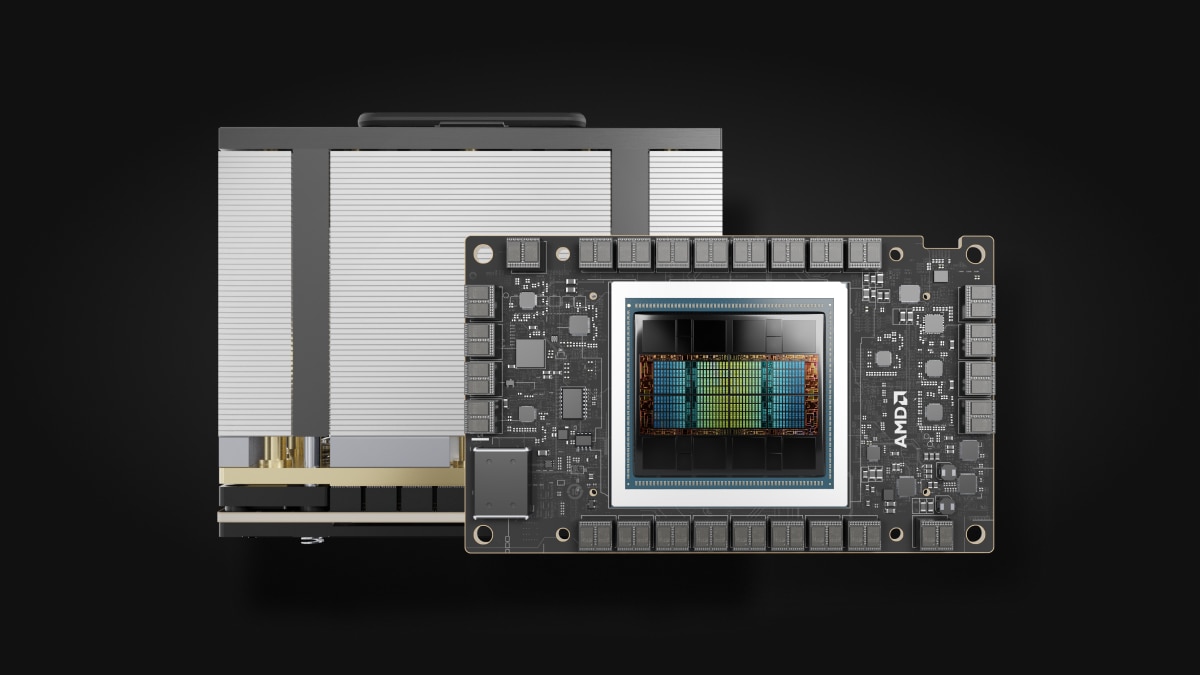
MI300X (full name AMD Instinct MI300X Accelerator, part of the "CDNA 3" family) is a data center GPU announced for release (GA) by AMD at December 6, 2023 at the "Advancing AI" event: per card 192GB HBM3 and 5.3TB/s The bandwidth figures are AMD's official 'best-in-class' claims[2], and it also carried the industry's largest single-card HBM capacity as of 2023; FP8 peak of 2.61 PFLOPs, full-chip ECC, and 153 billion transistors (a hybrid TSMC 5nm+6nm process, 304 Compute Units + 1216 Matrix Cores, per the official spec page[1]).
This was AMD's first genuine flagship-tier challenger in a data center market dominated by CUDA: at launch, AMD secured a whole row of ecosystem endorsements from Microsoft Azure, Meta, Oracle, Lenovo, and others[3]; the same-family MI300A (a fused CPU+GPU APU variant) pushed El Capitan to the top of the TOP500 as the world's fastest supercomputer in November 2024[5]—the MI300 family is the highest-profile generation in AMD's data center GPU history.
In the 2026 spot market, the MI300X plays the role of AMD's representative in the large-VRAM spot segment : the successor MI325X launched in October 2024 (256GB HBM3E, 6TB/s[6]), and MI300X has shifted from new product to legacy inventory and spot-market circulation. The core trade-off for selection comes down to one thing: the migration cost of moving existing CUDA production lines to the open ROCm software stack (with support for mainstream open-source frameworks like PyTorch and vLLM). This entry carries no market pricing band—there is no unified market snapshot for MI300X yet, actual price subject to the seller's quote 。
Use Cases FIT
AIXX Index (0–100): estimated by this Pedia via weighted public specifications — memory 40% + interconnect 30% + ecosystem 30%, with weights adjusted by use case. 90+ flagship tier · 75+ Excellent · 60+ usable · below 60 not recommended. The methodology is transparent and verifiable, and does not constitute a performance guarantee.
History HISTORY
December 6, 2023 , AMD announced general availability (GA) of the MI300 series at its "Advancing AI" event: the MI300X debuted with a "best-in-class" 192GB HBM3 / 5.3TB/s memory configuration, alongside the world's first data center APU MI300A , along with adoption endorsements from ecosystem partners including Microsoft Azure, Meta, Oracle, and Lenovo[2][3].
2024 ,Ecosystem adoption expands: Azure launches the MI300X VM series、Meta Jointly disclosed inference deployments based on MI300X with Oracle (AMD ecosystem messaging[3]),Dell、Supermicro、8-GPU OAM systems from OEMs such as Lenovo (e.g., Dell PowerEdge XE9680) become the mainstream delivery form (per each vendor's official product line). November 2024 , with the MI300A powering El Capitan to the top of the TOP500 as the world's fastest supercomputer[5]—a highlight moment for the MI300 family.
October 10, 2024 , the successor model MI325X Launch: memory increased to 256GB HBM3E with 6TB/s bandwidth, while compute specs stay in the same tier as MI300X (FP8 also at 2.61 PFLOPs[6])—from this point MI300X moved from new product into legacy inventory and spot-market circulation.
2026 , its spot market positioning took shape: the MI300X circulates in the second-hand and spot channels with a differentiated identity of "192GB large VRAM per card + open software stack," competing head-on with NVIDIA's H200 (141GB HBM3e). Cross-border circulation policies for high-end data center GPUs are still evolving; for procurement, defer to regulators' policies and professional advice (public reporting basis, not legal advice).
Technical Specifications SPECIFICATIONS
| Item | Specs (AMD Instinct MI300X · official figures) |
|---|---|
| GPU architecture | AMD CDNA 3 (chiplet design, hybrid TSMC 5nm + 6nm FinFET process) |
| Compute Units / Matrix Cores | 304 CUs / 1216 Matrix Cores · 19,456 stream processors |
| Peak engine clock | 2100 MHz |
| Board Memory | 192GB HBM3 · full-chip ECC |
| Memory Bandwidth | 5.3TB/s (8192-bit bus · 5.2GHz memory clock) |
| FP8(E5M2/E4M3) | 2.61 PFLOPs |
| FP16 | 1.3 PFLOPs |
| TF32 Matrix / FP32 | 653.7 TFLOPS / 163.4 TFLOPS |
| FP64 Matrix / FP64 | 163.4 TFLOPS / 81.7 TFLOPS |
| INT8 | 2.6 POPs |
| Last-level cache (LLC) | 256MB |
| GPU-to-GPU Interconnect | Infinity Fabric 8 links · 128GB/s per link |
| Host Interface | PCIe Gen5 x16 |
| Form factor / cooling | OAM module · passive cooling (Passive OAM) |
| Power / consumption | 54V UBB baseboard power · peak board power (TBP) 750W |
| Virtualization | SR-IOV support (one card split across multiple VMs) |
| Transistor count | 153 billion |
| Previous generation / successor | MI210(CDNA2 · 64GB)/ MI325X(256GB HBM3E) |
Specifications follow AMD's official product pages (October 2026 official snapshot[1], verified line-by-line against this entry's Spec Card spec_reference); 'Peak' figures are official nominal claims.
Generational reference · three AMD generations + NVIDIA baseline GENERATIONS
| Item | MI210 | MI300X | MI325X | H200 (reference) |
|---|---|---|---|---|
| Board Memory | 64GB HBM2e | 192GB HBM3 | 256GB HBM3E | 141GB HBM3e |
| Memory Bandwidth | 1.6TB/s | 5.3TB/s | 6TB/s | 4.8TB/s |
| Flagship precision | FP16/BF16 | FP8 | FP8 | FP8(Transformer Engine) |
| GPU-to-GPU Interconnect | 3 IF links · 100GB/s | 8 IF links · 128GB/s | 8 IF links · 128GB/s | NVLink 4 · 900GB/s |
| One-line buying advice | Previous-gen headroom · specific HPC | Large-VRAM spot · open stack | Successor purchase · 33% more VRAM | CUDA ecosystem · large-VRAM mainstay |
MI210/MI325X are listed with the same official snapshot basis as this entry's Spec Card[1][6]; see the H200 entry for the H200 comparison.
Family Members FAMILY
The MI300 family splits into three branches by "pure GPU / APU / memory generation"; the MI300X is the pure-GPU flagship, and the main members in 2026 spot circulation are:
Cooling & Deployment COOLING
The MI300X has only one deployment form in the official spec sheet: OAM module + passive cooling + 54V UBB baseboard power[1]. This means it never appears as "a single card" — eight MI300X modules are mounted on an OAM baseboard to form one complete system (the UBB backplane supplies 54V centrally), with total GPU full load around 6kW (estimated from 8×750W, excluding CPU and fans); the data center's power, busbars, and airflow must be planned at the rack level. What this means for buyers: buying an MI300X means buying a full-system solution — it won't fit into an ordinary air-cooled PCIe slot, so run the power numbers before retrofitting an older facility.
SR-IOV is a practical deployment card: a single card can be partitioned into multiple VM instances (per the official spec page[1]), combined with container orchestration for multi-tenant inference pools—splitting the large 192GB memory across different business groups delivers far better utilization than dedicated whole-system allocation.
Model Compatibility MODEL FIT
| Model / Scenario | Memory requirements (FP16 estimates) | MI300X deployment (8 GPUs, 1536GB) | AIXX Index |
|---|---|---|---|
| DeepSeek R1 full (671B) | FP16 ~1.3TB / FP8 ~690GB | 8 GPUs fit it comfortably — about 690GB in FP8 leaves ample headroom against 1536GB, and FP16 is borderline feasible; "full R1 on a single node" is the loudest selling point of the MI300X in the spot market | 82 |
| 70B-class open models | FP16 ~140GB | Single-card direct install — 192GB fits a 70B in FP16 with room to spare for KV cache; unlike 80GB-class cards which must start with two GPUs, communication overhead is eliminated entirely | 90 |
| 7B–14B class | FP16 ~14–28GB | Easy on a single card; rely on SR-IOV partitioning or multi-GPU concurrency for batch production lines | 88 |
| Scientific computing / FP64 simulation | Depends on mesh size | FP64 Matrix 163.4 TFLOPS plus 192GB of VRAM — a combination that "computes it and fits it" | 75 |
VRAM estimated as FP16 weights ≈ parameter count × 2 bytes (estimated, excluding KV cache and activation headroom); full R1 figures use the same basis as this AIXX Pedia's A100/H200 entries. The ROCm inference stack centers on open-source engines like vLLM/SGLang — verify your target framework's ROCm version compatibility before deployment.
Gallery GALLERY
Actual photos are added continuously as inspection batches are stocked; AI-generated images are never passed off as real photos.
Software & Ecosystem ECOSYSTEM
| Item | Requirements / Status |
|---|---|
| Software stack | ROCm (AMD's open software stack) — a primary support target since the MI300X launch; the current 6.x series is continuously updated |
| Training frameworks | Official PyTorch ROCm build supported; Megatron / DeepSpeed have community adaptations, less mature than the CUDA side |
| Inference engines | vLLM / SGLang and other mainstream open-source engines have ROCm support; TensorRT and other NVIDIA proprietary stacks are unavailable |
| Driver | amdgpu kernel driver (installed with ROCm); rocm-smi / amd-smi as system monitoring tools |
| Virtualization | SR-IOV officially supported[1], with mature multi-tenant partitioning solutions |
| Cloud ecosystem | Microsoft Azure, Oracle Cloud, and others offer MI300X instances (per AMD's ecosystem announcements[3]) |
| Operating system | Mainstream Linux distributions (Ubuntu / RHEL families, per the ROCm official support matrix) |
After two years of maturation, the ROCm ecosystem covers mainstream open-source training and inference stacks, but operator coverage and tuning manpower still trail CUDA — run benchmark validation on your target model before migrating. Software stack versions evolve over time; defer to AMD's official releases.
Purchasing & Inspection PROCUREMENT
MI300X procurement inspection points (three items):
The full six-item stress-test verdicts (MI300X-anchored values) are in this entry "How to Stress-Test" section.
How to Stress Test BENCH TEST
Six-item stress-test basis, all value verdicts anchored to the MI300X: unboxing identification → single-GPU Burn-in Test (750W Peak, ≤86°C with zero ECC errors = Pass) → full-system Full Load → memory bandwidth (rated 5.3TB/s, ≥85% = Pass) → Interconnect Bandwidth (rccl-tests bus bandwidth at standard) → inference throughput (≥80% of public benchmarks).
Shipping & Delivery LOGISTICS
OEM & Variants VENDORS
MI300X's system ecosystem secured a whole row of endorsements at launch[3], with 8-GPU OAM systems from various vendors as the mainstream delivery form:
| System Vendor | Representative Form Factor | Differentiators | Status as of 2026 |
|---|---|---|---|
| Dell | PowerEdge XE9680 (8-GPU OAM) | Globally Tier-1 service network; a volume workhorse for AI systems | One of the mainstays of spot supply and installed-base circulation |
| Supermicro | 8-GPU OAM systems (Air-cooled / Liquid-cooled) | Full range of form factors, fast delivery cadence | Spot circulation |
| Lenovo | 8-GPU OAM system | Enterprise-grade service network | Project-based circulation |
| Microsoft Azure | Cloud instances (ND MI300X series) | No on-site availability — a benchmark for renting in the cloud instead of buying | In operation (per AMD ecosystem coverage) |
Channel and cloud instance details follow vendors' official product lines[3], provided as a reference for comparing rental vs. purchase pricing.
Glossary Cards GLOSSARY
HBM3 Memory
Third-generation high-bandwidth memory. The MI300X carries 192GB HBM3 per card with 5.3TB/s bandwidth and full-chip ECC — the largest single-card HBM capacity in the industry at launch in 2023 (AMD's "best-in-class" claim); the previous-gen MI210 had 64GB HBM2e, and its successor MI325X offers 256GB HBM3E.
CDNA 3 and Chiplet Design
AMD's third-generation data center GPU architecture. The MI300X uses a chiplet design that packages multiple compute chiplets (XCDs) together with an I/O die (IOD), on a TSMC 5nm+6nm hybrid process, with 153 billion transistors and 304 compute units + 1216 Matrix Cores — chiplets are AMD's signature approach to managing advanced-process cost and yield.
Infinity Fabric
AMD's high-speed inter-GPU interconnect: the MI300X offers 8 links at 128GB/s each, with multi-GPU networking via the OAM baseboard; the corresponding collective-communication library on the software side is rccl (a ROCm port of NCCL). Under stress testing, the bus bandwidth reported by rccl-tests is a must-check metric for multi-GPU systems.
OAM and 54V UBB
OAM (OCP Accelerator Module) is the open-compute standard specification for accelerator modules; UBB (Universal Baseboard) is an 8-GPU baseboard powered centrally by a 54V busbar. The MI300X's 750W Peak power draw means it must ship as a complete system — baseboard power delivery and rack cooling are hard prerequisites for deployment.
SR-IOV
Single Root I/O Virtualization: splitting one physical card for direct use by multiple VMs. The MI300X officially supports SR-IOV (per the official spec page), and pairing it with 192GB of large VRAM for multi-tenant inference pools is a practical use case — partitioning functionality should be on the test checklist at procurement inspection.
ROCm
AMD's open compute software stack (ROCm = Radeon Open Compute): a collection of drivers, compilers, math libraries, and the HIP toolchain, with ROCm builds of mainstream open-source frameworks like PyTorch and vLLM. The ecosystem gap versus CUDA is the core variable in MI300X selection — pipelines the open-source stack can cover migrate smoothly, while pipelines deeply tied to NVIDIA proprietary components (such as TensorRT) carry high migration costs.
Limitations & Controversies LIMITS
- The Ecosystem Gap Is the Primary Variable : The ROCm-versus-CUDA gap isn't about "whether it runs" (mainstream open-source frameworks all run), but in operator coverage, tuning effort, and the depth of troubleshooting resources — migration costs should be counted in person-months, not days (per this library's inspection experience and public review consensus). Pipelines deeply bound to CUDA proprietary components should not force a migration just for the price difference.
- An Interconnect Generational Gap Versus NVIDIA Flagships : Infinity Fabric runs 8 links at 128GB/s each, and multi-GPU scalability depends on baseboard topology; NVIDIA's NVLink 4 already delivers 900GB/s per card (H200) — communication efficiency for cross-GPU tensor parallelism in large models is an item that demands serious stress testing in MI300X cluster proposals.
- 750W Power Draw and the Whole-System Barrier : Passive cooling plus 54V UBB baseboard power mean an 8-GPU system draws roughly 6kW at Full Load across its GPUs (estimated) — without a whole-system solution and data center retrofit budget, "buying cheap modules" is not a viable option.
- Residual-Value Pressure from the Successor : the MI325X launched in October 2024 (256GB HBM3E, 6TB/s, same compute tier[6]), with the MI400 series on AMD's public roadmap—MI300X spot price spreads should be tracked against the successor's trajectory, as its resale value curve runs steep.
- Cross-border trade policy variables : Export control policies on high-end data center GPUs to China continue to evolve, and the cross-border compliance status of the MI300 series shifts with policy changes (per public reporting) — this library notes this only as a policy-development reminder; specific determinations should follow regulatory policy and professional advice, and do not constitute legal advice.
Market Notes MARKET NOTE
MI300X spot supply is mostly whole-system solutions and channel inventory; configuration (system/module), condition, warranty, and channel terms make price dispersion large — no verifiable unified market snapshot is available yet, AIXX Pedia honesty principle: no market band; prices are subject to the seller's quote 。
Spot search: AIXX Exchange Hall › (Zero-commission Matching; no involvement in transactions; no knowledge of or speculation on transaction prices — hence data neutrality). This section will switch to a standard market band once enough snapshots accumulate.
Price milestone timeline MILESTONES
FAQ FAQ
Yes (on FP8 accounting): full R1 671B FP8 weights are about 690GB, and 8 MI300X cards offer 1536GB of VRAM in total — enough with ample headroom (FP16 at ~1.3TB is borderline); use the ROCm builds of vLLM/SGLang as the inference stack. "Full R1 on a single node" is its loudest selling point on the spot market.
Look at the software stack: MI300X wins on memory and bandwidth (192GB/5.3TB/s vs 141GB/4.8TB/s) with same-generation compute (both lead with FP8); but H200 has CUDA and NVLink 4 (900GB/s) behind it. For open-source-stack greenfield pipelines chasing large-memory value — MI300X; for installed pipelines deeply bound to CUDA seeking ecosystem peace of mind — H200.
The MI300X has no display outputs and its compute form factor isn't used for crypto mining, so the "was it mined on?" question carries little meaning; the real risks are aging from heavy data center workloads and refurbishment. The right approach: ask for the rack's load history and power-on hours, verify identification and serial numbers via rocm-smi, export ECC logs, and run the six-point stress test (memory bandwidth and rccl interconnect are the focus).
PyTorch (official ROCm build), vLLM, SGLang, and other mainstream open-source frameworks all run; NVIDIA proprietary components such as TensorRT are unavailable. We recommend running a baseline of your target model on ROCm before deployment — open-source stack coverage has improved fast over two years, but operator compatibility still needs case-by-case verification.
Normal circulation is as 8-GPU OAM systems (UBB baseboard + rack-level cooling + 54V busbar), with systems like the Dell XE9680 as the mainstream form; "loose modules" cannot operate independently outside a baseboard and airflow, so be wary of cheap loose cards. Procurement should insist on whole-system solutions and verify power/cooling provisions and accompanying documentation.
Related Entries SEE ALSO
Model comparison and selection COMPARE
References REFERENCES
- AMD official site — Instinct MI300X product page (primary spec source, verified 2026-10, consistent with this library's Spec Card snapshot) https://www.amd.com/en/products/accelerators/instinct/mi300/…
- AMD Newsroom — AMD Delivers Leadership Portfolio of Data Center AI Solutions with AMD Instinct MI300 Series (launch release, 2023-12-06) https://www.amd.com/en/newsroom/press-releases/2023-12-6-amd…
- AMD Newsroom — AMD Showcases Growing Momentum for AMD Powered AI (ecosystem release, 2023-12-06: Azure/Meta/Oracle/Lenovo) https://www.amd.com/en/newsroom/press-releases/2023-12-6-amd…
- GPU database — AMD Instinct MI300X (secondary source) https://www.techpowerup.com/gpu-specs/instinct-mi300x.c4179
- TOP500 — November 2024 list: El Capitan ranks No. 1 worldwide (powered by MI300A) https://www.top500.org/lists/top500/2024/11/
- AMD official site — Instinct MI325X product page (successor generation, 256GB HBM3E / 6TB/s) https://www.amd.com/en/products/accelerators/instinct/mi300/…
- Listing search — AIXX Exchange (Zero-commission Matching; no market snapshot for MI300X yet, actual price subject to the seller's quote) https://www.aixx.vip/hall.html?model=MI300X