AIXX Pedia › Model Entry › MI325X
MI325X
Overview OVERVIEW
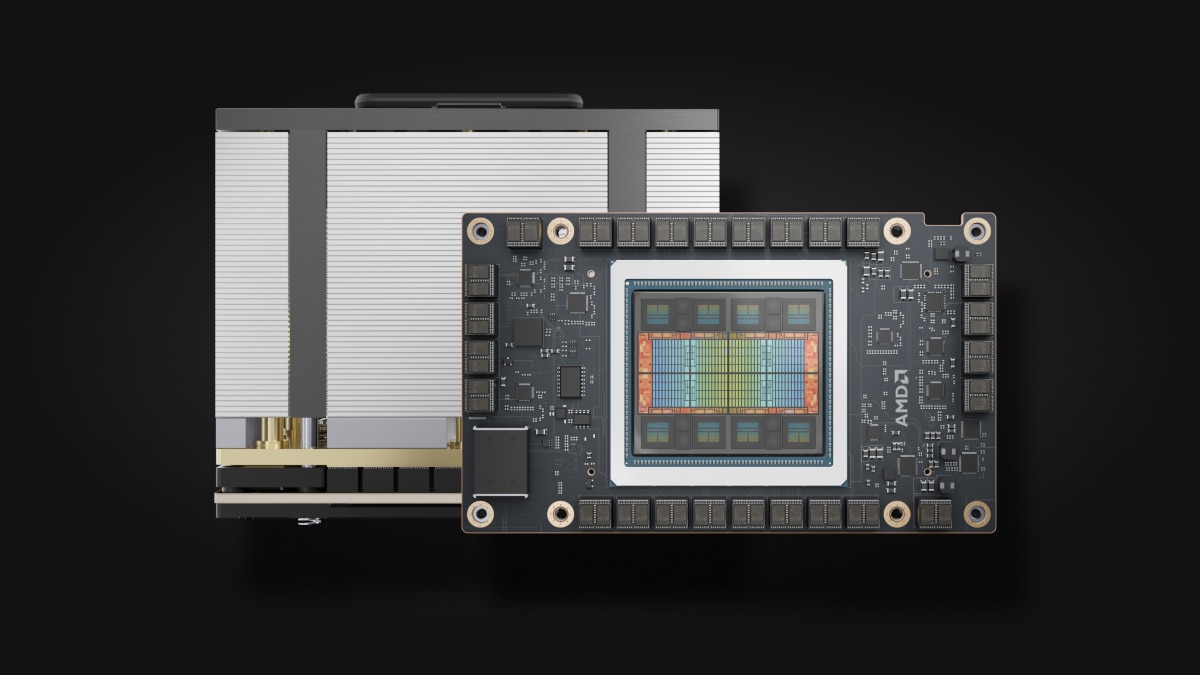
MI325X It's the new flagship of the AMD Instinct family with massive memory Launched in October 2024 — 256GB HBM3E memory per card and 6TB/s bandwidth (up from the MI300X's 192GB/5.3TB/s on both counts), FP8/INT8 performance of 2.61 PFLOPS in the same class as the MI300X, OAM module form factor, 1000W peak power draw, and networking over 8 Infinity Fabric links (per AMD's official spec snapshot [1]).
Its market story is AMD's answer to the "memory arms race" KV cache and long-context workloads in large model inference keep pushing memory requirements ever higher, and the MI325X's 256GB per-card memory opens a capacity gap over the NVIDIA H200 (141GB) — combined with the continued maturation of the ROCm ecosystem, it stands as AMD's flagship answer on the inference side for 2025–2026 (per AMD's product page [2]).
In the 2026 spot market, the MI325X circulates widely within complete system solutions: 8-GPU OAM systems are the mainstream delivery form. Three core questions before buying: the ROCm version support matrix for the card 、 the completeness of the system solution (UBB baseboard + 1000W power and cooling) 、 whether the price gap versus the MI300X matches the 33% memory increase . This entry carries no market band — actual price subject to the seller's quote.
Use Cases FIT
AIXX Index (0–100): Estimated in this Pedia via weighted public specs — memory 40% + interconnect 30% + ecosystem 30%.
History HISTORY
June 2024 At its Advancing AI event, AMD previewed the MI325X: 256GB of HBM3E and 6TB/s of bandwidth — the first time the 'one generation per year' memory arms race was laid out in the open (per AMD's announcement [2]).
October 10, 2024 The MI325X was officially launched and moved into mass production: same silicon as the MI300X (a tuned CDNA3 architecture) with a generational memory upgrade — 256GB vs 192GB is a 33% bump, and bandwidth goes from 5.3TB/s to 6TB/s (per AMD's official spec snapshot [1]).
2025-2026 , wide circulation: 8-GPU OAM system solutions (UBB baseboard, 1000W power and cooling) rolled out with cloud and AI computing center projects, and ROCm 6.x support for the MI325X matured — AMD's inference flagship entered the spot market (per this Pedia's compilation). Cross-border circulation policy is still evolving; for procurement, defer to competent authorities' policies and professional advice (per public reporting).
Technical Specifications SPECIFICATIONS
| Item | Specs (AMD Instinct MI325X · official) |
|---|---|
| GPU architecture | AMD CDNA3(TSMC 5nm | 6nm FinFET) |
| Board Memory | 256GB HBM3E |
| Memory Bandwidth | 6TB/s(8192-bit) |
| FP8 / INT8 | 2.61 PFLOPS / 2.6 POPs |
| FP16 | 1.3 PFLOPS |
| FP32 / FP64 | 163.4 TFLOPS / 81.7 TFLOPS |
| Stream processors / LLC | 19,456 / 256MB |
| GPU-to-GPU Interconnect | Infinity Fabric 8 links · 128GB/s per link |
| Host Interface | PCIe Gen5 x16 |
| Form factor / cooling | OAM module · Passive cooling |
| Power | 1000W Peak |
| Launch | 2024-10-10 (Advancing AI) |
Specifications are based on AMD's official snapshot (October 2026 data [1], verified item-by-item against the Spec Card).
Two generations of AMD flagships compared TWO GEN
| Item | MI300X | MI325X (this entry) |
|---|---|---|
| Memory | 192GB HBM3 | 256GB HBM3E |
| Bandwidth | 5.3TB/s | 6TB/s |
| FP8 | 2.61 PFLOPS | 2.61 PFLOPS |
| Power | 750W Peak | 1000W Peak |
| One-line buying advice | Value on existing stock | New purchase, memory first |
See the MI300X entry for details; same compute class, with memory and power upgrades being the MI325X's main upgrade axes (per each official snapshot).
Family Members FAMILY
The Instinct family is tiered by generation and positioning; the MI325X is the current memory flagship:
Cooling & Deployment COOLING
The MI325X is an OAM module + passive cooling + 1000W peak — Cooling leaves only one viable path: full-system solutions. An 8-GPU UBB baseboard system with rack-level airflow or Liquid-cooled support, with rack-level thermal and power planning (8kW-class at 1000W×8, via the 54V power-bus UBB design) as an integrated exercise (per the official Spec Card snapshot [1]). A plain PCIe slot-in card simply doesn't exist — buying the MI325X means buying the full-system solution.
Three pre-deployment checks: Power (8kW-class GPU total plus system overhead; verify rack power against the system rating), Cooling (airflow or liquid cooling rated for 1000W per card), ROCm version (the 6.x support matrix for the MI325X, framework compatibility checks, per the ROCm entry).
Model Compatibility MODEL FIT
| Model / Scenario | Memory requirements (FP16 estimates) | MI325X deployment guide | AIXX Index |
|---|---|---|---|
| 70B-class inference (FP16) | ~140GB | Single-card 256GB direct fit plus generous KV cache headroom | 90 |
| DeepSeek R1 full (671B) | FP8 ~690GB | 8 cards with 2TB fit comfortably with ample headroom (FP8 path subject to ROCm framework support) | 86 |
| Ultra-long-context inference | KV cache scales linearly with length | 256GB of KV cache room is the MI family's signature strength | 90 |
| Large model training | Multi-node, multi-cluster | Trainable on 8-GPU IF networking; factor in tuning labor (per the ROCm entry) | 78 |
Memory estimated as FP16 weights ≈ parameter count × 2 bytes (estimate); FP8 path subject to actual ROCm framework support.
Gallery GALLERY
Software & Ecosystem ECOSYSTEM
| Item | Requirements / Status |
|---|---|
| Software stack | ROCm 6.x (support matrix per official docs, per the ROCm entry) |
| Frameworks | PyTorch ROCm build / vLLM / SGLang — inference ecosystem usable (spillover from MI300X-family cases) |
| Virtualization | SR-IOV support (per the official spec snapshot [1]) |
| Monitoring tools | rocm-smi / amd-smi |
| Comparison | See the ROCm entry migration framework for the CUDA ecosystem comparison |
Ecosystem info compiled from public sources; versions evolve over time — defer to AMD's official releases.
Purchasing & Inspection PROCUREMENT
Three inspection points when buying an MI325X:
Acceptance Quick Reference QUICK CHECK
Four-step MI325X check:
Shipping & Delivery LOGISTICS
Glossary Cards GLOSSARY
HBM3E
The enhanced version of third-generation high-bandwidth memory: 256GB HBM3E and 6TB/s per MI325X card — AMD's answer to the "one generation per year" memory upgrade cadence (vs the MI300X's 192GB HBM3).
OAM module
OCP Accelerator Module: the open-compute accelerator module standard — the MI325X's OAM form factor means it must ship with a UBB baseboard as a complete system; off the baseboard it cannot operate independently.
1000W Peak
The MI325X's board-level peak power: a big jump from the MI300X's 750W — 8kW-class cooling and power for 8 cards per system is a hard constraint in data center planning (official snapshot).
UBB baseboard
Universal Baseboard: the unified baseboard for 8 OAM modules — carrier for the 54V power busbar and IF interconnect, the physical chassis of the MI325X system solution.
Limitations & Controversies LIMITS
- The ROCm migration ledger : price CUDA legacy line migration in person-months of total cost (same framework as the ROCm entry) — the MI325X's memory advantage only justifies the move if it outweighs migration costs (per this Pedia's compilation).
- The 1000W power data center threshold : 8-GPU systems at 8kW-class GPU power plus system overhead — air-cooled rack density limits and liquid-cooling retrofit budgets must be planned upfront (per this Pedia's compilation).
- Positioning: same compute, more memory : FP8 compute in the same class as the MI300X (2.61 PFLOPS) — for pure compute needs, used MI300X stock is cheaper; only memory-bound workloads justify the MI325X (per each official snapshot).
- Second-hand market still nascent : The MI325X only shipped in late 2024 and second-hand market benchmarks haven't formed — memory health and IF link status are the inspection focus (per this Pedia's inspection experience).
- Cross-border trade policy variables : AMD high-end cards also fall under export-control contexts (per public reporting) — for cross-border procurement compliance, defer to professional advice; this Pedia does not constitute legal advice.
Market Notes MARKET NOTE
The MI325X circulates mainly as 8-GPU OAM systems, with condition and channel driving price differences — no verifiable unified market snapshot yet; AIXX Pedia honesty principle: no market band; prices are subject to the seller's quote 。
Spot search: AIXX Exchange Hall › (Zero-commission Matching, hence neutral data).
Price milestone timeline MILESTONES
FAQ FAQ
For memory-bound workloads (ultra-long context / large KV cache), pick the MI325X: 256GB vs 192GB is a 33% increase, with 6TB/s bandwidth; for budget-sensitive scenarios, MI300X stock is cheaper at the same compute class (both 2.61 PFLOPS FP8) — note the MI325X's 1000W vs 750W power, and plan data center capacity accordingly.
On FP8, yes: full R1 in FP8 is about 690GB, and 8 MI325X cards with 2TB total fit it with ample headroom — use the ROCm builds of vLLM/SGLang for the inference stack and run benchmarks before deployment.
They can't run standalone: an OAM module cannot work off a UBB baseboard — the MI325X circulates as 8-GPU systems; be highly wary of module provenance and solution completeness when offered as "cheap loose cards."
Four steps: rocm-smi identity check (256GB / serial number) → memory bandwidth test (6TB/s class, ≥85% = Pass, estimate) → 8-GPU rccl-tests interconnect → 1000W Full Load Burn-in Test for temperature and ECC. Verifying the ROCm version support matrix is a procurement prerequisite.
A dilemma of memory vs ecosystem: the MI325X's 256GB beats the H200's 141GB on memory, but the H200 rides the CUDA ecosystem with stronger NVLink 900GB/s interconnect — new open-source-stack lines can evaluate the MI325X, while for CUDA legacy lines the H200 carries zero migration cost.
Related Entries SEE ALSO
Model comparison and selection COMPARE
References REFERENCES
- AMD Official Site — Instinct MI325X Product Page (primary spec source; official snapshot verified against this entry's Spec Card, 2026-10) https://www.amd.com/en/products/accelerators/instinct/mi300/…
- AMD Newsroom — MI325X Launch Coverage (Advancing AI) https://www.amd.com/en/newsroom.html
- AMD Official Documentation — ROCm Documentation Site (support matrix) https://rocm.docs.amd.com/
- Marketplace Search — AIXX Exchange (Zero-commission Matching; no MI325X price snapshot available yet, actual price subject to the seller's quote) https://www.aixx.vip/hall.html?model=MI325X