SECTIONS
EDITIONS
NETWORK
Spec Card SPEC CARD
AMD Instinct MI325X
256GB HBM3E at 6TB/s, a bigger-cup variant on the same die as the MI300X, with headroom to fit a 70B-parameter model on a single card; 1TB-class power draw requires dedicated server-room power delivery; the new-generation large-memory inference workhorse
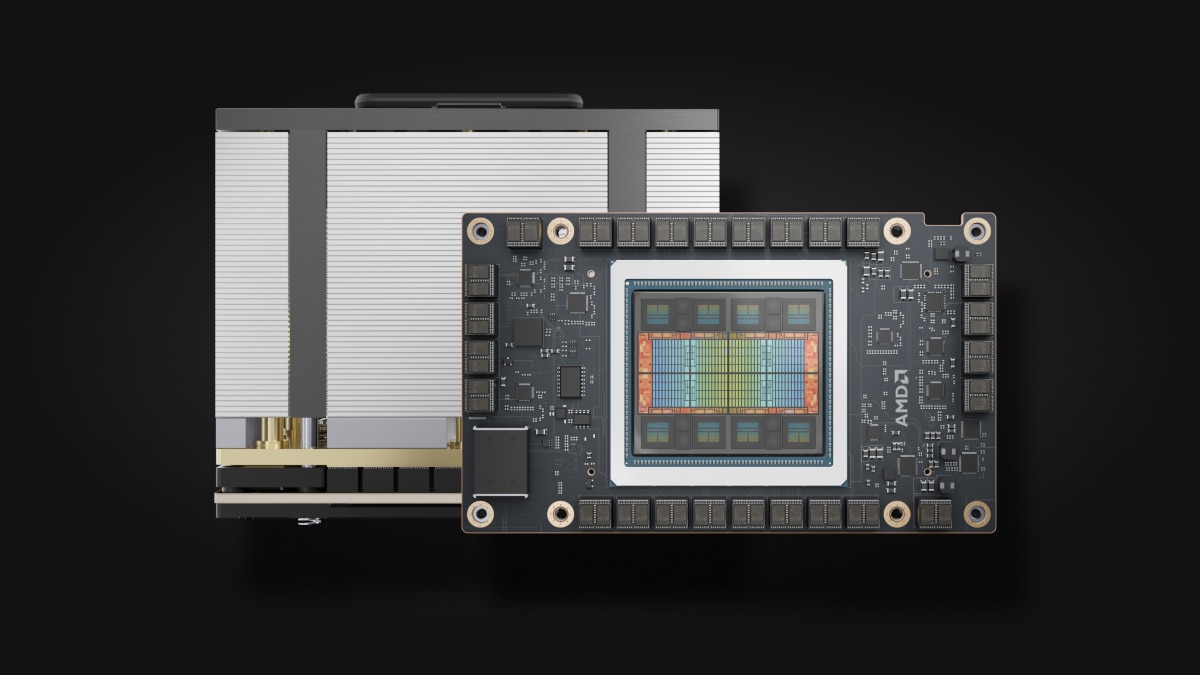
AMD official product image
Overview
The AMD Instinct MI325X is AMD's CDNA3-based data center accelerator, serving as the memory-expanded upgrade in the MI300X family: it uses the same TSMC 5nm+6nm hybrid process and 19,456 stream processors, with memory upgraded to 256GB HBM3E, delivering 6TB/s of memory bandwidth over an 8192-bit bus (up from 192GB HBM3 and 5.3TB/s on the MI300X), while FP8 peak compute stays at 2.61 PFLOPs within the same tier. The card comes in OAM module form with 1000W peak board power, offers 8 Infinity Fabric links (128GB/s per link) for multi-GPU networking, and connects to the host via PCIe 5.0 x16 — targeting large-model inference and training scenarios that demand massive memory capacity.
Core Specs
| Architecture | CDNA3 |
| Memory | 256 GB |
| Memory Type | HBM3E |
| Memory Bus Width | 8192-bit |
| Memory Bandwidth | 6 TB/s |
| FP8 compute | 2.61 PFLOPs |
| FP16 Performance | 1.3 PFLOPs |
| FP32 Performance | 163.4 TFLOPs |
| FP64 Performance | 81.7 TFLOPs |
| INT8 Performance | 2.6 POPs |
| TBP power draw | 1000W Peak |
| Interconnect | PCIe® 5.0 x16 |
| Infinity Fabric Links | 8 |
| Infinity Fabric Bandwidth | 128 GB/s |
| Stream Processors | 19,456 |
| Form Factor | OAM Module |
| Last-level cache (LLC) | 256 MB |
| Process | TSMC 5nm | 6nm FinFET |
Specs verified against official documentation ( official benchmarks , updated 2026-10-09) · actual price subject to the seller's quote
Use Cases
- Single-card hosting of ultra-large parameter models: 256GB of HBM3E can hold weights of a tens-of-billions-parameter LLM on one card, leaving ample KV cache headroom for long-context workloads and reducing the communication overhead of multi-GPU tensor parallelism
- Large-model online inference serving: 2.61 PFLOPs of FP8 compute delivers high-throughput inference, and 6TB/s of memory bandwidth helps ease the decode bottleneck under large-batch concurrency — well suited to production-grade inference services
- Multi-GPU training and cluster scaling: 8 Infinity Fabric links support high-speed multi-GPU interconnect, enabling 8-GPU systems on OAM baseboard designs for large-model training and fine-tuning
- High-performance computing: 81.7 TFLOPs of FP64 double-precision performance supports traditional HPC workloads such as computational fluid dynamics and weather simulation
Same-Family Models
| Model | Memory | Power |
|---|---|---|
| AMD Radeon PRO W7900 Compare | 48GB GDDR6 with ECC + Infinity Cache 96MB | 295W | 2×8pin | Recommended PSU 750W |
| AMD Instinct MI100 Compare | 32GB HBM2 (Full-Chip ECC, 4 stacks) | 300W Peak (TDP, passive cooling) |
| AMD Instinct MI300X Compare | 192 GB | 750W Peak |
| AMD Radeon Instinct MI50 Compare | 16GB or 32GB HBM2 (Full-Chip ECC, two variants) | 300W Peak TDP (2x8-Pin external power) |
| AMD Instinct MI455X Compare | 432GB HBM4 | — |
| AMD Instinct MI250X Compare | 128GB HBM2e (Full-Chip ECC, combined across dual dies) | 500W (TDP) | 560W Peak |
Video Overview VIDEO
Procurement & Inspection Notes
- Confirm the system form factor: the MI325X is a passively cooled OAM module that relies on a UBB baseboard and forced airflow from the chassis — it cannot be dropped into a standard PCIe air-cooled slot. Verify server system compatibility before purchasing
- Budget for power and cooling headroom: peak board power reaches 1000W (up from 750W on the MI300X). For multi-GPU deployments, itemize and verify rack power delivery, busbars, and cooling capacity
- Verify software and interconnect health on acceptance: check the ROCm driver version's support coverage for this model, review memory ECC logs for anomalies, and require the seller to provide Infinity Fabric link connectivity and Full Load stability test reports
FAQ
How large a model can a single MI325X run?
The 256GB of HBM3E can fully hold the weights of a tens-of-billions-parameter LLM on a single card, with KV cache room to spare for long-context inference; larger models can be sharded across multiple GPUs via tensor parallelism over the 8 Infinity Fabric links.
What are the main differences between the MI325X and the MI300X?
Core compute specs are identical (2.61 PFLOPs FP8 on both); the differences center on memory: the MI325X carries 256GB HBM3E at 6TB/s, while the MI300X has 192GB HBM3 at 5.3TB/s. Peak board power also rises from 750W to 1000W on the MI325X. In short: same compute tier, more memory.
What to watch for when buying MI325X units on the spot market?
This model circulates mainly as complete systems or baseboard solutions. When purchasing, confirm OAM module and UBB baseboard matching, ensure the power design supports 1000W peak draw, verify the ROCm software stack version and memory ECC records, and request multi-GPU interconnect and Full Load Burn-in Test logs.
Data updated 2026-10-09 · Go to In-depth Entry Editorial Policy workflow
Editorial Constitution Summary
Every claim sourcedDrawbacks always stated · corrections publicly loggedNo paid entries acceptedZero traffic-funneling or sales elements within entriesMarket data attached only as data modulesMarket data source: AIXX Exchange · © 2026 AIXX Pedia · An AIXX Product