AIXX Pedia › Model Entry › AMD Instinct MI355X
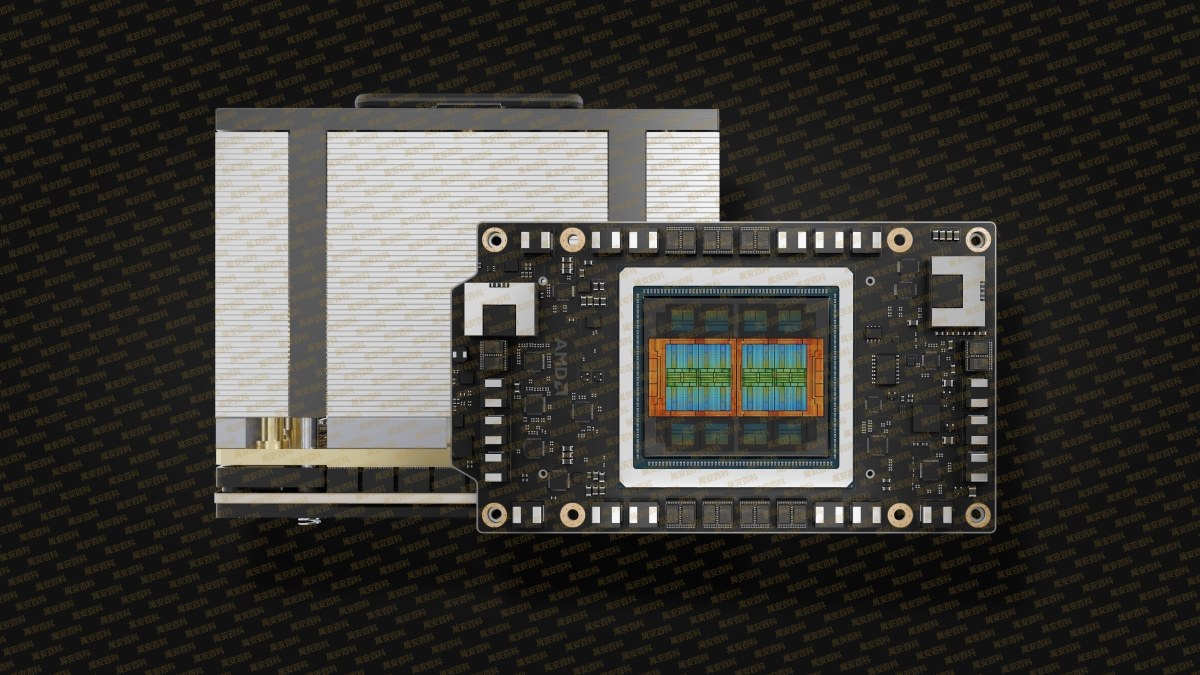
AMD Instinct MI355X
Overview OVERVIEW
AMD Instinct MI355X Released by AMD at the June 12, 2025 "Advancing AI" event as a datacenter AI flagship accelerator card : CDNA 4 architecture, 288GB HBM3E large memory capacity (supplied by Micron/Samsung), 8TB/s bandwidth (8192-bit wide) and 1400W Liquid-cooled Power draw — officially positioned as "a high-density compute flagship for large-scale AI training and inference", going head-to-head with the NVIDIA B300[1].
Its biggest trump card is memory capacity and low-precision compute : 288GB per card, on par with the B300 and 12.5% more than the previous-gen MI325X (256GB); it supports MXFP6/MXFP4 Microscaling formats (AMD officially touts FP4/FP6 data types as its generational inference selling point[3]); across an eight-card platform 2.3TB HBM3E . Third-party benchmarks (SemiAnalysis InferenceMAX, AMD Signal65 methodology) show it is competitive with the B300 on cost per million tokens it is competitive with the B300, and even holds the advantage on a TCO basis[5].
The China-market channel must be addressed first :MI355X not received export licenses for China (After the April 2025 tightening of export controls, AMD pivoted to the China-market Variant MI308 and obtained a license in late 2025[7]) — on legitimate mainland China channels, the MI308/H20 and compliant derivatives dominate; the MI355X is only seen in overseas markets. This is the first watershed of any procurement decision.
Use Cases FIT
AIXX Index (0–100): estimated by this Pedia via weighted public specifications — memory 40% + interconnect 30% + ecosystem 30%, with weights adjusted by use case. 90+ flagship tier · 75+ Excellent · 60+ usable · below 60 not recommended. The methodology is transparent and verifiable, and does not constitute a performance guarantee.
History HISTORY
In October 2024 , AMD previewed the MI350 series roadmap (CDNA 4 architecture, 288GB HBM3E, H2 2025 launch) at its Advancing AI event, just as the MI325X launched.
April 2025 , US export controls on China tightened: the MI350 series, including the MI355X, received no China license, and AMD publicly booked roughly $1.5 billion Inventory write-downs and a pivot to the China-market Variant MI308[7].
On June 12, 2025 at its "Advancing AI" event, AMD officially launched the MI350 series (MI350X/MI355X): AMD claims up to 40x inference improvement over the MI300X (on MXFP4 figures[2]); media reported MI355X pricing raised by roughly 70% to roughly $25,000 per card (public reporting figures[6]).
August 2025 ). AMD and NVIDIA successively reached arrangements with the US government to remit 15% of China chip-sale revenue arrangement in exchange for continued licensing (public reporting figures[8]); the MI308 obtained its China license in late 2025.
2026 the MI355X is ramping among overseas cloud providers and AI infrastructure customers, with third-party figures pitting its inference cost directly against the B300[5]; the China channel remains MI308/compliant derivatives.
Technical Specifications SPECIFICATIONS
| Item | Specifications (MI355X · AMD official figures, verified 2026-10[1]) |
|---|---|
| GPU architecture | AMD CDNA 4 (4th-gen data center architecture, official whitepaper[3]) |
| Compute Units | 256 Compute Units · 16,384 stream processors (third-party spec database figures[10]) |
| Board Memory | 288GB HBM3E (Micron/Samsung, 8 stacks) |
| Memory Bandwidth | 8TB/s (8192-bit, official figures[1]) |
| Low-precision formats | MXFP6 / MXFP4 (CDNA 4 generational support, official figures[3]) |
| GPU-to-GPU Interconnect | 4th-gen Infinity Fabric · over 1TB/s (official wording "over 1 TB/s"[1]) |
| Host Interface | PCIe Gen 5 |
| Power | 1400W (default for the Liquid-cooled OAM form factor; official figures[1]) |
| Form Factor | OAM (Open Accelerator Module) · Liquid-cooled cold plate |
| Eight-card platform | 2.3TB HBM3E total memory (official figures[1]) |
| Previous gen / counterpart product | MI325X (256GB, +12.5% generational gain) / NVIDIA B300 (288GB, same-capacity counterpart) |
Specifications per the AMD official product page (verified 2026-10[1]); CU/stream processor counts per third-party spec databases[10]; the official page describes FP4/FP6 compute as "generational support" without listing per-precision TOPS — we recommend verifying with rocm-smi before purchase.
Selection comparison · MI355X vs B300 CONTEXT
| Item | AMD MI355X | NVIDIA B300 |
|---|---|---|
| Board Memory | 288GB HBM3E | 288GB HBM3e |
| Board bandwidth | 8TB/s | ~8TB/s |
| GPU-to-GPU Interconnect | Infinity Fabric · over 1TB/s | NVLink 5 · 1.8TB/s |
| Power / cooling | 1400W · Liquid-cooled OAM | ~1400W class · NVL8 Air-cooled/Liquid-cooled |
| Software ecosystem | ROCm 7 (open-source path) | CUDA (de facto standard) |
| China channel | No license (MI308 Variant substitute) | H20/compliant derivatives in circulation |
| One-line buying advice | Inference TCO dark horse · overseas markets | Ecosystem default · flagship new purchases |
Comparisons are based on public specs and third-party benchmarks[5]; for ecosystem impact on real workloads, we recommend trial runs of your own models on both ROCm/CUDA stacks.
Family Members FAMILY
The MI350 series splits into three branches by cooling and target market:
Cooling & Deployment COOLING
The MI355X defaults to a 1400W Liquid-cooled cold plate (OAM) form: 1400W per card alone, with eight-card platform system power heading past 12kW — a liquid-cooling loop (CDU/cold plates/piping) is a hard deployment prerequisite , and air-cooled server rooms cannot host it directly. Without liquid cooling, choose the MI350X Air-cooled version (with corresponding performance discount). Power delivery follows the OAM platform spec, supplied integrally by the Server OEM / Integrator — no per-card wiring.
At rack level: eight-card OAM platforms (UBB) ship with liquid cooling distribution units as a set; the server room needs space for CDU installation and primary/secondary loops. Factor the upfront engineering and cost of liquid-cooling retrofit into the purchase decision alongside card pricing (see "Procurement & Acceptance").
Model Compatibility MODEL FIT
| Scenario | Fitment figures for a single 288GB card (estimated: weights × precision + KV/framework overhead; method detailed in the selector) |
|---|---|
| DeepSeek-class MoE inference | Full residency of sparse models at the hundreds-of-billions scale: 288GB large memory + high bandwidth is MoE's natural home turf (third-party figures[5]) |
| Full DeepSeek FP8 inference | FP8 weights ≈ hundreds of GB: loaded on one card with headroom for long context and concurrency |
| MXFP4 Quantization inference | Double model capacity per load or double throughput (CDNA 4 generational formats, official figures[3]) |
| Large-model fine-tuning | LoRA/QLoRA feasible at large parameter counts; full-parameter training is an eight-card platform scenario |
| FP64 HPC | FP64 figures listed on the official page (see spec table[1]); HPC applications per the ROCm certification list |
Figure basis: memory usage ≈ parameter count × bytes per parameter (FP16=2B / FP8=1B / FP4=0.5B), with KV and framework overhead counted separately; same source as the selector's "VRAM math" and independently verifiable.
Gallery GALLERY
The MI355X is a Liquid-cooled OAM module, and official renders are limited — for system/cluster form factors, see the AMD CDNA 4 whitepaper[3] and OEM partner materials.
Video Overview VIDEO
Video walkthrough of this entry is in the production queue (see the video slot schedule for Chinese/multilingual workflow) — this section updates automatically once it goes live.
Software & Ecosystem ECOSYSTEM
The software stack runs on ROCm 7 (AMD's open-source route): official PyTorch/TensorFlow/JAX support, native adaptation in vLLM/SGLang inference frameworks (third-party benchmark figures[5]), portable Triton kernels. The ecosystem gap versus CUDA is honestly the largest discount factor: ROCm coverage of long-tail frameworks/operators/commercial software is still catching up, and running your own model stack on ROCm before purchase is essential — this matters more for delivery than card price.
Cluster management uses AMD's suite (ROCm/SSO/AMDMonitor), with the AMD Device Plugin in the K8s ecosystem; major customers (overseas cloud providers) have scale deployments. We recommend explicitly writing enterprise support contracts and ROCm upgrade cadence into procurement agreements.
Purchasing & Inspection PROCUREMENT
Common risks
For high-value OAM platform purchases, third-party inspection and on-arrival testing are recommended, verifying that reports match serial numbers.
How to Stress Test BENCH TEST
AMD benchmarking tools: bundled with drivers rocm-smi (topology / power / temperature), AMD official rocminfo , open-source Burn-in Test gpu-burn (ROCm version) , Measured bandwidth rocm-bandwidth-test , interconnect stress testing rccl-tests (ROCm version of nccl-tests). General criteria: no throttling during Burn-in Test with liquid-cooling inlet temperature at spec, HBM Measured Bandwidth close to the official 8TB/s rating, and zero ECC errors throughout.
Cross-benchmarks against NVIDIA machines reference the publicly available SemiAnalysis InferenceMAX figures[5]; a verdict piece dedicated to this card is in production.
Shipping & Delivery LOGISTICS
| Stage | Key Points |
|---|---|
| Form Factor & Weight | OAM liquid-cooled module · Primarily delivered as complete eight-card UBB platforms; module weight per platform vendor's measurements |
| Packaging | Factory anti-static bag plus cold plate port protective caps; liquid-cooling quick connectors must be kept free of contamination and impact in transit |
| Cross-border Compliance | US-origin AI accelerators are export-control-sensitive items—no license for MI355X to China; cross-border transfers require full compliance documentation throughout |
| Insurance | Insure at full value (public reporting puts a single card at roughly the $25,000 level[6]); consider adding liquid-cooling interface leak coverage |
OEM & Variants VARIANTS
| Variants / OEM | Form Factor & Positioning |
|---|---|
| MI355X | 1400W liquid-cooled OAM · Series flagship (AMD official design, OEM platform integration) |
| MI350X | 1000W-class Air-cooled OAM · an option for sites without liquid cooling (official figures[1]) |
| MI308 | China-market Variant · MI300-line compliant down-spec · China license obtained (public reporting figures[7]) |
| OAM platform systems | Eight-card UBB platforms from Supermicro / Dell / HPE / Lenovo and others (public reporting figures[6]) |
Limitations & Controversies LIMITS
- No License for China : the MI355X has not received a China export license and is unavailable through legitimate mainland channels — AMD supplies the Chinese market with the MI308, and the performance gap between the two product lines is an objective fact[7].
- 1400W liquid-cooling hard requirement : cannot be deployed directly in Air-cooled data centers; liquid-cooling retrofit is a hidden major cost—choose MI350X if no liquid cooling is available (with a performance discount).
- ROCm ecosystem gap : given CUDA's de facto standard status, ROCm coverage of long-tail operators, frameworks, and commercial software is still catching up—migration costs can swallow the hardware price gap; judge by trials on your own stack.
- Interconnect Bandwidth positioning : officially stated GPU-to-GPU Interconnect is "over 1TB/s", below the B300 NVLink 5's 1.8TB/s — the interconnect gap in large-scale tensor-parallel scenarios is an objective fact[1].
- 15% revenue remittance arrangement : from August 2025, AMD/NVIDIA remit 15% of China chip sales revenue to the US government in exchange for licenses (public reporting figures[8]) — policy volatility is a long-term supply chain variable.
Market Notes MARKET
| Date | Type | Market | Price Band | Basis |
|---|---|---|---|---|
| 2026-10 | Channel Reference | Overseas | Public reporting puts it at roughly $25,000/card (media reports of a ~70% price increase[6]; actual price subject to the seller's quote) | AMD has no official standing list price |
| 2026-10 | Cloud rental reference | Overseas Clouds | MI300X at roughly $2.39/GPU·hour (third-party figures[5]) | MI355X cloud pricing to be observed once services launch |
| 2026-10 | Marketplace Status | Mainland China | No legitimate channel · Not applicable | No license for China; Marketplace Search › |
Caveat: this database has no transaction data for this model; "public reporting figures" reflect media-relayed asking prices — neither official list prices nor transaction prices — and do not constitute any basis for a deal. Market and inventory: AIXX Exchange (Zero-commission Matching; not a party to transactions).
Timeline MILESTONES
| Time | Event |
|---|---|
| 2024-10 | Advancing AI event previews MI350 roadmap (CDNA 4 · 288GB · H2 2025) |
| 2025-04 | China export controls tighten: MI350 series unlicensed; AMD books ~$1.5B charge and pivots to MI308[7] |
| 2025-06-12 | Advancing AI event launches MI350 series (MI350X/MI355X); media report pricing up ~70% to roughly $25,000[2][6] |
| 2025-08 | AMD/NVIDIA reach a 15% revenue remittance arrangement with the US government for China sales (public reporting figures[8]) |
| Late 2025 | MI308 obtains China license and begins shipments; MI355X ramps in overseas markets[7] |
| 2026-01-15 | BIS moves H200/MI325X China export review to a case-by-case regime (public reporting figures[7]) |
FAQ FAQ
Related Entries SEE ALSO
References REFERENCES
| [1] | AMD official · Instinct MI355X product page (specs: 288GB HBM3E / 8TB/s / 1400W / 2.3TB per eight-card platform / over 1TB/s interconnect) · https://www.amd.com/en/products/accelerators/instinct/mi350/ (verified 2026-10) |
| [2] | AMD Advancing AI event · MI350 series launch (2025-06-12, inference performance figures) · https://www.amd.com/en/events/advancing-ai (verified 2026-10) |
| [3] | AMD CDNA 4 architecture whitepaper (MXFP6/MXFP4 and architecture details) · https://www.amd.com/content/dam/amd/en/documents/instinct-te (verified 2026-10) |
| [4] | AMD official · ROCm 7 documentation and ecosystem · https://rocm.docs.amd.com/ (verified 2026-10) |
| [5] | SemiAnalysis · InferenceMAX benchmarks and TCO figures (MI355X vs B300) · https://inferencex.semianalysis.com/chips/mi355x (third-party figures) |
| [6] | Media reports · MI350 pricing up ~70% to roughly $25,000 per card (2025, publicly reported figures) · https://www.tomshardware.com/pc-components/gpus (per public reporting) |
| [7] | Public reports · China export controls and MI308 license (April 2025 tightening / licensed late 2025 / January 2026 BIS case-by-case review) · https://www.reuters.com/technology/ (per public reporting) |
| [8] | Public reports · AMD/NVIDIA 15% China sales revenue remittance arrangement (August 2025) · https://www.reuters.com/technology/ (per public reporting) |
| [9] | Selector tool · VRAM budgeting methodology (parameters × precision + KV/framework overhead) · /wiki/xuanxing.html (this site's methodology) |
| [10] | Third-party spec databases · CU/stream processor figures (256 CU / 16,384 SP) · https://www.techpowerup.com/gpu-specs/instinct-mi355x.c4309 (third-party figures) |
Specs are anchored to AMD's official pages; "publicly reported figures" entries are media/channel relays that this database does not vouch for—base procurement decisions on official documents and hands-on testing.