SECTIONS
EDITIONS
NETWORK
Spec Card SPEC CARD
AMD Instinct MI300X
192GB HBM3 with 5.3TB/s bandwidth fits inference for 70B-parameter large models on a single card, making it the most widely circulated AMD flagship on the used and spot markets and the best value for large model inference
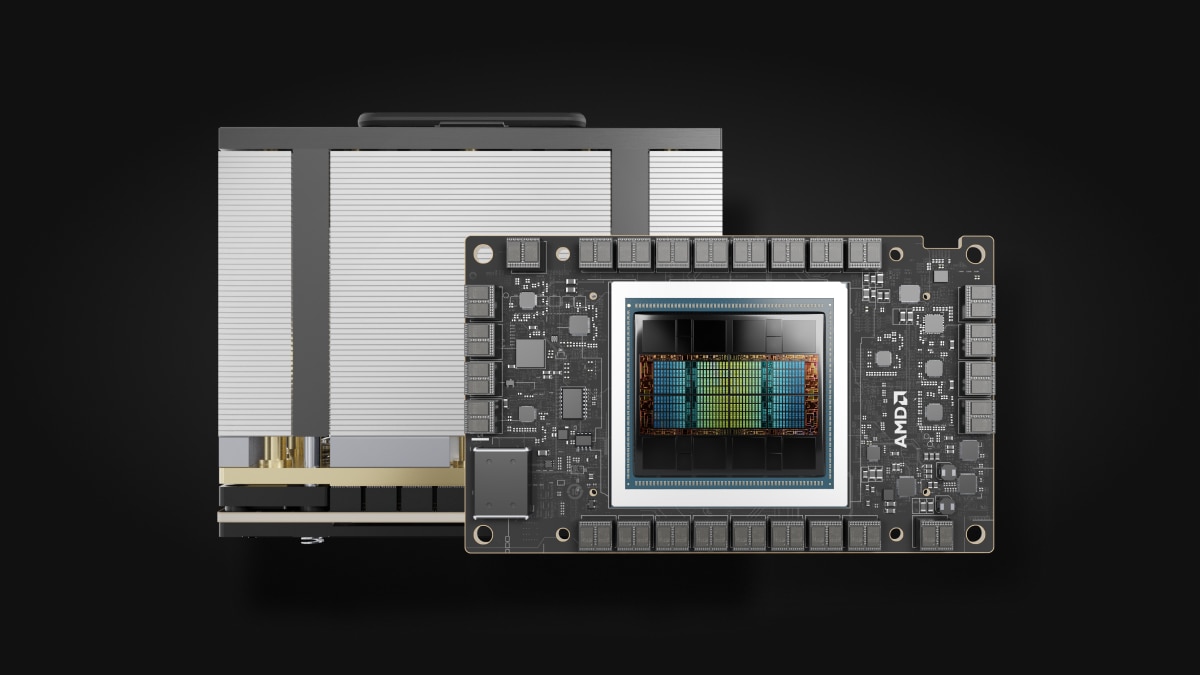
AMD official product image
Overview
AMD Instinct MI300X is a CDNA3-architecture data center accelerator built on a hybrid TSMC 5nm and 6nm process, integrating 19,456 stream processors, 304 compute units, and 1,216 matrix cores. Its defining feature is 192GB of HBM3 memory with an 8192-bit memory interface and full-chip ECC, allowing a single card to hold the weights and KV cache of large language models. For interconnect, it provides 8 Infinity Fabric links and supports multi-card networking for scaling. The card ships as a passive-cooled OAM module, connects to the host via PCIe 5.0 x16, and is typically used for large model inference, training, and HPC workloads.
Core Specs
| Architecture | CDNA3 |
| Memory | 192 GB |
| Memory Type | HBM3 |
| Memory Bus Width | 8192-bit |
| Memory Bandwidth | 5.3 TB/s |
| FP8 compute | 2.61 PFLOPs |
| FP16 Performance | 1.3 PFLOPs |
| FP32 Performance | 163.4 TFLOPs |
| FP64 Performance | 81.7 TFLOPs |
| INT8 Performance | 2.6 POPs |
| TBP power draw | 750W Peak |
| Interconnect | PCIe® 5.0 x16 |
| Infinity Fabric Links | 8 |
| Infinity Fabric Bandwidth | 128 GB/s |
| Stream Processors | 19,456 |
| Form Factor | OAM Module |
| Last-level cache (LLC) | 256 MB |
| Process | TSMC 5nm | 6nm FinFET |
Specs verified against official documentation ( official benchmarks , updated 2026-10-09) · actual price subject to the seller's quote
Use Cases
- Large language model inference: 192GB of HBM3 lets a single card load models at the tens-of-billions-of-parameters level along with KV cache for long contexts, making it well suited for online inference services
- Large model fine-tuning and training: matrix cores deliver high-throughput FP8/FP16 compute, and multi-card Infinity Fabric links can be used to build training clusters
- HPC and scientific computing: FP64 and FP64 matrix double-precision capability support traditional HPC scenarios such as simulation, weather modeling, and computational chemistry
- Virtualization and multi-tenant GPU pooling: SR-IOV support lets a single card be partitioned across multiple VM or container instances, improving resource utilization
Same-Family Models
| Model | Memory | Power |
|---|---|---|
| AMD Radeon PRO W7900 Compare | 48GB GDDR6 with ECC + Infinity Cache 96MB | 295W | 2×8pin | Recommended PSU 750W |
| AMD Instinct MI100 Compare | 32GB HBM2 (Full-Chip ECC, 4 stacks) | 300W Peak (TDP, passive cooling) |
| AMD Radeon Instinct MI50 Compare | 16GB or 32GB HBM2 (Full-Chip ECC, two variants) | 300W Peak TDP (2x8-Pin external power) |
| AMD Instinct MI455X Compare | 432GB HBM4 | — |
| AMD Instinct MI325X Compare | 256 GB | 1000W Peak |
| AMD Instinct MI250X Compare | 128GB HBM2e (Full-Chip ECC, combined across dual dies) | 500W (TDP) | 560W Peak |
Video Overview VIDEO
Procurement & Inspection Notes
- Verify form factor and cooling: MI300X is a passive-cooled OAM module that relies on forced chassis airflow. Before purchasing, confirm compatibility with the complete server solution (e.g., UBB/OAM baseboard designs)—it cannot be dropped into a standard air-cooled PCIe slot
- Assess power and cooling headroom: peak board power is high (officially rated at 750W Peak). For multi-card deployments, factor in rack power delivery, busbars (54V UBB power scheme), and air-cooled/liquid-cooled capacity
- Validate the software stack and firmware: when buying used or spot units, verify ROCm driver support coverage, VBIOS and firmware status, memory ECC logs, and SR-IOV functionality, and request the seller's connectivity test report for multi-card Infinity Fabric links
FAQ
How large a model can a single MI300X run?
Its 192GB of HBM3 can fully hold LLM weights at the tens-of-billions-of-parameters level on one card while leaving room for KV cache in long-context inference; larger models can be split via tensor parallelism across multiple cards over Infinity Fabric.
How does MI300X compare to NVIDIA's peer data center cards?
The main differentiator is larger per-card memory capacity (192GB HBM3), which favors memory-constrained large model inference. It also runs the ROCm software stack rather than CUDA, so framework compatibility should be evaluated. For performance comparisons, rely on independent third-party benchmarks.
What should I watch for when buying a used or spot-market MI300X?
This model circulates heavily on the used and spot markets. When purchasing, verify provenance and warranty status, check memory ECC error logs, confirm the OAM module matches the server platform (including the 54V UBB power scheme), and ask the seller for multi-card interconnect and Full Load stability test records.
Data updated 2026-10-09 · Go to In-depth Entry Editorial Policy workflow
Editorial Constitution Summary
Every claim sourcedDrawbacks always stated · corrections publicly loggedNo paid entries acceptedZero traffic-funneling or sales elements within entriesMarket data attached only as data modulesMarket data source: AIXX Exchange · © 2026 AIXX Pedia · An AIXX Product