AIXX Pedia › Model Entry › H100

H100
Overview OVERVIEW
H100 (Full name NVIDIA H100, part of the "Hopper" series) is a data center GPU announced by NVIDIA at GTC on March 22, 2022 with mass production officially confirmed in September 2022 (shipping from October): the opening act of the Hopper generation, the first GPU with a Transformer Engine (FP8 debut), the first with HBM3 memory and PCIe Gen5[1][2]。
This is the card that "pried open the LLM era": after ChatGPT ignited the global compute arms race, the H100 briefly became the world's most sought-after unit of AI compute, and due to export controls it also became a symbol of the US-China chip standoff (see "History" and "Limitations & Controversies").
In the 2026 spot market, the H100's role is a volume workhorse : its compute is still full-fat Hopper, its ecosystem the most mature, and rental demand actually rebounded through 2025-2026 (public index basis[7][8]), but the hard 80GB memory ceiling is being undercut generation by generation by the H200 (141GB) and B300 (288GB) — before buying, first confirm that memory isn't your bottleneck.
Use Cases FIT
AIXX Index (0–100): estimated by this Pedia via weighted public specifications — memory 40% + interconnect 30% + ecosystem 30%, with weights adjusted by use case. 90+ flagship tier · 75+ Excellent · 60+ usable · below 60 not recommended. The methodology is transparent and verifiable, and does not constitute a performance guarantee.
History HISTORY
GTC on March 22, 2022 , GTC unveiled the Hopper architecture and the H100: 80 billion transistors on a TSMC 4N custom process, a Transformer Engine that brought FP8 into the GPU's primary precision lineup for the first time, and the first GPU with HBM3 + PCIe Gen5[2][3]。
September 20, 2022 GTC fall keynote confirmed mass production, shipping from October[4]; March 21, 2023 DGX H100 entered volume production and the first unit was delivered to OpenAI[5]; over the following year the H100 became the absolute mainstay of global AI compute expansion.
October 7, 2022 : US export controls placed the H100 under China licensing; NVIDIA responded with the A800/H800 China-market variants (late 2022) and the H20 China-market line (shipped 2024) to keep supplying China, with repeated interruptions from the October 2023 control escalation and the April 2025 H20 licensing rules[6]. The H100 itself never returned to the approved China list — what was approved for China in December 2025 was the H200[9]。
2025-2026 : the H100 entered its "installed-base" phase. The H200/B300 siphoned off new purchase orders generation by generation, but inference demand pushed rental prices back up — the rental index rose roughly 10% from December 2025 to January 2026[7], and in April 2026 one-year contract rates broke $2/GPU·hr (public analysis basis[8]). It remains the highest-volume Hopper model in the spot market.
Technical Specifications SPECIFICATIONS
| Item | Specifications (H100 SXM · official figures) |
|---|---|
| GPU Core | NVIDIA Hopper GH100(SXM5) |
| Board Memory | 80GB HBM3 |
| Memory Bandwidth | 3.35TB/s per card |
| FP8 Tensor Core | 3,958 TFLOPS (with sparsity) |
| FP16 / BF16 Tensor Core | 1,979 TFLOPS (with sparsity) |
| TF32 Tensor Core | 989 TFLOPS (with sparsity) |
| FP64 / FP64 Tensor | 34 / 67 TFLOPS |
| GPU-to-GPU Interconnect | NVLink 4th gen · 900GB/s + NVSwitch full interconnect |
| Board Power (TBP/TGP) | Up to 700W (configurable; PCIe version 350W / NVL version 350-400W) |
| Mainstream System Form Factors | HGX H100 8-GPU baseboard (Air-cooled / Liquid-cooled) · DGX H100 |
| Previous Generation / Competing Product | A100 80GB(Ampere)/ H200、B300 |
Specifications are subject to NVIDIA's official public documentation[1]; all Tensor compute figures are official "with sparsity" numbers — halve them for dense; full-system configs vary by OEM and batch.
Generational Comparison · Four Generations Side by Side GENERATIONS
| Item | A100 80GB | H100 80GB | H200 | B300 |
|---|---|---|---|---|
| Board Memory | 80GB HBM2e | 80GB HBM3 | 141GB HBM3e | 288GB HBM3e |
| Memory Bandwidth | ~2TB/s | 3.35TB/s | 4.8TB/s | ~8TB/s |
| Flagship precision | FP16 | FP8(Transformer Engine) | FP8 | FP4 |
| GPU-to-GPU Interconnect | NVLink 3 · 600GB/s | NVLink 4 · 900GB/s | NVLink 4 · 900GB/s | NVLink 5 · 1.8TB/s |
| One-line buying advice | Installed-base continuation | Budget ceiling · largest ecosystem | Large memory · volume mainstay | Flagship new purchase · next generation |
Specifications per NVIDIA official public materials; see the A100/H200/B300 entries for their respective columns.
Family Members FAMILY
The H100 family splits into four branches by package and form factor; in mainland China and globally, the spot market is dominated by HGX 8-GPU systems (this catalog's stock consists of HGX H100 8 systems from Supermicro / Dell / H3C / Gigabyte):
Cooling & Deployment COOLING
The mainstream H100 is the air-cooled HGX 8-GPU form factor : the 700W-class SXM5 cooling tower solution is mature and deployable in existing server rooms — one reason it remains "compute with the lowest retrofit barrier" to this day. Liquid-cooled variants rolled out from 2023 with high-density projects (e.g., the Supermicro SYS-821GE-TNHR liquid-cooled system[12]), while the H100 PCIe version is a 350W dual-slot air-cooled card with no baseboard interconnect.


Model Compatibility MODEL FIT
| Model / Scenario | Memory requirement (FP8 estimate) | H100 deployment (8 cards, 640GB) | AIXX Index |
|---|---|---|---|
| DeepSeek R1 full (671B) | ~690GB | Doesn't fit on eight cards — requires INT4 quantization (~350GB, fits) or multi-node deployment; for a full-precision single node, see H200/B300 | 41 |
| R1-Distill 70B-class | ~70GB | Deployable on a single 80GB card, though headroom is tight (KV cache needs careful budgeting) | 82 |
| 72B-class open-source models | ~72GB | Single-card borderline; in practice usually run with two-card tensor parallelism | 75 |
| 7B-14B class (incl. small video-generation models) | ~8-30GB | Easy on a single card; batch pipelines scale concurrency with multiple cards | 90 |
Memory estimated as FP8 weights ≈ parameter count × 1 byte (rough estimate, excluding KV cache and activation headroom); the AIXX Index is this catalog's own estimation basis, updated with measurements. Single-card 70B deployment is a borderline case — go by measured results.
Gallery GALLERY


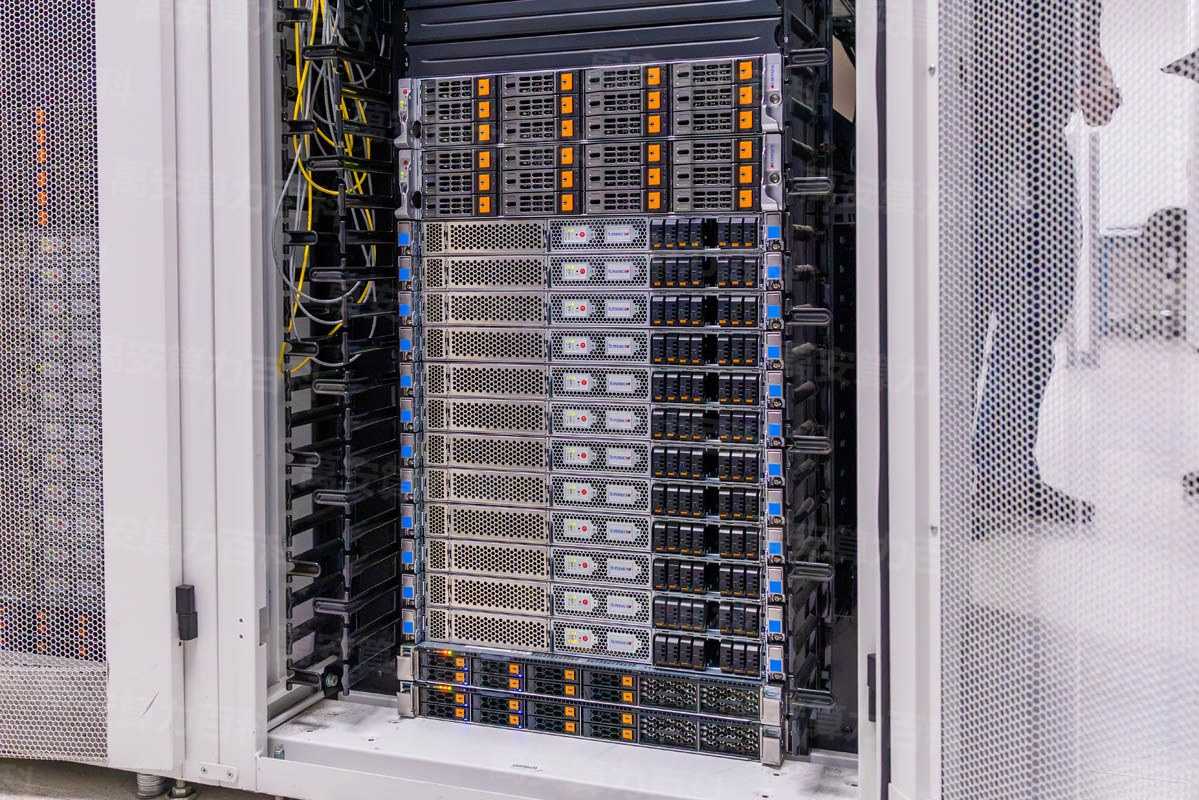
Actual photos are added continuously as inspection batches are stocked; AI-generated images are never passed off as real photos.
Video Overview VIDEO
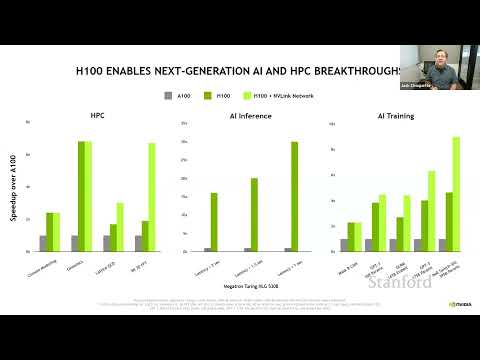
This video is the general stress-test reference footage (the six-test protocol is model-agnostic); the H100-specific version is in the production queue and will replace this one with an H100-anchored cover once live.
Community real hardware · Source: YouTube COMMUNITY HANDS-ON
Playback may not be available in some regions
Software & Ecosystem ECOSYSTEM
| Item | Requirements / Status |
|---|---|
| CUDA | Hopper supported since 11.8 (launch version), fully covered by the current 12.x line |
| Driver | From the 520 series (launch), current 550 series and above |
| Training frameworks | PyTorch / TensorFlow officially support Hopper — the most mature ecosystem |
| Inference engines | vLLM / SGLang / TensorRT-LLM all use the H100 as their baseline supported model |
| Networking | ConnectX-7 400G or an equivalent interconnect solution |
| Operating system | Mainstream Linux distributions (Ubuntu 22.04+ etc.) |
With over three years of maturation, the Hopper ecosystem is the most developed; most public inference-optimization benchmarks use the H100 as the baseline model. Software stack versions evolve over time — defer to official NVIDIA releases.
Purchasing & Inspection PROCUREMENT
Three inspection points when buying an H100:
The full six-test stress-test protocol (figures anchored to the H100) is in this entry's "How to Stress-Test" section.
How to Stress Test BENCH TEST
Six-test protocol, all numeric examples anchored to the H100: unboxing identification → single-card Burn-in Test (700W air-cooled tower, ≤85°C, zero ECC errors to Pass) → Full Load on all cards → memory bandwidth (3.35TB/s spec, ≥85% to Pass) → Interconnect Bandwidth (nccl-tests ≥750GB/s vs. 900GB/s spec) → inference throughput (≥80% of public baselines).
nvidia-smigpu-burn 3600 or dcgmi diag -r 3 · 30–60 minutesbandwidthTest(CUDA bundled sample)nccl-tests all_reduce benchmarkvLLM Run a real model under loadMethodology note: The Pass/Excellent thresholds were compiled by this database based on common engineering practice (bandwidth as a share of rated values, temperatures per standard datacenter limits), and will be calibrated gradually as Measured Bandwidth data from Inspection Reports accumulates; this table constitutes no acceptance commitment — specifics are subject to contract terms. The measured items in this database's Inspection Reports are recorded per this table — NOT_EXECUTED means the item was not run; "not tested" is itself important information.
Shipping & Delivery LOGISTICS
OEM & Variants VENDORS
On the same HGX H100 board, OEM systems differ in form factor, cooling, and service — start by comparing the differences (four of them are currently listed in our catalog):
| System Vendor | Representative Form Factor | Differentiators | Best For |
|---|---|---|---|
| Supermicro | HGX H100 8 Systems (Air-cooled / Liquid-cooled) | Volume workhorse; the liquid-cooled model has been fully reviewed by professional media[12] | Spot Purchase · Best Value |
| Dell | PowerEdge Series (HGX H100 8) | Global tier-one service network and enterprise-grade support | Multinational Deployment · Service First |
| H3C | HGX H100 8 System | Local service and delivery network, common in APAC projects | APAC Channels · Local Service |
| Gigabyte | HGX H100 8 System | Flexible configurations, strong APAC channel presence | APAC Channel Purchase |
| NVIDIA official | DGX H100 (8-GPU System) | Official integrated delivery, full-stack software with vendor backing; first unit delivered to OpenAI[5] | Turnkey Training · Vendor Support |
AIXX Index · Four-Dimension Deployment Comparison AIXX INDEX
| System Vendor | Ease of Installation | Maintenance Convenience | Performance Density | Expected Lifespan |
|---|---|---|---|---|
| Supermicro | 88 | 84 | 84 | 80 |
| Dell | 90 | 92 | 84 | 85 |
| H3C | 86 | 84 | 83 | 82 |
| Gigabyte | 85 | 80 | 85 | 80 |
| NVIDIA official | 92 | 88 | 82 | 85 |
The AIXX Index is our catalog's estimation methodology (0–100, based on public form factor, cooling solution, and service network differences), updated with hands-on verification, and does not constitute a purchase commitment. Refer to official vendor releases for specific models.
Glossary Cards GLOSSARY
HBM3 Memory
High-bandwidth memory stacked next to the GPU. Each H100 carries 80GB of HBM3 at 3.35TB/s — HBM3e only arrived with the H200 generation. Memory capacity is the H100's biggest selection drawback today.
NVLink 4 Interconnect
Fourth-generation NVLink, 900GB/s per-GPU direct interconnect; paired with NVSwitch, eight GPUs act as one. The H100 and H200 share the same generation and speed.
SXM5 Mezzanine Package
GPUs are soldered directly onto the board (not plug-in cards); the HGX H100 8-GPU board is the SXM5 form factor — inspect the board together with the GPUs during verification. The plug-in counterpart is the PCIe version (350W, HBM2e).
Transformer Engine / FP8
The H100's launch Mixed Precision engine made 8-bit floating point a mainstream precision for training and inference. Estimate memory footprint: FP8 weights ≈ parameter count × 1 byte.
Export Controls & Compliant Batches
The H100 has been subject to U.S. export controls on China since October 2022; the China-market Variant line (A800/H800/H20) are all adjusted models derived from these controls. Batch and customs pathway affect warranty and resale value — always check during inspection. All statements in this catalog reflect public reporting and do not constitute legal advice.
News & Related Events TIMELINE
Limitations & Controversies LIMITS
- Hard Memory Ceiling : 80GB HBM3 / 3.35TB/s, substantially surpassed by the H200 (141GB / 4.8TB/s). Full DeepSeek R1 in FP8 is roughly 690GB, which the H100's 640GB across eight GPUs cannot fit (estimated; see "Model Fit") — the root cause of the selection divide between it and its successor.
- The Face of China Export Controls : First added to the control list in October 2022, after which the China-market Variant line (A800/H800/H20) was adjusted several times under policy changes; the H100 itself has yet to return to the approved list for China (the H200 was approved in December 2025) — no public sales through legitimate mainland channels, spot availability is gray-market[6][9]. This catalog records public reporting only and does not constitute legal advice.
- Blackwell Generation Pressure : The B300, with 288GB of HBM3e, FP4 precision, and NVLink 5 (1.8TB/s), opens up a two-precision-tier generational gap; the H100's share of new compute purchases keeps eroding.
- Version Traps : The PCIe version (HBM2e / 2TB/s / 350W / no full NVSwitch interconnect) differs greatly in performance from the SXM version — most "cheap H100" quotes are for PCIe versions. Quotes and inspection must first pin down the package form factor.
- Refurb & Impersonation Risk : The H100 and H200 look highly similar, and "passing off an H100 as an H200" has been reported in the spot market (per inspection agency bulletins); independent serial-number verification plus measured memory checks are essential steps.
- Generational Debate : "The H100 is outdated" and "the H100 holds its value" camps coexist — rental prices rebounding in 2025–2026 (public index data[7]) supports the latter, while Blackwell's replacement curve supports the former; we take no stance here. See "Market Pulse" for the data.
Market Band MARKET DATA
| Date | Basis | Region | Reference Price Band | Notes |
|---|---|---|---|---|
| 2026-10-20 | Hall Real-Time | US (USD) | $1.87M – 1.87M | 1 quote › (batch asking prices) |
| 2026-10-20 | Hall Real-Time | Mainland China | ¥50.24M – 50.24M | 1 quote › (batch asking prices) |
| 2026-10-20 | Hall Real-Time | Singapore (SGD) | S$3.6M – 4.14M | 3 quotes (batch asking prices) |
| 2026-10-20 | Hall Real-Time | Middle East (AED) | AED 3.6M – 3.6M | 1 quote (batch asking prices) |
| 2026-10-20 | Hall Real-Time | Europe (EUR) | €2.91M – 2.91M | 1 quote (batch asking prices) |
| 2026-10-20 | Hall Real-Time | Japan (JPY) | JPY 3.73M – 3.73M | 1 quote (batch asking prices) |
| 2026-10 | Channel Reference | Global | New single GPU around $31K each | Aggregated public quotes[10] · Systems on Sale › |
| 2026-04 | Rental Market | North America Cloud | One-year contracts >$2 / GPU·hr (+40%) | Public analysis[8] |
| 2026-01 | Rental Market | Global | Rental price index +10% in one month | Silicon Data Rental Index[7] |
| 2026-10 | Policy Status | Mainland China | No approved public sales | The H100 is not on the approved list for China; spot availability is gray-market (public reporting; not legal advice) |
Methodology: North America is an estimated band — anchored to publicly reported system prices of $280K–350K/unit at initial 2023 shipment, and to the on-sale observed price of $1.874M/unit (1 listing) on the October 2026 anchor date, with slow-rise interpolation in between, replaced point-by-point as daily snapshots accumulate. Mainland China/Singapore/Europe/Japan/Middle East are on-sale observed snapshots (CNY 5.024M/unit · 1 listing · SGD 3.604–4.142M · 3 listings · EUR 2.915M / JPY 3.734M / AED 3.601M · 1 each), all in native currency, not converted between one another. Price data source for this catalog: AIXX Exchange (Zero-commission Matching; does not participate in transactions, does not possess or speculate on transaction prices — hence the data's neutrality). The estimated band is for trend reference only; actual price subject to the seller's quote.
Price milestone timeline MILESTONES
FAQ FAQ
Look at the bottleneck: for budget-sensitive builds, sub-70B-scale inference and fine-tuning, and HPC/FP64 workloads, the H100 remains the spot market's largest ecosystem with the deepest installed base — and rental prices even rebounded in 2025–2026 (public index data). But 80GB of memory is a hard ceiling for tens-of-billions-parameter models — if memory is the bottleneck, go straight to the H200.
Compute is on par and the interconnect is the same generation (NVLink 4 · 900GB/s); the difference is all in memory: 80GB HBM3 / 3.35TB/s vs 141GB HBM3e / 4.8TB/s; 640GB vs 1.128TB across eight GPUs — full R1 in FP8 (about 690GB) won't fit on an H100 but deploys on a single H200 node. In one line: the H200 sells memory, the H100 sells budget.
The H100 has been under U.S. export controls on China since October 2022; the H200 was approved for China in December 2025, but the H100 is not on the approved list. There are no public sales through legitimate mainland channels; spot availability is gray-market. This reflects public reporting and is not legal advice — defer to the relevant authorities' policies and professional compliance advice before purchasing.
The two generations look highly similar, and photos alone aren't reliable: check silkscreen markings against official firmware reports, verify serial numbers through independent channels, then settle it with a measured memory check — 80GB vs 141GB shows up immediately (see "Purchasing & Inspection" and "How to Stress Test").
SXM version: 700W, HBM3 at 3.35TB/s, full NVSwitch interconnect — the mainstream HGX 8-GPU form factor. PCIe version: 350W, HBM2e at 2TB/s, and no high-speed interconnect without a dual-GPU bridge. Most "cheap H100" listings are PCIe versions; quotes and contracts must specify the package form factor.
Related Entries SEE ALSO
Model comparison and selection COMPARE
References REFERENCES
- NVIDIA Official Site — H100 Product Page (primary spec source, verified 2026-10) https://www.nvidia.com/en-us/data-center/h100/
- Tom's Hardware — Nvidia Reveals Hopper H100 GPU With 80 Billion Transistors (2022-03 GTC launch coverage) https://www.tomshardware.com
- Nvidia Launches Hopper H100 GPU, New DGXs and More(2022-03-22) https://www.hpcwire.com
- CRN — Nvidia H100 GPUs In Full Production, Shipping In October(2022-09-20 keynote) https://www.crn.com/news/components-peripherals/nvidia-h100-…
- NVIDIA Investor Relations — NVIDIA Hopper GPUs Expand Reach as Demand for AI Grows (2023-03-21, DGX H100 mass production / first unit to OpenAI) https://investor.nvidia.com/news/press-release-details/2023/…
- CRS R48642: U.S. Export Controls and China: Advanced Semiconductors (Export Control Timeline) https://www.congress.gov/crs-product/R48642
- Silicon Data — H100 Rental Price Index +10% (2026-01-09) https://www.silicondata.com
- H100 rental prices +40%, one-year contracts break $2/GPU·hr (2026-04, secondary reporting) https://semianalysis.com
- H200 approved for China; channel module prices around RMB 1.4M per module (2025-12-24, same as H200 entry [2])
- Channel Quote Aggregation — New H100 around $31,000/GPU (2026 data) https://benchgecko.ai
- Checking out the NVIDIA H100 in Our First Look at Hopper (module photos) https://www.servethehome.com/checking-out-the-nvidia-h100-in…
- A Look at the Liquid Cooled Supermicro SYS-821GE-TNHR 8x NVIDIA H100 AI Server (liquid-cooled system photos) https://www.servethehome.com/a-look-at-the-liquid-cooled-sup…
- Market band data — AIXX Exchange (listings on this platform and channel-informed ranges, updated daily) /hall.html