AIXX Pedia › Model Entry › NVIDIA L4
NVIDIA L4
Overview OVERVIEW
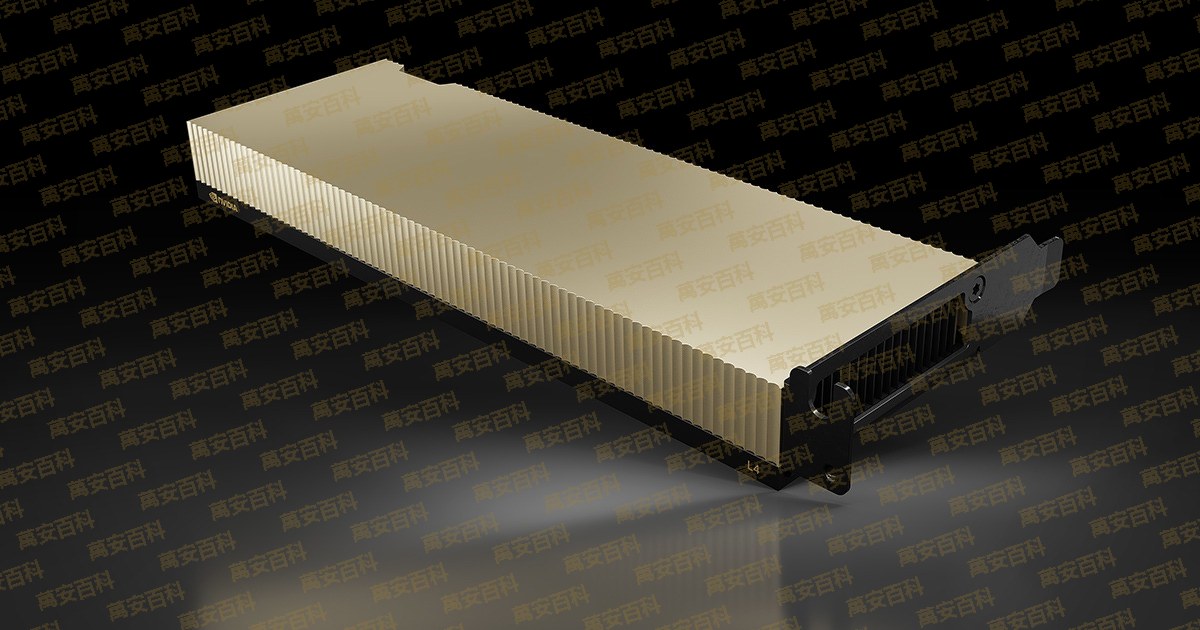
NVIDIA L4 is the 「performance-per-watt」specialist : Ada Lovelace architecture (per official page, the generation with DLSS 3 and ray tracing support[1]), 24GB GDDR6 、 72W Power draw, half-height single slot Form factor — unveiled at GTC in March 2022 alongside the H100 generation (per public reporting[3]), officially positioned as a general-purpose low-power accelerator for "video + AI + graphics": its video pipeline (officially stated 1,040 concurrent 720p30 AV1 streams[1]), generative AI inference, and VDI virtual workstations — three fronts at once.
The math is simple: INT8 Tensor Cores at 485 TOPS (with sparsity; dense 242.5) , FP8 at the same level, FP32 at 30.3 TFLOPS — the absolute compute isn't flagship-class, but 72W with no external power connector and a single-slot half-height profile that packs densely into 1U ) makes it an unbeatable TCO play in transcoding and inference workloads where "power and rack space dominate cost"[1]. The 2× NVENC + 4× NVDEC + 4× JPEG decoder media engine configuration is the densest of any single card in the family.
Positioning boundaries must be addressed first : 24GB of VRAM and 300GB/s bandwidth define what it is is not a large-model training card ; PCIe Gen4 host interface and 30.3 TFLOPS FP32 are likewise not flagship specs — the L4's value proposition only holds in the「video/inference/vision」three scenarios. Match the scenario first, then the price, before buying.
Use Cases FIT
AIXX Index (0–100): estimated by this Pedia via weighted public specifications — memory 40% + interconnect 30% + ecosystem 30%, with weights adjusted by use case. 90+ flagship tier · 75+ Excellent · 60+ usable · below 60 not recommended. The methodology is transparent and verifiable, and does not constitute a performance guarantee.
History HISTORY
March 2022 , L4 launched at GTC: introduced alongside the H100 generation, positioned as a general-purpose low-power accelerator for "video + AI + graphics" (per public reporting[3]).
Second half of 2022 , OEM cards from ASUS/Leadtek and others rolled out, entering the market primarily as OEM server appliance form factors (per public reporting[4]).
In 2023 , Google Cloud launched G2 instances (L4-powered) — the first major public cloud to offer L4 at scale (per public reporting[5]).
2024–2025 , twin tailwinds of AV1 adoption and generative AI inference growth: the video pipeline (transcoding/moderation/subtitling) and mid-size model inference became the workhorse configuration of the public cloud "value tier" (per public reporting[3]).
2026 , still available on the official page, with 1–8 GPU NVIDIA-Certified servers and partner systems listed (verified October 2026[1]).
Technical Specifications SPECIFICATIONS
| Item | Specifications (NVIDIA L4 · official figures, verified October 2026[1]) |
|---|---|
| GPU architecture | Ada Lovelace generation (per official page, the DLSS 3/ray tracing support tier[1]) |
| Memory | 24GB GDDR6 |
| Memory Bandwidth | 300GB/s |
| INT8 Tensor Core | 485 TOPS (with sparsity; dense 242.5, official figures[1]) |
| FP8 Tensor Core | 485 TFLOPS (with sparsity, official figures[1]) |
| FP16/BF16 Tensor Core | 242 TFLOPS (with sparsity; dense 121-class, official figures[1]) |
| FP32 | 30.3 TFLOPS (official figures[1]) |
| Media Engine | NVENC ×2 | NVDEC ×4 | JPEG decoders ×4 (official figures[1]) |
| Video Capability | Officially rated 1,040 concurrent 720p30 AV1 streams (official figures[1]) |
| Power | 72W (officially "72W low-power envelope"[1]) — no external power connector required |
| Form Factor | Half-height single slot · low profile · PCIe |
| Host Interface | PCIe Gen4 x16 · 64GB/s (official figures[1]) |
| Server Configurations | Partner/NVIDIA-Certified systems, 1–8 GPUs (official figures[1]) |
Specifications per the official NVIDIA L4 page (verified October 2026[1]); sparse/dense figures transcribed per the official page's "with sparsity" labeling; CUDA core count is not listed on the official page — verify with nvidia-smi before purchasing.
Comparison · L4 vs T4 vs L40S CONTEXT
| Item | NVIDIA T4 (previous generation) | NVIDIA L4 | NVIDIA L40S |
|---|---|---|---|
| Memory | 16GB GDDR6 | 24GB GDDR6 | 48GB GDDR6 |
| Memory Bandwidth | 320GB/s | 300GB/s | 864GB/s |
| INT8 | ~130 TOPS class (generation figures) | 485 TOPS (with sparsity[1]) | ~725 TOPS class (with sparsity, see our entry) |
| Media Engine | NVENC ×1 | NVDEC ×2 | NVENC ×2 | NVDEC ×4 | JPEG ×4[1] | NVENC ×3 | NVDEC ×3 |
| Power | 70W | 72W | 350W |
| Form Factor | half-height single slot | half-height single slot | Full-height dual slot |
| One-line buying advice | Legacy baseline | Video/inference value tier | Large-VRAM inference tier |
Comparisons are based on official product pages and this site's entry data; the T4 serves as the Turing-generation baseline for reference. Media engine and codec support follow the NVENC/NVDEC support matrix[6].
Family Members FAMILY
Ada Lovelace data center family lineup:
Cooling & Deployment COOLING
L4's deployment profile: 72W with no external power (PCIe slot power suffices) + half-height single slot + passive cooling — multiple cards can tile densely in a 1U server, and power density is its core deployment advantage over 350W-class cards like the L40S (official form-factor figures[1]). Passive cooling means chassis airflow is a hard prerequisite : tower workstations or modded cases need verified airflow before mounting an L4, or it will throttle from overheating.
PCIe Gen4 host interface — even on Gen5 motherboards, bandwidth still runs at Gen4 (64GB/s, official figures[1]); just match host generation to the card at purchase, no need for a full Gen5 build.
Model Compatibility MODEL FIT
| Scenario | Fit per card at 24GB (estimated: weights × precision + KV/framework overhead; see the model selector for methodology) |
|---|---|
| 7B–14B inference | FP16 weights run 14–28GB-class: 7B FP16 or 14B FP8 resident on one card is the comfort zone (estimated) |
| 70B-class at 4-bit Quantization | weights around 35GB-class — out of reach on one card; two-card sharding works (estimated, throughput limited by bandwidth) |
| Embeddings/RAG/Reranking | embedding and reranker models are generally under 10GB-class: an always-on, low-power production slot (estimated) |
| Vision/Multimodal | 4× JPEG hardware decode feeds image streams[1]: an acceleration slot for OCR/inspection/content moderation pipelines |
| Video transcoding | Officially rated 1,040 concurrent 720p30 AV1 streams[1] — standard fit for FFmpeg NVENC pipelines |
| Not applicable | Large-model training (dual ceiling of 300GB/s bandwidth and 24GB capacity, official figures[1]) |
Methodology: memory footprint ≈ parameter count × bytes per parameter (FP16=2B / FP8=1B / INT4=0.5B), KV and framework overhead excluded; same source as the selector's "memory budget," verifiable.
Gallery GALLERY
See the official NVIDIA page[1] and OEM vendors' (ASUS/Leadtek, etc.) product pages for low-profile single-slot form factor and heatsink details.
Video Overview VIDEO
Video walkthrough of this entry is in the production queue (see the video slot schedule for Chinese/multilingual workflow) — this section updates automatically once it goes live.
Software & Ecosystem ECOSYSTEM
The dual ecosystem of full-stack CUDA plus media: Inference side : standard support for TensorRT-LLM/Triton Inference Server/vLLM (FP8 via Ada Tensor Cores); Media side FFmpeg NVENC/NVDEC pipelines with native AV1 encode hardware support (codec matrix in official documentation[6]); Cloud side Public cloud instances such as GCP G2 offer the L4 as a standard "value tier" supply (per public reporting[5]).
Transcoding vs consumer cards (4090-class): data center cards carry no NVENC concurrent-session limit (per driver policy), so for 7×24 video pipelines the L4 over a consumer card is a dual choice of compliance and stability — a point low-bid proposals often conveniently omit.
Purchasing & Inspection PROCUREMENT
Common risks
For loose-card purchases, third-party inspection or platform Buyer Fund Verification and inspection flows are recommended — Marketplace Search ›
How to Stress Test BENCH TEST
Judgment tools: nvidia-smi/DCGM (power/temperature/ECC status), bandwidthTest (memory bandwidth vs. the official 300GB/s rating[1]), gpu-burn (Burn-in Test, 72W envelope validation), FFmpeg benchmark (practical stream counts at target formats vs. the official 1,040-stream 720p30 AV1 figure[1]), TRT-LLM/vLLM benchmark (inference throughput and latency with your own models). Acceptance for a transcoding card hinges on two metrics: "measured stream count + no sustained throttling." Dedicated test video samples for this card are in production.
Shipping & Delivery LOGISTICS
| Stage | Key Points |
|---|---|
| Form Factor & Weight | Half-height half-length compact single card — anti-static bag plus anti-static foam is sufficient; low shock-resistance requirements for full-box shipping |
| Heatsink | Passive cooling, no fan — avoid crushing the heatsink fins during transport; inspect exterior on arrival |
| Cross-border Compliance | Compute tier below consumer-flagship sensitivity to export controls — still defer to current lists and customs classification |
| Insurance | Insure by cargo value; for server-level delivery, acceptance is based on the complete server system |
OEM & Variants VARIANTS
| Variants / OEM | Form Factor & Positioning |
|---|---|
| NVIDIA L4 | Low-profile single-slot standard form factor (official figures[1]) |
| OEM card | Partner form factors from ASUS/Leadtek/Gigabyte and others (per public reporting[4]) |
| NVIDIA-Certified servers | 1–8 GPU system integration (official figures[1]) |
| Cloud instances | Public cloud L4 instances such as GCP G2 (per public reporting[5]) |
Limitations & Controversies LIMITS
- 24GB/300GB/s ceiling : low on both memory and bandwidth (official figures[1]) — out of the running for training and large-model scenarios; even 70B-class Quantization inference needs two-card sharding.
- PCIe Gen4, not Gen5 : 64GB/s host bandwidth (official figures[1]) — data-throughput-sensitive inference services gain no bandwidth benefit on Gen5 platforms.
- FP32 only 30.3 TFLOPS : mediocre graphics/simulation performance (official figures[1]) — it's a "video + AI" specialist card, not an all-rounder.
- Limited retail availability : channel is appliance-dominant (official 1–8 GPU system figures[1]) — a small loose-card market with high risk of pulled cards.
- 72W performance ceiling : the price of performance-per-watt is absolute performance — high-throughput transcoding farms need to stack cards by stream count; a single card can't compare to the L40S.
Market Notes MARKET
| Date | Type | Market | Price Band | Basis |
|---|---|---|---|---|
| 2026-10 | Card price | Overseas channels | No standing official card price · actual price subject to the seller's quote (primarily OEM appliance form[1]) | Channel basis |
| 2026-10 | Cloud Rental | Overseas public cloud | Billed per GPU-hour (GCP G2 and similar instances[5]; actual price subject to the seller's quote on cloud pricing pages, varies by region) | Third-Party Metrics |
| 2026-10 | Marketplace Status | Mainland China | Few loose cards in circulation · mostly servers/pulled parts | Marketplace Search › |
Note: this database holds no standing transaction data for this model; "actual price subject to the seller's quote" means we do not anchor on one-sided asking prices. Market and inventory: AIXX Exchange (Zero-commission Matching; not a party to transactions).
Timeline MILESTONES
| Time | Event |
|---|---|
| 2022-03 | L4 unveiled at GTC (sharing the stage with the H100 generation, per public reporting[3]) |
| H2 2022 | OEM cards and server systems rolled out (per public reporting[4]) |
| In 2023 | Google Cloud G2 instances launched — first major cloud to offer it at scale (per public reporting[5]) |
| 2024–2025 | AV1 adoption + generative AI inference growth: dual mainstays of video pipelines and "value tier" inference (per public reporting[3]) |
| 2026-10 | Available on the official page: 1–8 GPU certified systems listed (verified October 2026[1]) |
FAQ FAQ
Related Entries SEE ALSO
References REFERENCES
| [1] | NVIDIA official · L4 product page (24GB/300GB/s/485 TOPS with sparsity/72W/half-height single-slot/Gen4/NVENC2+NVDEC4+JPEG4/1,040-stream AV1 basis) · https://www.nvidia.com/en-us/data-center/l4/ (verified 2026-10) |
| [2] | NVIDIA official · NVENC/NVDEC codec support matrix · https://developer.nvidia.com/video-codec-support (official documentation) |
| [3] | Public reporting · GTC 2022 L4 launch and video/AI scaling momentum · https://www.reuters.com/technology/ (per public reporting) |
| [4] | Public reporting · OEM card and server form factor availability (ASUS/Leadtek etc.) · https://www.reuters.com/technology/ (per public reporting) |
| [5] | Google Cloud · GPU documentation (L4 on G2 instances) · https://cloud.google.com/compute/docs/gpus (third-party figures) |
| [6] | This site · L40S entry (family comparison data source) · /wiki/l40s.html (This Site's Entry) |
| [7] | Selector tool · VRAM budgeting methodology (parameters × precision + KV/framework overhead) · /wiki/xuanxing.html (this site's methodology) |
Specs are anchored to NVIDIA's official page; "public reporting" items are media accounts and this database does not vouch for their accuracy; official figures such as transcoding stream counts are lab conditions — rely on real-world tests.