Spec Card SPEC CARD
NVIDIA H200 NVL
141GB HBM3e + 4.8TB/s fits a full 70-billion-parameter model on a single card; 2/4-way NVLink bridging at 900GB/s; air-cooled within 600W for easy colocation — the new in-stock favorite among large-memory inference cards
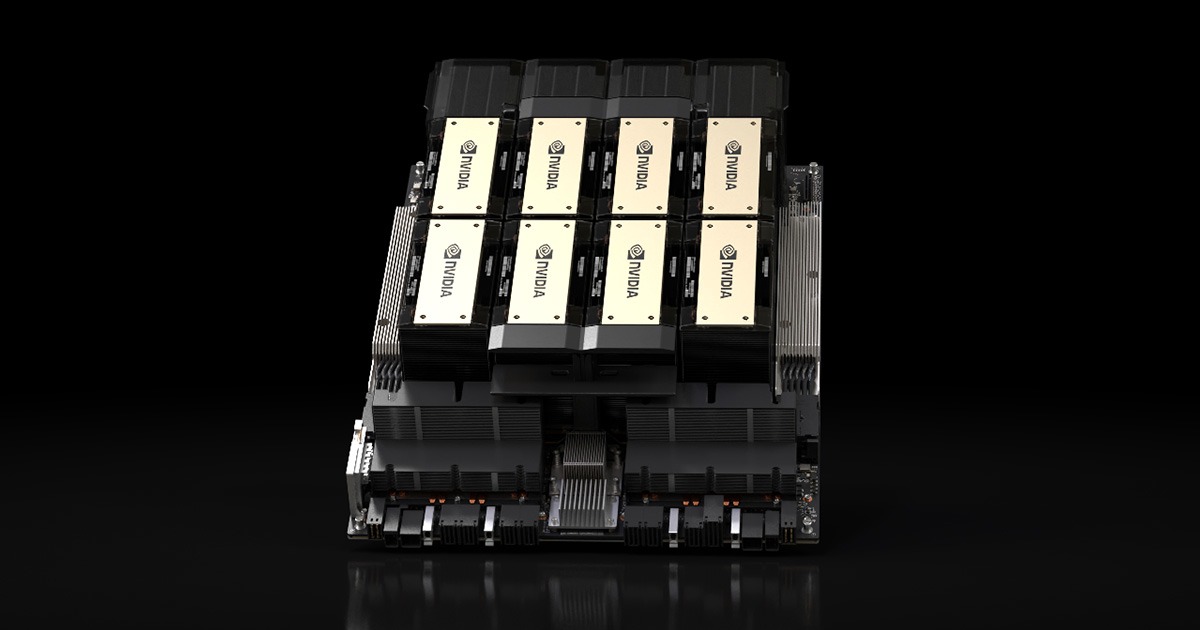
NVIDIA official product image
Overview
The NVIDIA H200 NVL is a data center GPU built on NVIDIA's Hopper architecture, in a dual-slot air-cooled PCIe form factor aimed at large-memory inference and training. Each card carries 141GB of HBM3e memory — the headline spec on the official product page — which reduces the complexity of multi-card model sharding in large-model scenarios. Cards can be bridged via 2-way or 4-way NVLink to deliver 900GB/s of interconnect bandwidth per GPU, or communicate with the host over PCIe Gen5 (128GB/s). The card supports Multi-Instance GPU partitioning (up to 7 instances of 16.5GB each) and Confidential Computing, and ships with NVIDIA AI Enterprise software support. Typical use cases include LLM inference, multimodal model deployment, and video decoding workloads.
Core Specs
| Architecture | NVIDIA Hopper |
| Memory | 141GB |
| Memory Type | HBM3e |
| Memory Bandwidth | 4.8TB/s |
| FP64 Compute | 30 TFLOPS |
| FP64 Tensor Core | 60 TFLOPS |
| FP32 Compute | 60 TFLOPS |
| FP8 Compute | 3,341 TFLOPS |
| FP16 Compute | 1,671 TFLOPS |
| INT8 Compute | 3,341 TFLOPS |
| Power (TDP) | Up to 600W (configurable) |
| Interconnect | 2- or 4-way NVIDIA NVLink bridge: 900GB/s per GPU | PCIe Gen5: 128GB/s |
| Form Factor | PCIe Dual-slot air-cooled |
| MIG partitioning | Up to 7 MIGs @16.5GB each |
| Codecs | 7 NVDEC | 7 JPEG |
| Confidential Computing | Supported |
Specifications verified against official documentation (
Official Benchmarks , updated 2026-10-09) · actual price subject to the seller's quote
Use Cases
- LLM inference serving: 141GB of HBM3e lets a single card — or a small number of cards — hold the full weights of fairly large models, cutting the sharding and cross-card communication overhead of multi-GPU setups
- Multi-card inference and small-to-mid-scale training: 2-way or 4-way NVLink bridging delivers 900GB/s per GPU of interconnect, suited to deployments that need tight inter-card coordination
- Multi-tenant GPU partitioning: with Multi-Instance GPU, a single card can be split into up to 7 independent instances (16.5GB of memory each) to isolate multiple lightweight inference workloads
- Video and image processing pipelines: with 7 NVDEC engines and 7 JPEG decoding units on board, it suits edge or on-prem workloads that mix inference with media decoding
Sibling Models
| Model | Memory | Power |
|---|
| NVIDIA T4 Compare | 16GB GDDR6 with ECC (enabled by default) | 70W (Total board power, default) |
| NVIDIA A100 Compare | Dual versions: 40GB HBM2 / 80GB HBM2e (80GB version announced at SC20 on 2020-11-16), with ECC | SXM4: 400W (same for 40GB/80GB); PCIe versions: 40GB 250W / 80GB 300W |
| NVIDIA H20 Compare | 96GB HBM3 (three consistent sources: Flopper/VipraTech/Tencent News) | 400W TDP (three sources: Flopper/VipraTech spec sheet/Tencent News '400W thermal design power'; VipraTech's body text cites a conflicting 350W figure — discarded) |
| NVIDIA GB300 Compare | 288GB HBM3e (per GPU package; 576GB for the superchip; coexisting figures of 2.1TB per HGX board / 20TB per rack) | TGP up to 1400W |
| NVIDIA A30 Compare | 24 GB HBM2 | 165 W |
| NVIDIA GeForce RTX 4090 Compare | 24GB GDDR6X | 450W TGP (315W average gaming, recommended PSU 850W) |
Video explainer VIDEO
Buying & Inspection Checklist
- Verify data center fit: this model is a dual-slot air-cooled PCIe design. Before deployment, check server PCIe slot spacing, dual-slot thermal clearance, and air-cooling capacity. For colocation, evaluate rack intake temperature and airflow paths to avoid localized overheating in high-density deployments
- Confirm the interconnect plan: for multi-card coordination, confirm at purchase time the selection of the 2-way or 4-way NVLink bridge and motherboard compatibility; over PCIe Gen5 alone, interconnect bandwidth is 128GB/s — assess whether that meets the communication demands of your target model
- Verify accessories and authenticity: buy through authorized channels and validate official warranty coverage; confirm the NVIDIA AI Enterprise license is included. Also confirm the TDP configuration profile and power plan — the card's power draw is configurable, so calculate rack power and PDU headroom based on the actual settings before going live
FAQ
What's the difference between the H200 NVL and the H200 SXM?
Both belong to the H200 product line and share the same Hopper architecture; the main differences are form factor and deployment style. The H200 NVL is a dual-slot air-cooled PCIe design that's easy to install in standard servers and expand later; the H200 SXM is an SXM module that requires a dedicated baseboard. On interconnect, the H200 NVL achieves 900GB/s per GPU of card-to-card bandwidth via 2-way or 4-way NVLink bridging, with fallback to PCIe Gen5 (128GB/s) communication.
With 141GB per card, do I still need multiple GPUs for large models?
It depends on model parameter count, quantization precision, and concurrent batch size. The H200 NVL's 141GB of HBM3e can hold the weights and KV cache of a fairly large model on a single card, reducing the communication overhead of tensor parallelism. For larger models or higher throughput, you can scale out to multi-card instances via 2-way or 4-way NVLink bridging; the 900GB/s inter-card link helps limit the latency penalty of multi-GPU inference. We recommend sizing the card count based on your target model's actual memory footprint.
Can the H200 NVL be split among multiple users or tasks?
Yes. The card supports Multi-Instance GPU (MIG), letting a single card be divided into up to 7 instances with 16.5GB of memory each, fully isolated from one another — ideal for multi-tenant inference, development and testing, and other scenarios needing fine-grained allocation. The H200 NVL also supports Confidential Computing for deployments with data security compliance requirements.