SECTIONS
EDITIONS
NETWORK
Spec Card SPEC CARD
NVIDIA A30
165W low power combined with a rare 24GB HBM2 configuration, offering 5.2 TF of FP64 double precision and NVLink at 200GB/s. MIG allows splitting into 4 instances for subleasing, making it a cost-effective choice for compact-rack inference and entry-level HPC.
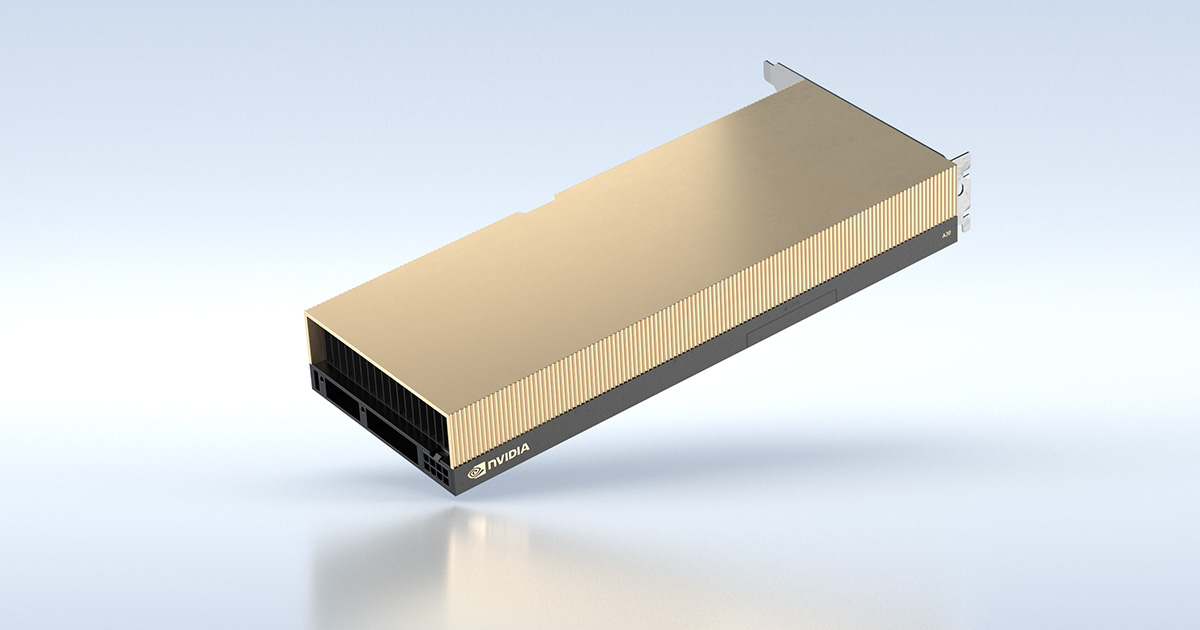
NVIDIA official product image
Overview
The NVIDIA A30 is an Ampere-architecture accelerator card from NVIDIA for data centers, in a dual-slot full-height full-length (FHFL) form factor with a TDP of just 165W, placing it in the low-power tier of general-purpose compute GPUs. It comes with 24GB of HBM2 memory at 933GB/s bandwidth, delivers 5.2 teraFLOPS of FP64 double-precision compute, and supports third-generation NVLink interconnect (200GB/s). With MIG multi-instance partitioning and Tensor Core acceleration, the A30 is commonly used for mid-scale inference, entry-level HPC workloads, and multi-tenant GPU resource pooling—well suited to deployments where power and space are at a premium.
Core Specs
| Architecture | NVIDIA Ampere |
| Memory | 24 GB HBM2 |
| Memory Bandwidth | 933 GB/s |
| FP32 Performance | 10.3 teraFLOPS |
| FP64 Performance | 5.2 teraFLOPS |
| TF32 performance | 82 teraFLOPS | 165 teraFLOPS |
| FP16 Performance | 165 teraFLOPS | 330 teraFLOPS |
| INT8 Performance | 330 TOPS | 661 TOPS |
| Power (TDP) | 165 W |
| Interconnect | PCIe Gen4: 64GB/s / Third-gen NVLINK: 200GB/s |
| Form Factor | Dual-slot, full-height, full-length (FHFL) |
| MIG | 4 GPU instances @ 6GB each |
Specs verified against official documentation ( official benchmarks , updated 2026-10-09) · actual price subject to the seller's quote
Use Cases
- Small-to-mid-scale AI inference services: With TF32/FP16/INT8 Tensor Core performance, it can handle inference workloads under low power, and after MIG partitioning, separate GPU instances can be allocated to multiple business lines
- Entry-level HPC and scientific computing: 5.2 teraFLOPS of FP64 double precision plus FP64 Tensor Core capability can meet engineering simulation and numerical computing tasks that require double precision
- Multi-tenant GPU resource pools: MIG splits a single card into 4×6GB or 2×12GB instances, ideal for cloud providers or enterprises to isolate and allocate GPU resources across multiple users
- Video and image processing: With four NVDEC video decoders, one JPEG decoder, and an optical flow accelerator onboard, it can handle media workloads such as video transcoding and image analysis
Same-Family Models
| Model | Memory | Power |
|---|---|---|
| NVIDIA T4 Compare | 16GB GDDR6 with ECC (enabled by default) | 70W (total board power, default) |
| NVIDIA A100 Compare | Dual versions: 40GB HBM2 / 80GB HBM2e (80GB added at SC20 on 2020-11-16), with ECC | SXM4 400W (same for 40GB/80GB); PCIe version 250W for 40GB / 300W for 80GB |
| NVIDIA H20 Compare | 96GB HBM3 (consistent across Flopper, VipraTech, and Tencent News sources) | 400W TDP (three sources: Flopper, VipraTech spec sheet, and Tencent News' "400W thermal design power"; VipraTech's body text also cites 350W, a conflicting figure that has been discarded) |
| NVIDIA GB300 Compare | 288GB HBM3e (per GPU package; 576GB for the superchip; HGX board-level 2.1TB / rack-level 20TB coexist) | TGP up to 1400W |
| NVIDIA GeForce RTX 4090 Compare | 24GB GDDR6X | 450W TGP (315W average gaming, 850W recommended system power) |
| NVIDIA RTX PRO 6000 Blackwell Compare | 96GB GDDR7 with ECC (the workstation GPU with the largest memory per card) | 600W total board power (official), power via 1x PCIe CEM5 16-pin, double-flow-through cooling |
Video Overview VIDEO
Procurement & Inspection Notes
- Verify power and cooling conditions in the server room: The A30 has a TDP of 165W with low overall power draw, but you still need to confirm chassis compatibility with the dual-slot FHFL form factor and ensure airflow meets cooling requirements
- Pay attention to interconnect and topology planning: For multi-card collaboration, confirm whether the server supports third-generation NVLink bridging (200GB/s); on the PCIe side it's Gen4 with 64GB/s bidirectional bandwidth, so the host platform must match the corresponding slot specs
- During inspection, verify memory and MIG configuration: The card ships standard with 24GB HBM2 at 933GB/s bandwidth; confirm that MIG partitioning works properly (4×6GB / 2×12GB / single 24GB card), and use official NVIDIA tools to verify device authenticity and firmware status
FAQ
How should I choose between the NVIDIA A30 and the T4?
Both sit in the low-power tier, but the A30 comes with 24GB HBM2 at 933GB/s bandwidth, FP64 double-precision compute, and NVLink interconnect, giving it higher overall compute specs; the T4 draws less power and is more widely adopted. If your workloads demand more memory, double-precision compute, or multi-instance pooling, the A30 is the better fit; for light inference on a tight budget, the T4 is worth evaluating.
What is the maximum number of instances the A30's MIG can split into?
Using Multi-Instance GPU technology, the A30 can be divided into up to 4 GPU instances, each with 6GB of memory; it can also be split into 2×12GB instances, or used as a single full card with 24GB. Resources are isolated between instances, making it suitable for multi-tenant or parallel multi-service deployments.
Is the A30 suitable for large model training?
The A30 is positioned more toward inference and entry-level HPC. Its 24GB HBM2 and 330 teraFLOPS (sparse) FP16 Tensor Core performance can support training or fine-tuning of some small-to-mid-sized models, but large-scale model training generally requires flagship products with more memory and NVLink multi-card scaling—evaluate based on your actual model size.
Data updated 2026-10-09 · Go to In-depth Entry Editorial Policy workflow
Editorial Constitution Summary
Every claim sourcedDrawbacks always stated · corrections publicly loggedNo paid entries acceptedZero traffic-funneling or sales elements within entriesMarket data attached only as data modulesMarket data source: AIXX Exchange · © 2026 AIXX Pedia · An AIXX Product