Spec Card SPEC CARD
NVIDIA H100 NVL
94GB HBM3 per card, 188GB via dual-card NVLink bridging — a dedicated card for 70B-class LLM inference, 350-400W air-cooled dual-slot for easy hosting, bundled with AI Enterprise, and an unavoidable near-flagship on the second-hand market
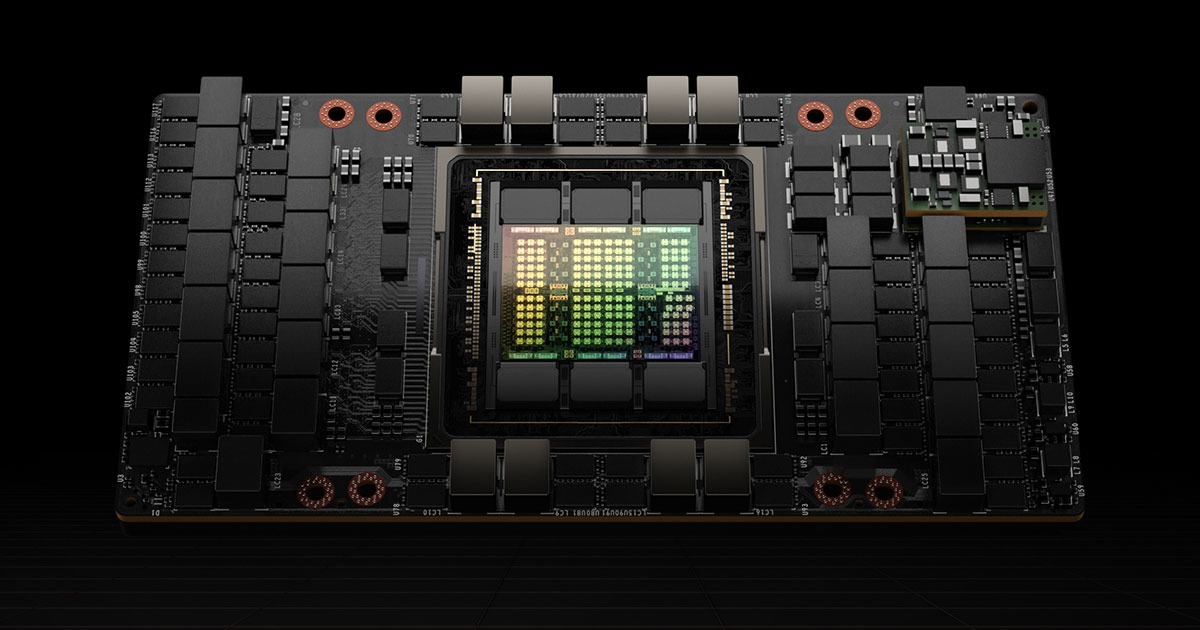
NVIDIA official product image
Overview
The NVIDIA H100 NVL is a PCIe-form-factor data center GPU built on NVIDIA's Hopper architecture, positioned as a near-flagship product for large-memory inference workloads. A single card comes with 94GB of HBM3 memory, and by bridging two cards over NVLink you can combine them into a 188GB unified memory pool — well suited to carrying inference loads for large-parameter language models. The card uses a dual-slot air-cooled design with a configurable TDP range, making it easy to deploy in standard rack environments; NVLink provides 600GB/s bidirectional interconnect bandwidth between cards, alongside a PCIe Gen5 host interface. Each card ships with the NVIDIA AI Enterprise software suite, covering enterprise-grade AI inference and deployment needs.
Core Specs
| Architecture | NVIDIA Hopper |
| Memory | 94GB |
| Memory Type | HBM3 |
| Memory Bandwidth | 3.9TB/s |
| FP64 Performance | 30 teraFLOPs |
| FP64 Tensor Core | 60 teraFLOPs |
| FP32 Performance | 60 teraFLOPs |
| FP8 compute | 3,341 teraFLOPS |
| FP16 Performance | 1,671 teraFLOPS |
| INT8 Performance | 3,341 TOPS |
| Power (TDP) | 350-400W (configurable) |
| Interconnect | NVIDIA NVLink: 600GB/s | PCIe Gen5: 128GB/s |
| Form Factor | PCIe dual-slot air-cooled |
| MIG Slicing | Up to 7 MIGS @ 12GB each |
| Codecs | 7 NVDEC | 7 JPEG |
Specs verified against official documentation (
official benchmarks , updated 2026-10-09) · actual price subject to the seller's quote
Use Cases
- Large-parameter LLM inference services: after dual-card NVLink bridging, the 188GB memory pool can hold full model weights with room left over for KV Cache
- Multi-tenant GPU resource partitioning: use MIG to split a single card into up to 7 instances, each with 12GB of memory — ideal for small-model inference or isolating multiple workloads
- Video and image processing pipelines: multiple NVDEC decoders and JPEG decoding units on board, well suited to visual AI workloads that mix inference and decoding
- Enterprise AI platform deployment: rely on the bundled NVIDIA AI Enterprise for a supported enterprise software stack in production inference and fine-tuning tasks
Same-Family Models
| Model | Memory | Power |
|---|
| NVIDIA T4 Compare | 16GB GDDR6 with ECC (enabled by default) | 70W (total board power, default) |
| NVIDIA A100 Compare | Dual versions: 40GB HBM2 / 80GB HBM2e (80GB added at SC20 on 2020-11-16), with ECC | SXM4 400W (same for 40GB/80GB); PCIe version 250W for 40GB / 300W for 80GB |
| NVIDIA H20 Compare | 96GB HBM3 (consistent across Flopper, VipraTech, and Tencent News sources) | 400W TDP (three sources: Flopper, VipraTech spec sheet, and Tencent News' "400W thermal design power"; VipraTech's body text also cites 350W, a conflicting figure that has been discarded) |
| NVIDIA GB300 Compare | 288GB HBM3e (per GPU package; 576GB for the superchip; HGX board-level 2.1TB / rack-level 20TB coexist) | TGP up to 1400W |
| NVIDIA A30 Compare | 24 GB HBM2 | 165 W |
| NVIDIA GeForce RTX 4090 Compare | 24GB GDDR6X | 450W TGP (315W average gaming, 850W recommended system power) |
Video Overview VIDEO
Procurement & Inspection Notes
- Verify chassis and power compatibility: the H100 NVL is a dual-slot air-cooled PCIe card with a configurable TDP. Before purchase, check server slot height, airflow design, and per-card power headroom. The air-cooled solution places lower demands on data center cooling and noise management than a liquid-cooled SXM setup, but you still need ample front intake airflow at Full Load
- Verify the NVLink bridge configuration: if your goal is dual-card 188GB large-memory inference, confirm whether the NVLink bridge is included with the card or sold separately, and whether motherboard card spacing allows bridge installation; the bridge can be omitted for single-card use
- Second-hand and stock channel inspection points: check memory capacity (94GB HBM3 per card) and device serial numbers, test NVLink and PCIe Gen5 link negotiation, confirm MIG partitioning works properly, and confirm how the NVIDIA AI Enterprise license is delivered with the card and how much support time remains
FAQ
What's the difference between the H100 NVL and the standard PCIe H100?
The H100 NVL is a PCIe-form-factor H100 variant whose main distinction is NVLink bridging capability, letting you bridge two cards into a 188GB combined memory pool — designed for inference scenarios that need large memory across cards. The standard PCIe version typically ships without a factory bridging solution. Both are based on the Hopper architecture.
Is 94GB on a single card enough to run large models? When do you need dual-card bridging?
It depends on model parameter count and the quantization scheme. If a single card's memory can't fit the model weights plus runtime overhead like KV Cache, you can bridge two H100 NVL cards over NVLink for 188GB of combined memory. Once bridged, the memory pool is connected via NVLink at 600GB/s, which offers better communication efficiency than multi-card solutions going over PCIe Gen5.
Is the H100 NVL good for rental or hosting? What's MIG for?
Yes. The card uses a standard dual-slot air-cooled PCIe design, and its configurable TDP allows deployment in conventional rack servers, keeping hosting barriers relatively low. MIG can physically partition a single card into up to 7 independent instances, each with 12GB of memory and fully isolated — ideal for cloud providers or teams sharing one card across multiple tenants or multiple lightweight inference tasks.