AIXX Pedia › Model Entry › NVIDIA Spectrum-4
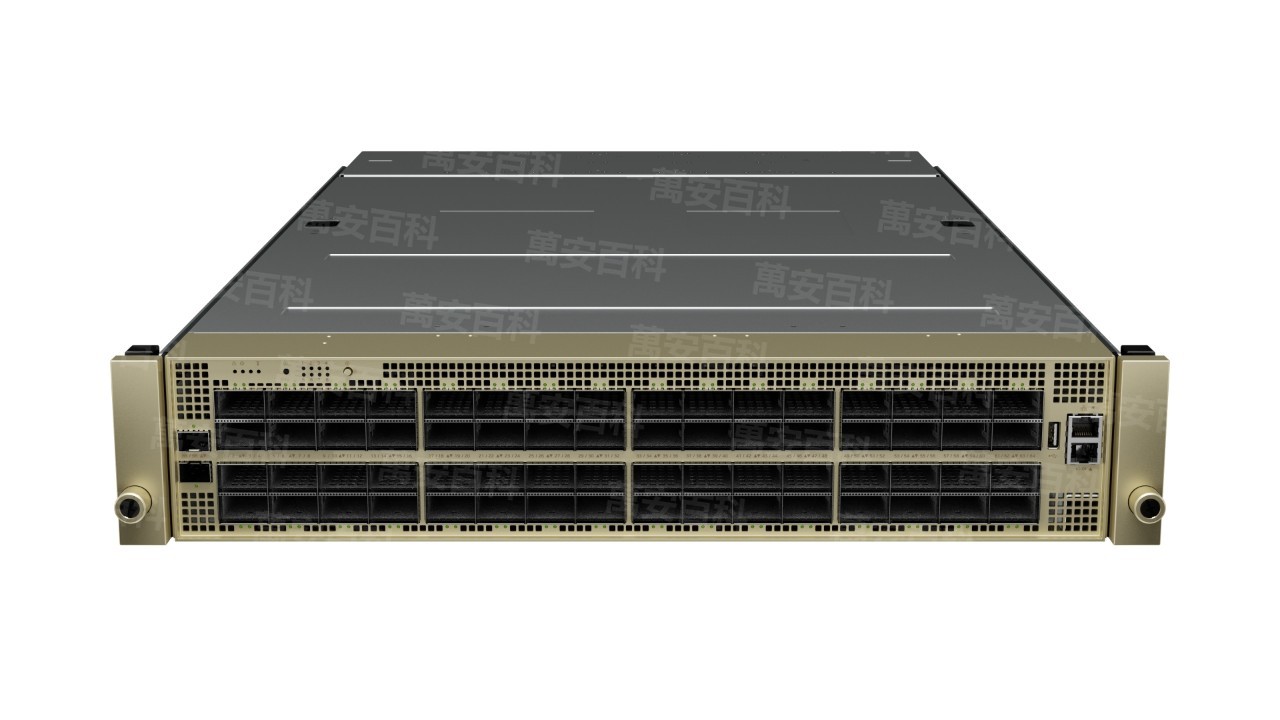
NVIDIA Spectrum-4
Overview OVERVIEW
NVIDIA Spectrum-4 Is NVIDIA Next-generation Spectrum Ethernet switching platform The driving ASIC of (the SN5000 series): single-chip switching capacity of 51.2Tb/s (double the previous-generation Spectrum-3's 25.6Tb/s), with port speeds covering 10GbE–800GbE — officially billed as the world's first family of 51.2Tb/s Ethernet switches built for deep learning networks (official figure[1]). Announced at GTC 2022 (public reporting[3]), shipped as SN5400/SN5600 series.
Its role: the cornerstone of NVIDIA's Ethernet roadmap for the "AI factory." Spectrum-4 plus BlueField-3 DPU forms the Spectrum-X AI networking solution (official framing; same lineage as this site's Spectrum-X800 entry), delivering RoCE ultra-low-latency lossless networking inside AI clusters, with 800G uplinks out of the rack — the SN5600 offers 128×400G or 64×800G port configuration (official figure[1]). Together with the Quantum-2/Quantum-X800 (InfiniBand line), it forms NVIDIA's dual-track networking strategy.
Set the selection boundaries first : Spectrum-4 is platform/ASIC — what you actually procure are SN5400/SN5600 switch systems (see our SN5600 entry for model details[6]); its 51.2Tb/s is a system-level figure. When selecting AI networking, compare the InfiniBand line (Quantum family) alongside port density/latency/networking cost — not just raw silicon capacity.
Use Cases FIT
AIXX Index (0–100): This library estimates via weighted public specs — bandwidth 40% + features 30% + ecosystem 30%, with weights adjusted per scenario. Methodology is transparent and verifiable; not a performance guarantee.
History HISTORY
In 2022 , Spectrum-4 and the SN5000 series launched at GTC: 51.2Tb/s, 10–800GbE, officially the first 51.2Tb/s Ethernet family for deep learning networks (official figure[1]; public reporting[3]).
In 2023 , the SN5600 reached volume production, putting 800G-generation switches on public cloud and AI cluster procurement lists (public reporting[3]).
2024 , Spectrum-X (Spectrum-4 + BlueField-3) deployments scaled with AI cluster construction, and the Ethernet-vs-InfiniBand competition in AI networking went fully into the open (public reporting[3]).
2025–2026 , 800G clusters became standard: our Spectrum-X800 entry (switch platform) and the CX-8 800G network interface of GB300-generation racks (official figure[6]) belong to the same generation.
Technical Specifications SPECIFICATIONS
| Item | Specifications (Spectrum-4 / SN5000 series · official, verified 2026-10[1]) |
|---|---|
| Positioning | Spectrum Ethernet switching platform ASIC · SN5000 series carrier |
| Switching capacity | 51.2Tb/s (double Spectrum-3's 25.6Tb/s, official figure[1]) |
| Port speeds | 10GbE–800GbE (official figure[1]) |
| SN5600 configuration | 128×400G or 64×800G · 51.2Tb/s (official figure[1]) |
| SN5400 configuration | 64×400G / 32×800G class · 25.6Tb/s class (series entry tier, public datasheet[5]) |
| AI networking features | RoCE / adaptive routing / telemetry / ECN (official feature set[1]); paired with BlueField-3 to form the Spectrum-X solution |
| Counterpart products | Quantum-2 / Quantum-X800 (NVIDIA InfiniBand line); Broadcom Tomahawk generations (third-party Ethernet line) |
| Form Factor | SN5600 is a 2U switch system (our entry's figure[6]) |
Specifications per NVIDIA's official Ethernet switch page (verified 2026-10[1]); SN5400 port details per the official datasheet[5]; this entry covers the platform — model-level specs (power/port layout/optical module compatibility) are in the SN5600 entry.
Selection comparison · Spectrum-4 Ethernet line vs Quantum InfiniBand line CONTEXT
| Item | Spectrum-4 (SN5000 · Ethernet) | Quantum-X800(InfiniBand) |
|---|---|---|
| Single-chip/single-appliance capacity | 51.2Tb/s (official[1]) | 115.2Tb/s class (this site's entry framing) |
| Protocol ecosystem | Ethernet/RoCE (general IT ecosystem) | IB (traditional HPC home turf) |
| AI solution | Spectrum-X(+BlueField-3) | A common line in NVIDIA AI cluster reference architectures |
| Operations | General Ethernet ops stack/Sonet/SONiC ecosystem (third-party framing) | IB subnet manager stack (proprietary) |
| One-line buying advice | Prioritize generality + cloud ecosystem | Prioritize extreme RDMA latency |
Comparison is based on public framing; actual line selection hinges on cluster size, ops stack, and existing investment — this site's Quantum-X800/QM9700 entries cover IB-side details.
Family Members FAMILY
Spectrum Ethernet switching platform lineage:
Cooling & Deployment COOLING
The SN5000 series is data-center server-room equipment : standard rack mounting, machine-room Air-cooled/Liquid-cooled depending on model (SN5600 is a 2U form factor[6]). Deployment prerequisites: budget optical modules (400G/800G OSFP/QSFP types) and AOC/DAC cables per the port front — optical module cost often exceeds the switch itself — the first hidden cost of fabric procurement. Verify power supply against the model's power datasheet (model details in the SN5600 entry[6]).
Networking: in Spine/Leaf architectures, Spectrum-4 typically serves as the spine/core layer; RoCE lossless networking requires coordinated tuning of ECN/PFC parameters with GPU-side NICs (ConnectX family) — "switch in place" ≠ "network ready for AI"; budget tuning time in deployment planning.
Model Compatibility MODEL FIT
| Scenario | Network fit framing (fabric perspective) |
|---|---|
| Hundred-GPU AI training | A 51.2Tb/s spine tier matches the east-west traffic of hundred-GPU H100/B300 clusters (official figure[1]) |
| Thousand-GPU clusters | Multiple SN5600s as spine, or step up to the Quantum-X800 line — decided by cluster size and RDMA latency budget. |
| Inference clusters | Inference east-west traffic is lower than training; Spectrum-4 fabrics often "run under-provisioned" — budget optimization room is here. |
| Storage / East-Data-West-Compute | 400G/800G uplinks to NVMe-oF/distributed storage (BlueField-3 pairing[1]) |
Framing: fabric selection targets "unoversubscribed bandwidth + controlled latency"; capacity calculations here differ from this site's selector's "VRAM accounting" — this is a network engineering framing.
Gallery GALLERY
Spectrum-4 is a platform/ASIC — official public materials center on the system form factors (SN5400/SN5600); this entry uses same-series product photos, clearly labeled. Model details in the SN5600 entry[6].
Video Overview VIDEO
Video walkthrough of this entry is in the production queue (see the video slot schedule for Chinese/multilingual workflow) — this section updates automatically once it goes live.
Software & Ecosystem ECOSYSTEM
Software stack: both NVIDIA Cumulus Linux and the SONiC ecosystem are operational paths; Cumulus's MLNX-OS management plane is the official route. In AI scenarios it works with BlueField-3 DPUs and ConnectX-7/8 NICs (see our entries) for lossless RoCE and endpoint-network coordination. The Spectrum-X solution packages "Ethernet-grade operations + AI-specific features" into an official reference architecture (official figure[1]).
Ecosystem position: the Ethernet line's biggest advantage is general-purpose ops stacks — existing Ethernet skills of network teams transfer directly; the IB line's edge is pure-bred HPC/RDMA latency. The two-track competition in AI clusters is the main storyline of data center networking in 2024–2026 (public reporting[3]).
Purchasing & Inspection PROCUREMENT
Common risks
For network equipment procurement, third-party inspection recommended; serial numbers and warranty status must match.
How to Stress Test BENCH TEST
Judgment tools: iperf3/qperf (end-to-end throughput), dedicated traffic generators (fully loaded stress testing), ib_write_bw/roce dedicated tests (RDMA latency and bandwidth — the core of RoCE line acceptance), built-in switch telemetry (ECN marking rate/queue depth monitoring). Criteria for a switch being 'healthy': no packet loss under full load, ECN/PFC parameters taking effect, configuration surviving power loss and reboot. A dedicated case-study piece for this site is in production.
Shipping & Delivery LOGISTICS
| Stage | Key Points |
|---|---|
| Form Factor & Weight | 2U switch system (SN5600 spec[6]) — rack unit ships in original factory carton with shock-absorbing foam; weight per model datasheet |
| Accessory verification | Full inventory check of power modules/optical module cage baffles/management cables — missing power modules are a bargaining point |
| Cross-border Compliance | High-speed network equipment sits at the edge of sensitive lists — subject to the current list and customs interpretation |
| Insurance | Insure on a combined 'switch + modules' basis; high-value modules itemized separately |
OEM & Variants VARIANTS
| Variant / Form Factor | Positioning |
|---|---|
| SN5400 | 25.6Tb/s class · series entry tier (public datasheet[5]) |
| SN5600 | 51.2Tb/s · 128×400G / 64×800G · series flagship (official figure[1]) |
| SN5610 | Flexible 100/200/400/800GbE configurations (public datasheet[5]) |
| Spectrum-X800 platform | Spectrum-4's AI solution packaging (AIXX Pedia entry) |
| OEM whitebox | White-box form factors from Supermicro/Wistron and the like (public reporting[3]) |
Limitations & Controversies LIMITS
- Platform name ≠ model : Spectrum-4 has no standalone retail form — all procurement lands on SN5400/SN5600 systems (official figure[1]); marketing materials and purchase contracts must align on the model.
- IB line competition : for extreme RDMA latency scenarios, the Quantum family remains NVIDIA's own recommended line (official dual-track[1]) — "Ethernet does everything" is marketing talk; choose by scenario.
- Optical module cost : 800G-generation modules carry high unit prices, and module costs often exceed half the total fabric bill (channel spec) — budget models must include modules.
- RoCE tuning threshold : ECN/PFC parameter tuning of a lossless network in coordination with GPU clusters is specialized engineering — 'plug and play' doesn't hold.
- Second-hand market aging : large volumes of cloud-provider decommissioned equipment circulate — long-term 7×24 operation makes fan/PSU lifespan a hidden risk; inspection must include runtime verification.
Market Notes MARKET
| Date | Type | Market | Price Band | Basis |
|---|---|---|---|---|
| 2026-10 | New units | Overseas channels/OEM | No official standing price · subject to OEM/solution provider quotes | System quotes |
| 2026-10 | Second-hand Market Circulation | third-party channel | SN5000-series second-hand prices fluctuate with cloud-provider decommission batches · subject to current inventory | Marketplace Search › |
Pricing: network equipment prices fluctuate widely by batch and configuration; this library keeps no standing anchor prices. For model-level market info, see the SN5600 entry. Market and inventory: AIXX Exchange (Zero-commission Matching; not a party to transactions).
Timeline MILESTONES
| Time | Event |
|---|---|
| In 2022 | GTC launch of Spectrum-4 / SN5000 series (51.2Tb/s debut[1]) |
| In 2023 | SN5600 volume production, 800G era begins (public reporting[3]) |
| 2024 | Spectrum-X deployments scale up; Ethernet vs IB competition in AI networking fully in play (public reporting[3]) |
| 2025–2026 | 800G clusters become standard: GB300-generation CX-8 800G interface same generation (official figure[6]) |
FAQ FAQ
Related Entries SEE ALSO
References REFERENCES
| [1] | NVIDIA official · Ethernet switching product page (SN5000 series/51.2Tb/s/10–800GbE/Spectrum-X spec) · https://www.nvidia.com/en-us/networking/ethernet-switching (verified 2026-10) |
| [2] | NVIDIA official · Spectrum SN5000 series datasheet (SN5400/SN5600/SN5610 port details) · https://networking-docs.nvidia.com/sn5000hw/introduction (official documentation) |
| [3] | Public reporting · Spectrum-4 launch and Spectrum-X ramp-up dynamics · https://www.reuters.com/technology/ (per public reporting) |
| [4] | This site · SN5600 entry (model-level specs and 2U form factor spec) · /wiki/sn5600.html (This Site's Entry) |
| [5] | Public datasheet · SN5000 series PDF (reposted via OEM channels) · https://www.ironsystems.com/sites/default/files/pdfs/nvidia- (third-party figures) |
| [6] | This site · GB300 Superchip entry (CX-8 800G same-generation spec) · /wiki/gb300-superchip.html (This Site's Entry) |
Specs anchored to NVIDIA official pages/documentation; entries labeled 'public reporting spec' or 'third-party spec' are not vouched for by this library; capacity calculations for network design should follow the actual cluster topology.