Spec Card SPEC CARD
NVIDIA A16
Four GPUs on a single card with 4x16GB, purpose-built for VDI. Four cards fit in a 2U server, yielding 64 16GB instances; the whole card draws just 250W, making it a staple for cloud desktop data centers.
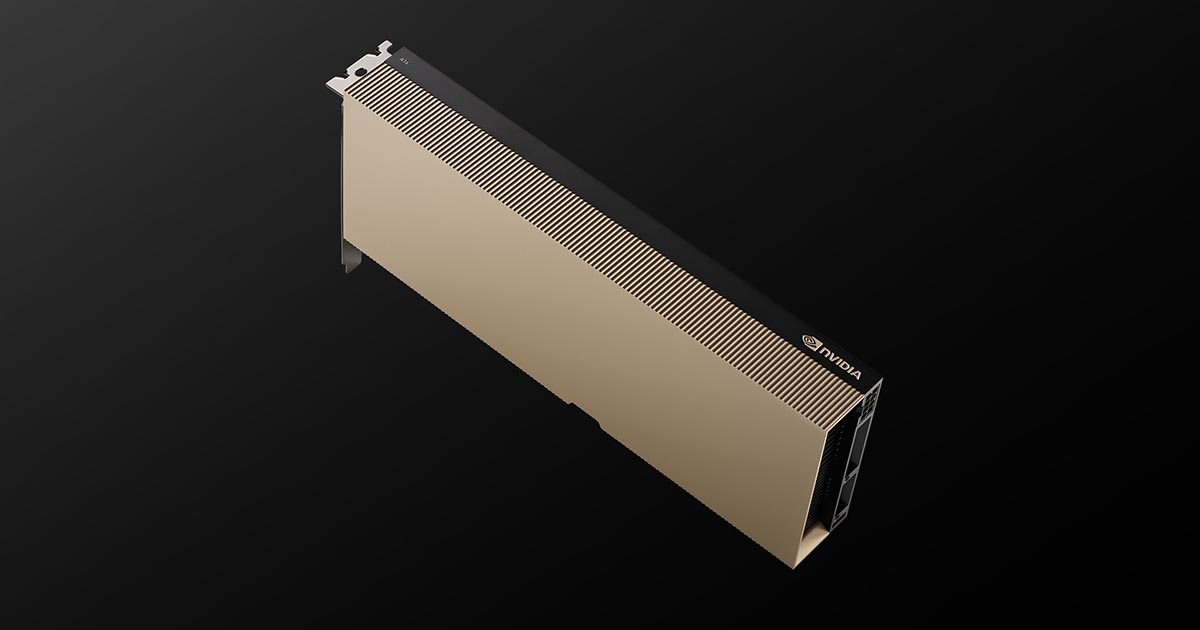
NVIDIA official product image
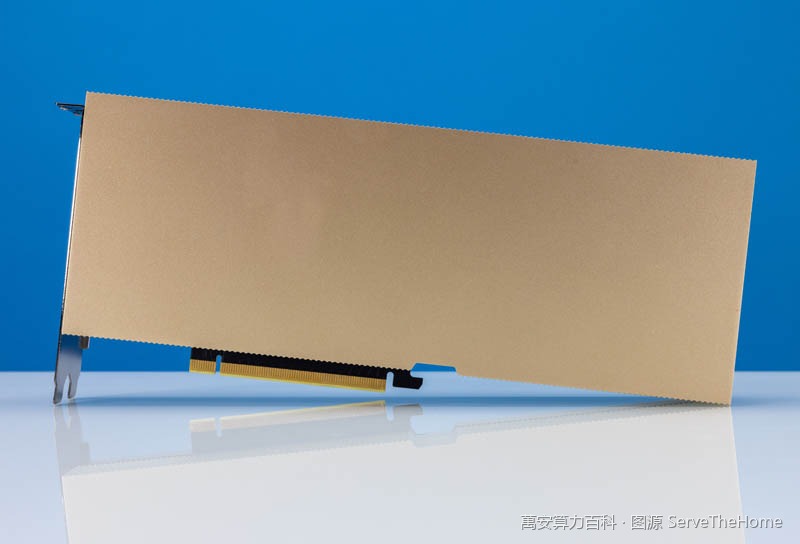
Actual photo
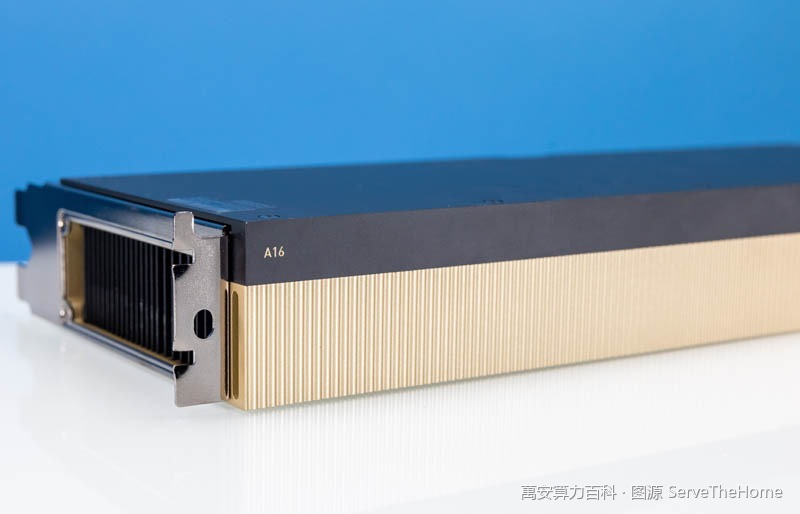
Actual photo
Overview
The NVIDIA A16 is a data center GPU designed for Virtual Desktop Infrastructure (VDI), built on the NVIDIA Ampere architecture. A single card integrates four GPUs, each with 16GB of ECC-protected GDDR6 memory, for a combined 4x 16GB of memory and 4x 200 GB/s of memory bandwidth. The card uses a PCI Express Gen 4 x16 interface, has a maximum board power of 250W, and comes in a full-height, full-length dual-slot passive cooling design. Its combination of CUDA cores, second-generation RT Cores, and third-generation Tensor Cores lets it serve as a hosted virtual workstation via NVIDIA RTX vWS software, or repurpose idle VDI resources for compute workloads. The card carries 4 NVENC and 8 NVENC encode/decode units — 4 NVENC and 8 NVDEC — with video decode support including AV1. Typical uses include large-scale cloud desktop deployments, virtual graphics workstations, and remote office environments.
Core Specs
| Architecture | NVIDIA Ampere |
| Memory | 4x 16GB GDDR6 |
| Memory Bandwidth | 4x 200 GB/s |
| Power | 250W |
| Interconnect | PCI Express Gen 4 x16 |
| Form Factor | Full height, full length (FHFL) dual slot |
| Cooling | Passive |
| NVENC|NVDEC | 4x | 8x (includes AV1 decode) |
| Power connector | 8-pin CPU |
| NEBS | Level 3 |
Specs verified against official documentation (
official benchmarks , updated 2026-10-09) · actual price subject to the seller's quote
Use Cases
- Large-scale cloud desktop (VDI) deployments: a single card can be split into multiple 16GB virtual GPU instances serving large numbers of concurrent users
- Virtual graphics workstations on NVIDIA RTX vWS: delivering graphics acceleration for remote design, modeling, and other office scenarios
- Video streaming and transcoding: leveraging 4 NVENC and 8 NVDEC units (with AV1 decode) to handle video processing and streaming workloads in remote workspaces
- Running compute workloads on idle VDI resources to boost overall utilization
Same-Family Models
| Model | Memory | Power |
|---|
| NVIDIA T4 Compare | 16GB GDDR6 with ECC (enabled by default) | 70W (total board power, default) |
| NVIDIA A100 Compare | Dual versions: 40GB HBM2 / 80GB HBM2e (80GB added at SC20 on 2020-11-16), with ECC | SXM4 400W (same for 40GB/80GB); PCIe version 250W for 40GB / 300W for 80GB |
| NVIDIA H20 Compare | 96GB HBM3 (consistent across Flopper, VipraTech, and Tencent News sources) | 400W TDP (three sources: Flopper, VipraTech spec sheet, and Tencent News' "400W thermal design power"; VipraTech's body text also cites 350W, a conflicting figure that has been discarded) |
| NVIDIA GB300 Compare | 288GB HBM3e (per GPU package; 576GB for the superchip; HGX board-level 2.1TB / rack-level 20TB coexist) | TGP up to 1400W |
| NVIDIA A30 Compare | 24 GB HBM2 | 165 W |
| NVIDIA GeForce RTX 4090 Compare | 24GB GDDR6X | 450W TGP (315W average gaming, 850W recommended system power) |
Video Overview VIDEO
Related Articles
Keewano launches KeewanoDB for AI agents alongside $12 million round2026-09-15Procurement & Inspection Notes
- The A16 is a full-height, full-length (FHFL) dual-slot passive card and must be installed in a server chassis with forced air cooling. Before purchasing, verify that the server supports FHFL dual-slot passive cards and that the airflow direction matches. Plan power delivery around the card's 250W maximum, and note that it uses an 8-pin CPU power connector — data center power and cabling must be prepared accordingly
- The interconnect is PCI Express Gen 4 x16; confirm PCIe Gen 4 support on the server motherboard and backplane before purchase. Since a single card integrates four GPUs, verify that your virtualization platform (e.g., the hypervisor's GPU assignment scheme) can correctly split and schedule the 16GB memory instances of all four GPUs
- Hardware root-of-trust-based Secure Boot and Measured Boot are optional; users with compliance requirements should confirm this option at purchase. The card is NEBS Level 3 qualified and suitable for telecom-grade data centers. On delivery, check that the passive cooling form factor matches your facility's cooling capacity, and confirm that the ECC memory and firmware version can be verified through official channels
FAQ
How many virtual desktop instances can one NVIDIA A16 run?
An A16 card integrates four GPUs, each with 16GB of GDDR6 memory, so a single card can be partitioned into four independent 16GB GPU instances. The actual number of concurrent virtual desktops also depends on each user's memory allocation, vCPU count, and licensing plan, and should be planned around the specific virtualization platform.
How does the A16 differ from the A2 and T4?
The A16 uses a four-GPU-per-card design with 4x 16GB of memory total, targeting VDI and cloud desktop scenarios with many concurrent users. The T4 and A2 are single-GPU cards geared more toward inference and lightweight compute workloads. Choose based on whether your deployment goal is high-density user concurrency or per-instance compute power, and compare against each model's official specifications.
What are the server and data center requirements for deploying the A16?
The A16 is a full-height, full-length dual-slot passive card and must be installed in a server with forced airflow. Maximum board power is 250W with an 8-pin CPU power connector, so server power and cooling must be planned accordingly. The interconnect is PCI Express Gen 4 x16, requiring a compatible PCIe slot on the host. The card is NEBS Level 3 qualified and suitable for telecom-grade data centers.