2026-11-26 · Source:Ars Technica
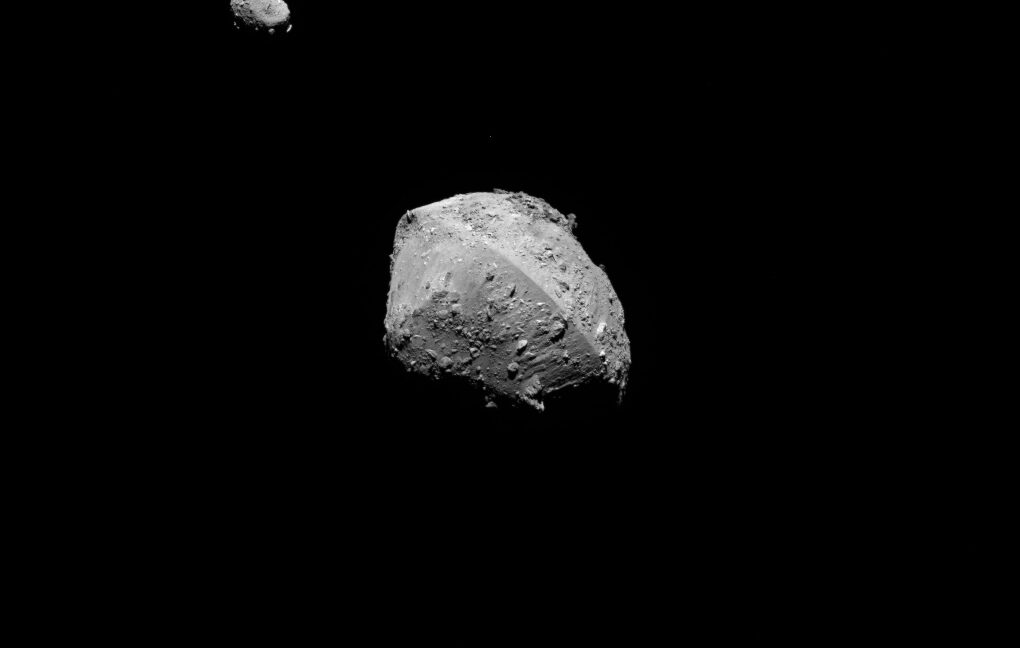
New images from Europe's Hera spacecraft show NASA's 2022 asteroid-impact test carved a stadium-sized crater and set the asteroid wobbling chaotically.
Four years after NASA launched a small spacecraft on a deliberate collision course with an asteroid, scientists are finally seeing the aftermath up close. The Double Asteroid Redirection Test, or DART, struck the asteroid Dimorphos in September 2022 at more than 13,700 mph, or 6.14 kilometers per second, releasing roughly 10 billion joules of energy and permanently shifting the rock's trajectory.
Astronomers tracking Dimorphos with ground-based telescopes found that the impact shortened its 12-hour orbit around its larger companion, Didymos, by about 33 minutes—roughly 25 times the most conservative prediction. But because DART was destroyed on impact, distant telescopes and a brief flash captured by a small CubeSat were the only views of what happened next.
"We knew right away that the impact was successful, that DART made a really, really large mess," said Sabina Raducan, a planetary scientist at the International Space Science Institute in Bern, Switzerland. "However, we didn't really know what kind of mess. We were still missing pieces of the puzzle."
The European Space Agency's Hera spacecraft has now arrived at the binary asteroid system after a two-year journey from Florida, and on Wednesday ESA published the probe's first images of the impact site. They show DART's car-sized impactor excavated a crater the size of a stadium—nearly as large as Dimorphos itself, a rugged rock about 500 feet, or 151 meters, across.
"I would say we had two kinds of predictions: either we made a crater, or we reshaped the asteroid," said Patrick Michel, Hera's principal investigator from Côte d'Azur Observatory in Nice, France. "In fact, we did both because the crater is so large that the shape has changed." He noted scientists are still uncertain how this transition between cratering and global transformation occurs.
Mission planners chose the Didymos system for the experiment because it resembles many near-Earth asteroids, though the pair poses no threat to Earth. Hera found the system currently orbiting the Sun about 120 million miles, or 193.5 million kilometers, from our planet, with Didymos spinning just as DART observed it on approach in 2022.
Dimorphos, however, is no longer stable. "As Hera returned more images, it became clear that the DART impact has left Dimorphos tumbling wildly in its orbit," said Michael Kueppers, ESA's Hera mission scientist. The spacecraft will maneuver closer to the pair over the next six months to gather detailed observations. Source: Ars Technica.
Tags: European
萬安算交所 AIXX · AIXX · Verified compute exchange · Enter spot hall